
 (317)516-7460
  service@ampvortex.com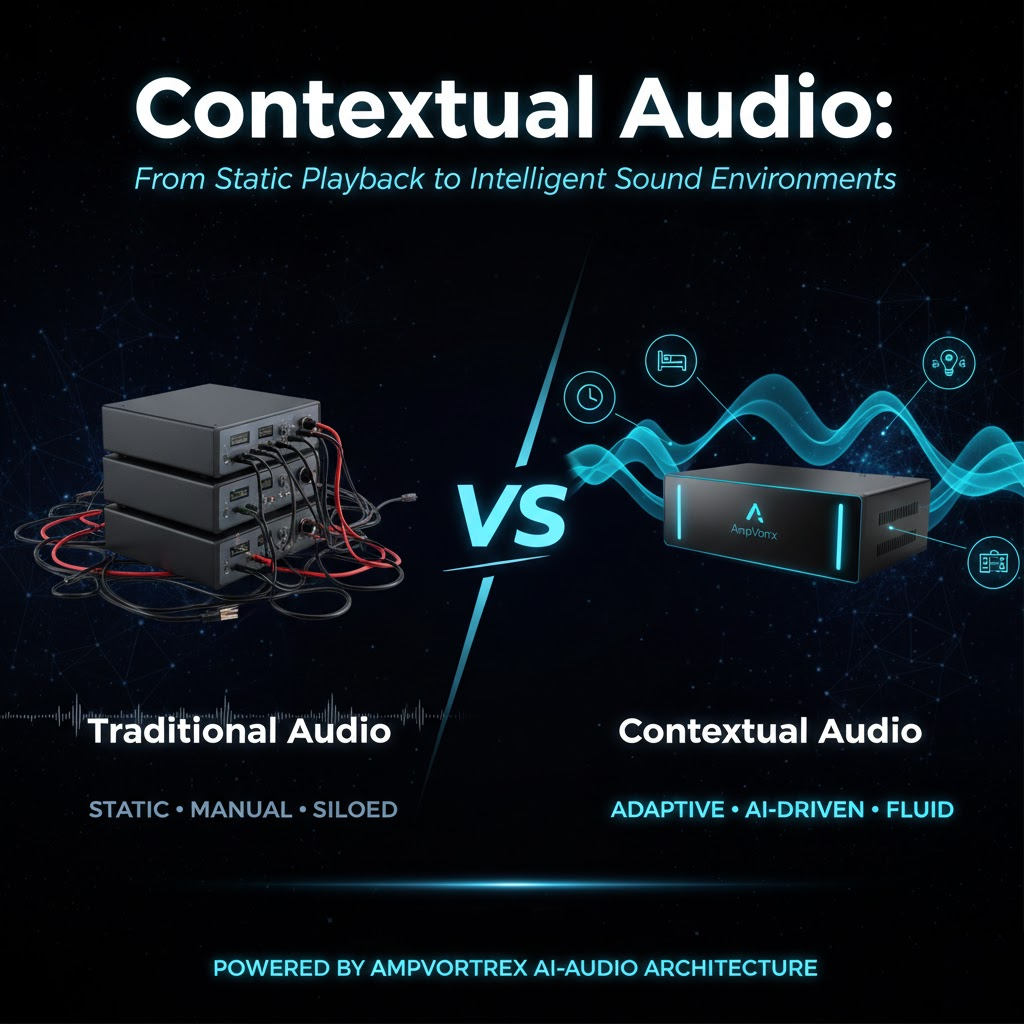
Contextual Audio: From Static Playback to Intelligent Sound Environments
Contextual Audio:
From Static Playback to Intelligent Sound Environments
Introduction: Why Audio Must Become Context-Aware
For decades, audio systems have been designed around a single assumption:
music is something users manually choose, start, and stop.
Even in the era of streaming and multi-room playback, most systems remain fundamentally static. A user opens an app, selects content, chooses a room, and presses play. The system reacts—but it does not understand why audio is playing, where it matters most, or how the environment has changed.
Contextual Audio represents a fundamental shift away from this model.
Instead of treating audio as a passive output, contextual audio treats sound as an adaptive system—one that responds intelligently to space, time, user behavior, and environmental signals. In this paradigm, audio becomes part of the living environment, not a foreground task.
What Is Contextual Audio?
Contextual Audio is not a codec, a protocol, or a single feature.
It is an architectural approach.
At its core, contextual audio means:
Audio playback that adapts automatically based on contextual signals rather than explicit user commands.
These signals can include:
- Spatial context: which rooms are occupied, how spaces are grouped
- Temporal context: time of day, routines, schedules
- Behavioral context: presence, movement, usage patterns
- Environmental context: lighting, noise level, ambient conditions
- System context: scenes, modes, automation rules
In a contextual audio system, users do not constantly “control” audio.
They set intent, and the system handles execution.
Why Traditional Audio Systems Fall Short
Most audio products today optimize for one of two things:
- Content access (Spotify, Apple Music, TIDAL)
- Playback convenience (casting, proprietary speaker ecosystems)
What they lack is contextual intelligence.
Even advanced multi-room systems typically require:
- Manual room grouping
- Manual source switching
- Manual volume balancing
- Manual interaction with apps
This creates friction—especially in larger homes, mixed-use spaces, or environments where audio should feel ambient rather than interactive.
Contextual audio does not remove control; it removes unnecessary control.
The Three-Layer Model of Contextual Audio
To understand how contextual audio works in practice, it helps to separate the system into three functional layers:
1. Context & Orchestration Layer (The “Why”)
This layer understands intent.
Platforms such as Home Assistant, Control4, or Crestron operate here. They aggregate signals from sensors, schedules, scenes, and user actions to determine what should happen.
Examples:
- “Someone entered the kitchen in the morning”
- “The house is switching to evening mode”
- “Nobody is home”
This layer does not handle audio playback itself.
2. System Intelligence Layer (The “How”)
This layer translates intent into audio behavior.
Systems like Roon or Music Assistant belong here. They decide:
- Which sources are available
- How zones are grouped
- How playback is synchronized
- What metadata or routing logic applies
They are aware of audio topology—but not the broader environment.
3. Execution Layer (The “What”)
This is where sound actually happens.
The execution layer consists of physical audio hardware—amplifiers, zones, channels, and speakers. This layer must be:
- Highly reliable
- Low-latency
- Zone-accurate
- Capable of independent control
This is where AmpVortex multi-room streaming amplifiers play a critical role.
Why Contextual Audio Requires Professional-Grade Amplification
Contextual audio places very different demands on hardware than traditional playback.
In a contextual system:
- Audio may start or stop automatically
- Zones may change dynamically
- Volume levels must adapt to space and time
- Different rooms may require different behavior simultaneously
Consumer-grade wireless speakers and smart speakers struggle here because they are designed for static, app-driven usage.
AmpVortex is designed for execution under orchestration.
Key characteristics that make AmpVortex contextual-audio ready include:
- True multi-zone architecture
Each zone is independently addressable, not virtually grouped. - High power headroom and stability
Audio remains consistent whether playing softly in the background or driving a large space. - Protocol-agnostic integration
Compatible with AirPlay 2, Google Cast, Spotify Connect, and system-level control. - Automation-first design
Exposed control interfaces allow seamless integration with home automation platforms.
In short: contextual audio only works when the execution layer is predictable and controllable.
Contextual Audio in Real-World Scenarios
Morning Routine
At 7:00 AM:
- Bedroom plays low-volume ambient music
- Bathroom activates spoken news
- Kitchen transitions to higher-energy audio
No app interaction. No manual grouping.
Presence-Based Audio
Music follows occupancy:
- Living room audio fades out when empty
- Office audio resumes when presence is detected
- Outdoor zones activate only when used
The system reacts to people—not buttons.
Mode-Based Audio
Switching modes changes audio behavior globally:
- “Work Mode”: minimal, non-distracting background audio
- “Evening Mode”: warmer sound profiles, broader zone grouping
- “Away Mode”: all zones muted automatically
Why AmpVortex Fits the Contextual Audio Paradigm
AmpVortex is not positioned as an “audio app” or a closed ecosystem.
It is positioned as a high-performance execution platform.
This distinction matters.
Contextual audio systems are inherently layered:
- Content platforms define what is available
- Intelligence layers define how audio behaves
- Automation defines when and why
- Hardware defines what actually happens
AmpVortex does not attempt to absorb all layers.
It focuses on doing one thing exceptionally well: executing audio behavior accurately, reliably, and at scale.
That is why it integrates cleanly into contextual audio systems rather than competing with them.
The Future: Audio as Environmental Infrastructure
As homes become more automated and adaptive, audio will increasingly resemble other forms of infrastructure—like lighting or climate control.
Users will not “play music” as an isolated action.
They will enter environments where sound is already appropriate.
Contextual audio is not a feature trend.
It is a structural evolution.
And systems built around open orchestration, system intelligence, and professional execution—such as AmpVortex—are positioned to define what this future sounds like.
Conclusion
Contextual Audio shifts the role of sound from a manual interaction to an environmental response.
It requires:
- Clear separation of control and execution
- Reliable, multi-zone hardware
- Open integration with automation systems
AmpVortex does not claim to be the brain of the system.
It is the muscle and nervous system—precise, responsive, and dependable.
In a world where audio is no longer started by tapping a screen, but by context itself, that distinction matters.