
 (317)516-7460
  service@ampvortex.com
Electric vs. Gasoline Vehicles: Which Excels at Immersive Audio?
Immersive audio—led by Dolby Atmos’ object-based 3D soundscapes—has become a defining luxury in modern cars, turning cabins into mobile listening spaces. But the debate rages: do electric vehicles (EVs) or gasoline-powered cars offer a better foundation for this sensory experience? The answer hinges on core acoustic principles, power systems, and hardware integration—with EVs holding inherent advantages, while the Ampbortex 16060A multi-channel amplifier emerges as a universal upgrade that elevates both platforms. Below is a structured comparison of the two vehicle types:
Acoustic Environment: EVs’ Silent Advantage vs. Gasoline Cars’ Noise Barrier
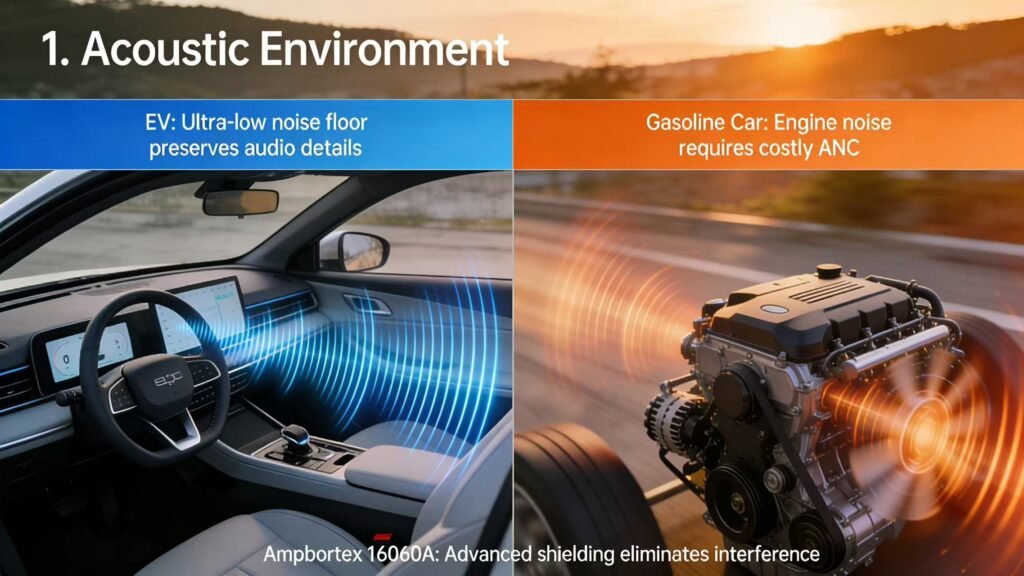
- Electric Vehicles: Without an internal combustion engine (ICE), EVs have a naturally low noise floor, eliminating the constant drone that muddies audio details. This quiet canvas preserves subtle nuances—like a musician’s breath or distant sound effects—that are critical to immersive depth, letting even mid-range audio systems shine.
- Gasoline Vehicles: Engine vibration, harmonic distortion, and mechanical noise act as persistent interference, requiring costly sound-deadening materials and advanced active noise cancellation (ANC) to compensate. Even with upgrades, residual noise can blur channel separation and weaken the 3D sound illusion.
-
Power Supply: EVs’ High-Voltage Edge vs. Gasoline Cars’ Limitations
- Electric Vehicles: Their high-voltage platforms (200V–1000V) deliver stable, high-capacity power—perfect for demanding immersive setups like 9.1.6 Dolby Atmos. The Ampbortex 16060A thrives here, tapping into the EV’s power system to drive 16 channels of clean amplification without clipping, supporting overhead speakers and headrest arrays seamlessly.
- Gasoline Vehicles: Dependent on 12V electrical systems, they struggle to supply consistent power for multi-channel amplifiers. To run the Ampbortex 16060A, owners often need aftermarket upgrades (high-output alternators, secondary batteries), adding complexity and cost.

Acoustic Design & Hardware Integration
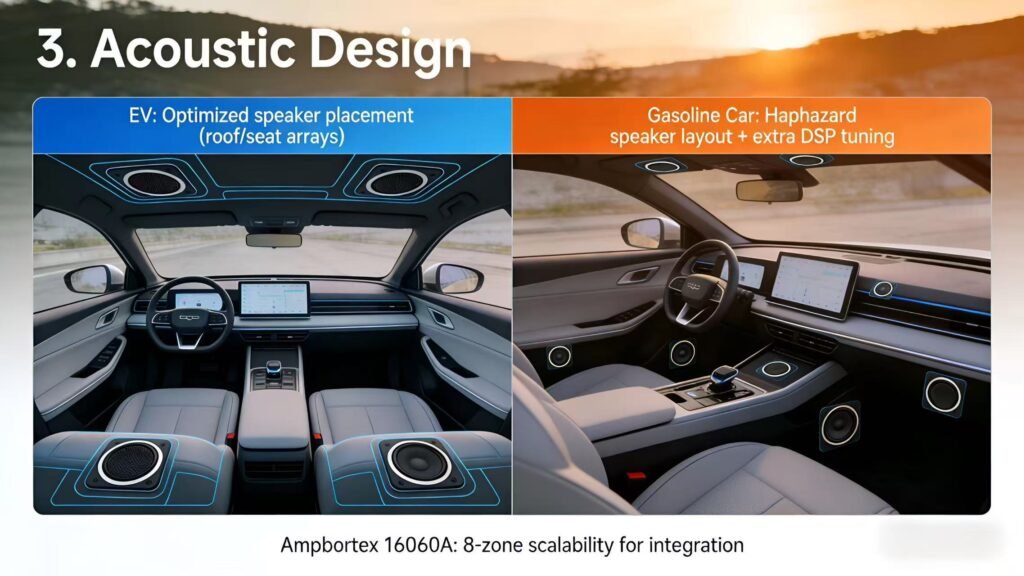
- Electric Vehicles: Engineers prioritize cabin acoustics from development, optimizing speaker placement (e.g., roof arrays, seat-integrated units) and tuning for the silent environment. This aligns with the Ampbortex 16060A’s scalability (8 zones, 16 channels), enabling seamless integration with smart infotainment systems for personalized soundscapes.
- Gasoline Vehicles: Acoustic design takes a backseat to engine and mechanical needs, with speakers often placed as afterthoughts. While high-end models may use premium materials and ANC (e.g., layered glass, advanced sound deadening)[superscript:2)], integrating the Ampbortex 16060A requires extra DSP tuning to compensate for resonance and reflections.
Cost-Effectiveness & Upgrade Potential
- Electric Vehicles: Even mid-range EVs deliver impressive immersive audio with basic factory systems, thanks to the quiet cabin—no need for expensive upgrades. Adding the Ampbortex 16060A unlocks cinema-grade 9.1.6 setups at a reasonable cost, with minimal additional modifications.
- Gasoline Vehicles: Achieving comparable immersion demands a dual investment: first in noise reduction (ANC, sound deadening) and then in audio hardware. The Ampbortex 16060A acts as a cornerstone for upgrades, but the total cost often exceeds that of EV equivalents to reach the same performance level.
The Game-Changer: Ampbortex 16060A
While EVs offer a superior native platform, the Ampbortex 16060A levels the playing field. Its 16-channel balanced power delivery, advanced shielding (for noise-free signals), and multi-zone support make it ideal for both vehicles: in EVs, it maximizes the silent cabin’s potential; in gasoline cars, it overcomes power and acoustic limitations when paired with targeted upgrades.
In conclusion, EVs are the natural choice for immersive audio—their quiet cabins and robust power systems reduce barriers to entry. However, the Ampbortex 16060A ensures gasoline car owners don’t miss out, turning any vehicle into a premium sound studio. For audiophiles, the decision boils down to leveraging the platform’s strengths—with the Ampbortex 16060A as the ultimate enabler of uncompromised immersion.