(317)516-7460
  service@ampvortex.com
From Rules to Intent: How AI is Transforming Smart Homes
For years, smart homes have promised convenience, efficiency, and control. Lights turn on at sunset, thermostats adjust to your schedule, and music can be played with a single command. Yet, for all their promise, traditional smart home systems have remained largely rule-based: deterministic triggers that execute specific actions. They handle “if-this-then-that” scenarios well—volume up, lights on, blinds closed—but falter when faced with more complex, real-world intentions.
What if your smart home could understand context, intent, and mood? What if it could orchestrate multiple devices seamlessly, anticipating your needs rather than simply responding to commands? This is the frontier where AI meets Smart Home automation, and at the center of this revolution is AmpVortex, your multi-room streaming amplifier, acting as the backbone for intelligent audio orchestration.
Traditional Smart Home Automation: Where It Falls Short
The typical smart home ecosystem today is functional but rigid:
- Rule-driven automation: Triggers execute pre-set actions. “At 7 PM, turn on living room lights.”
- Programmatic limitations: Complex activities often require multiple separate automations. Scheduling a party across music, lighting, and HVAC typically involves manual setup of dozens of rules.
- Lack of contextual understanding: The system doesn’t know why you want something done; it only knows that it must be done when X happens.
For example, consider planning a Christmas party for tomorrow at 5 PM. In a rule-based system, you could schedule music, lights, and temperature individually, but the system won’t coordinate these actions intelligently. If someone changes plans, or the number of guests is higher than expected, the automation fails without human intervention.
AmpVortex: The Heart of AI-Driven Audio
Enter AmpVortex, a multi-room streaming amplifier capable of high-fidelity audio, multi-zone playback, and precise input management. It does more than play music; it is the execution core for AI-driven home experiences:
- Zone-based orchestration: Adjust volume and audio sources for each room independently.
- Input separation: Human voice vs background music can be processed separately—ideal for karaoke or layered audio environments.
- High-resolution playback: Supports Qobuz, AirPlay 2, and other high-quality sources for an immersive experience.
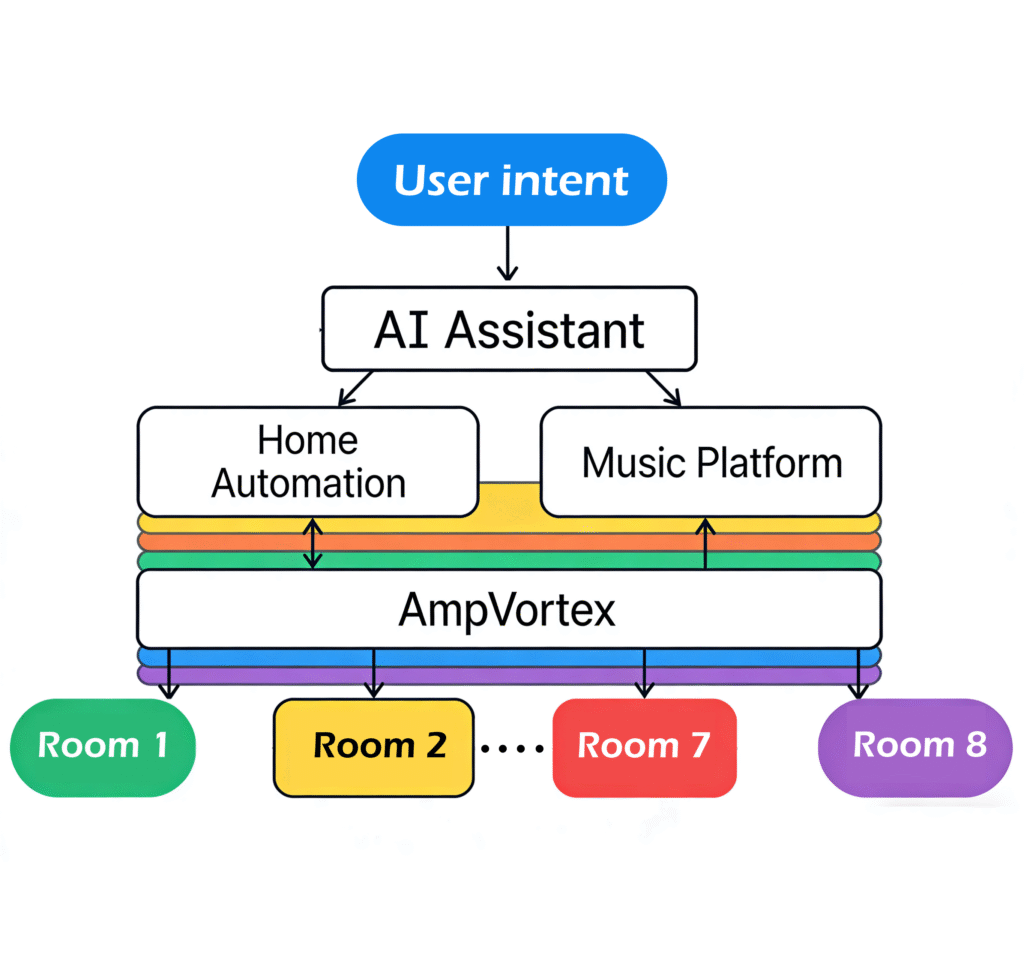
In AI-driven automation, AmpVortex allows intelligent agents to orchestrate every corner of the home. Imagine instructing your home assistant:
“Play a festive Christmas playlist tomorrow at 5 PM, with main living room at 80% volume, bedrooms at 40%, and background instrumental tracks in the hallway.”
AmpVortex ensures that each room receives the exact audio profile, seamlessly integrating AI’s intent into physical execution.
AI-Driven Smart Home: From Command to Intent
The leap from rules to AI-driven automation lies in understanding intent. Modern AI platforms—ChatGPT, Google Gemini, AI mobile assistants—enable a new level of home intelligence:
1. Intent recognition (Natural Language Understanding)
-
- Users can express complex goals naturally:
“I’m hosting a Christmas party tomorrow; set the music, lights, and temperature for an optimal festive atmosphere.”
-
- AI parses context, time, mood, and preferences to generate actionable plans.
2. Task planning and orchestration
-
-
- Cross-device coordination: AmpVortex for audio, smart lights for ambiance, thermostats for temperature, blinds for lighting control.
- Real-time optimization: Adjusts based on number of guests, sensor input, or sudden changes in schedule.
-
3. Platform integration and synergy
-
-
-
- ChatGPT: Analyzes user preferences, conversationally refines schedules, and adapts music or lighting suggestions.
- Google Gemini: Generates optimized multi-device execution plans, predicts conflicts, and ensures timing alignment.
- AI Mobile Assistants: Provide remote triggers, notifications, and real-time feedback.
-
-
Together, these platforms create a multi-agent system, where cloud-based intelligence plans and mobile/local devices execute. The home becomes a collaborative AI ecosystem, rather than a collection of isolated gadgets.
Multi-Modal Intelligence: Sensors, Context, and Feedback
AI automation goes beyond scheduling:
- Sensors and context-awareness: Motion detectors, occupancy sensors, light meters, and even weather data feed the AI decision engine.
- Learning and adaptation: The system records how occupants interact with devices and preferences for future optimization.
- Real-time adjustments: If guests arrive earlier, music, temperature, and lighting adapt automatically.
The combination of multi-modal input + AI orchestration + AmpVortex’s execution enables a level of automation previously impossible. Your home not only reacts but anticipates and optimizes.
The Role of AI Mobile Assistants
Modern smartphones are critical conduits for this intelligence:
- Act as remote control hubs, bridging cloud AI and local devices.
- Provide feedback loops: notifications for approval or adjustments.
- Enable personalized automation: AI understands individual user preferences and adapts multi-user environments.
Example scenario:
The AI system detects guests are arriving earlier than scheduled. Your mobile assistant notifies you, then dynamically adjusts living room volume, kitchen speakers, and hallway audio levels without manual intervention.
Future Perspectives: From Automation to Life Intelligence
The next frontier of smart home AI is intent-driven life orchestration:
- Predictive Automation: AI anticipates needs based on calendar events, past behavior, and external data.
- Adaptive Home Environment: Temperature, lighting, and audio adjust dynamically as situations evolve.
- Ethical and privacy considerations: As AI assumes more control, data security, user consent, and transparency become paramount.
A home is no longer a set of devices—it is an intelligent ecosystem, capable of understanding and executing the complex intentions of its inhabitants.
Challenges and Opportunities
- Challenges:
- Cross-platform interoperability (HomeKit, Matter, AirPlay 2, third-party devices)
- Privacy and data security
- Explainable AI for decision-making transparency
- Opportunities:
- Truly personalized living environments
- Seamless, multi-device orchestration without user micromanagement
- Integration of high-fidelity audio, lighting, and environmental controls for immersive experiences
The combination of AmpVortex’s multi-room audio capabilities, AI orchestration via ChatGPT and Google Gemini, and mobile assistants for real-time control represents a paradigm shift in smart home intelligence.
Conclusion
Traditional smart homes excel at simple, deterministic tasks. AI-driven smart homes transcend this by understanding intent, coordinating multiple devices, and adapting to context. AmpVortex plays a crucial role as the audio execution core, while ChatGPT, Google Gemini, and AI mobile assistants provide the intelligence and orchestration.
The future of home automation is no longer just about “what to do”; it’s about anticipating, understanding, and optimizing for life itself. With AI, your home becomes a proactive partner—planning, adapting, and executing complex scenarios like a fully intelligent life assistant.