
 (317)516-7460
  service@ampvortex.com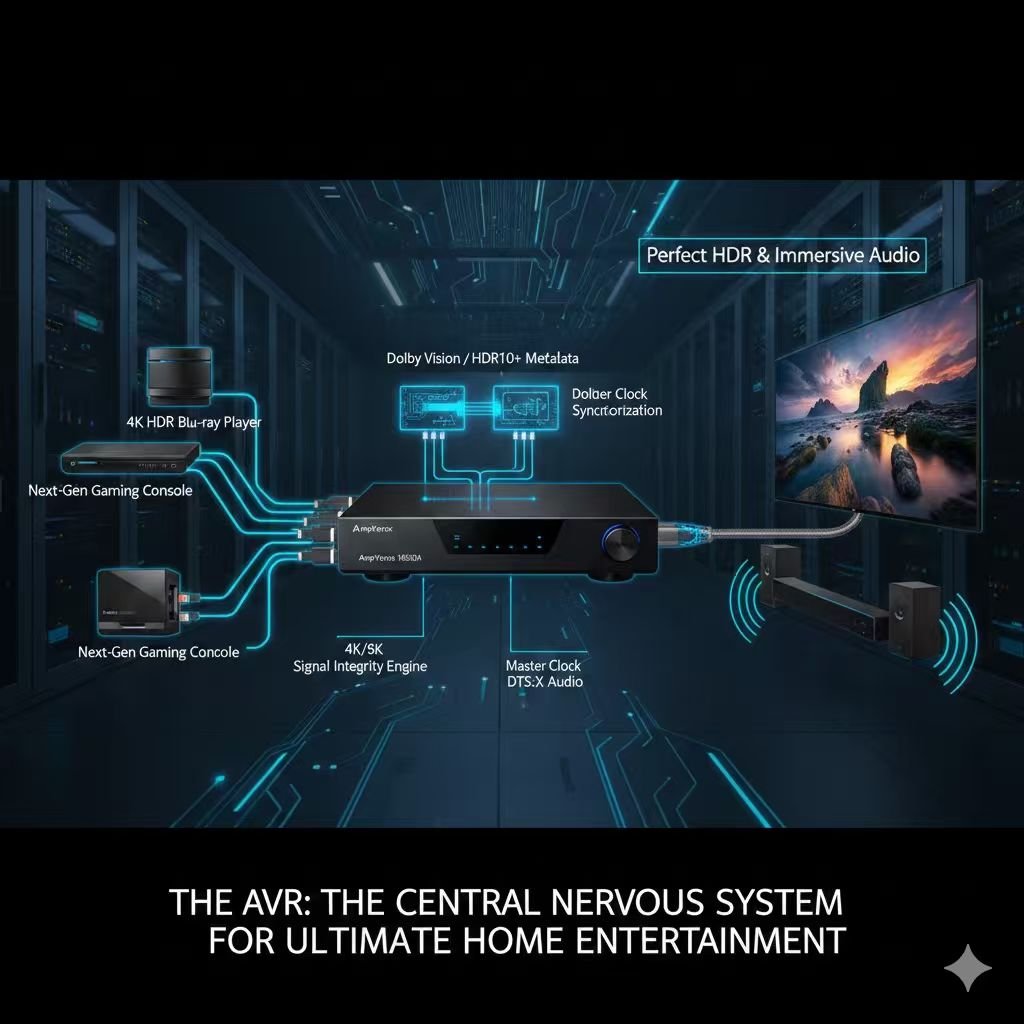
HDR Explained: Why AmpVortex AVRs Preserve Dolby Vision, HDR10+ & 4K120 Integrity
Beyond Resolution: Why HDR Finally Works When the AVR Is No Longer the Bottleneck
For years, HDR (High Dynamic Range) has been marketed as a breakthrough in display technology—brighter highlights, deeper blacks, and richer colors. Yet in real-world home theater systems, many users quietly discover a frustrating reality: HDR often looks inconsistent or underwhelming, even on high-end displays.
The problem is rarely the screen.
It is the signal chain behind it—and at the center of that chain sits the AVR.
As video standards evolved from 4K to HDR10, Dolby Vision, and now 8K HDR workflows, the AVR has transformed from a simple audio switch into a critical guardian of video signal integrity. AmpVortex approaches HDR not as a checkbox feature, but as a system-level responsibility.
HDR Is Not a Display Feature — It Is a System-Level Challenge
HDR is fundamentally about preserving dynamic range from source to screen.
A modern HDR signal carries:
- High peak brightness metadata (1,000–4,000 nits and beyond)
- Expanded color volume (BT.2020 container)
- Static or dynamic metadata (HDR10, HDR10+, Dolby Vision)
- Tight synchronization with multi-channel immersive audio
Any weakness along the chain—HDMI bandwidth instability, clock jitter, EDID mismanagement, or audio-video desynchronization—can silently collapse HDR into something flat and inconsistent.
Traditional AVRs were never designed for this level of precision. Many prioritized audio decoding while treating video as a passive passthrough. HDR exposed the limits of that approach.
Understanding HDR Standards — And Why the AVR Matters
Not all HDR formats place the same demands on the system.
HDR10, the baseline standard, uses static metadata and 10-bit color depth. While widely supported, it relies heavily on accurate end-to-end signal preservation to avoid clipped highlights or raised black levels.
HDR10+ introduces dynamic metadata, adjusting tone mapping scene by scene. This significantly increases sensitivity to HDMI negotiation, timing accuracy, and metadata handling—areas where many AVRs fail under real-world conditions.
Dolby Vision represents the most demanding HDR workflow. With dynamic metadata, higher peak brightness targets, and strict certification requirements, it exposes any weakness in HDMI bandwidth stability, clock synchronization, or EDID consistency.
In all cases, the AVR is not a passive participant.
It either preserves HDR intent—or silently degrades it.
How AVRs Quietly Break HDR in Real Homes
HDR failures rarely announce themselves as errors. Instead, users encounter symptoms:
- HDR content randomly falling back to SDR
- Dolby Vision working on one input but failing on another
- Raised black levels or clipped highlights
- Audio dropouts when switching HDR formats
- Lip-sync drift in high frame rate HDR content
These are not display issues.
They are AVR timing, bandwidth, and negotiation issues.
At HDR bitrates, HDMI tolerance margins shrink dramatically. An AVR that cannot maintain stable clock domains or clean metadata pass-through becomes the weakest link—regardless of display quality.
AmpVortex’s HDR Philosophy: Preserve the Signal, Don’t Interfere
AmpVortex treats HDR video the same way audiophiles treat bit-perfect audio:
do not process what does not need to be processed.
Full-Bandwidth HDMI Integrity
AmpVortex AVR platforms are built around HDMI 2.1 signal integrity, supporting:
- 4K120 and 8K60 HDR passthrough
- HDR10, HDR10+, and Dolby Vision
- Full chroma (4:4:4) and deep color
HDR metadata is neither reinterpreted nor altered. It is preserved end to end.
Audio and Video Clock Domain Isolation
One of the most overlooked causes of HDR instability is clock coupling between audio DSP load and video timing.
AmpVortex fully isolates audio processing clocks from video transport clocks, ensuring:
- No video jitter introduced by heavy audio decoding
- Stable HDR frame timing under immersive audio workloads
- Consistent Dolby Vision behavior across all inputs
This becomes critical when HDR cinema content is paired with Dolby Atmos or complex multi-channel layouts.
AmpVortex AVR Platforms: One Architecture, Scaled Power
All AmpVortex A-Series AVRs share the same system architecture.
There are no feature differences between models—HDR handling, HDMI bandwidth, audio decoding, synchronization behavior, and system stability are identical.
The only distinction is per-channel amplifier output power, allowing system designers to scale performance precisely to room size and speaker demand:
- AmpVortex-16060A — 65 W per channel
- AmpVortex-16100A — 110 W per channel
- AmpVortex-16200A — 210 W per channel
This ensures that HDR integrity and immersive audio performance remain consistent across the lineup, while output power is matched to real-world installation needs.
Users never choose between features and power.
They choose only how much power their system truly requires.
Why “HDR-Ready” AVRs Fail in Multi-Source Systems
Modern home theaters are no longer single-source environments. They combine:
- UHD Blu-ray players
- Streaming devices
- Game consoles
- Media servers and NAS playback
Each source negotiates HDR differently.
AmpVortex addresses this reality with:
- Robust EDID management per HDMI input
- Predictable HDR handshakes across mixed devices
- Stable behavior during resolution and frame-rate switching
This is where many consumer AVRs collapse—and where system-level design proves decisive.
HDR Has Become the Ultimate AVR Stress Test
In the past, AVRs were judged by:
- Power per channel
- Codec support
- Room correction features
Today, HDR has quietly become the most demanding test of all:
- Bandwidth stability
- Timing accuracy
- Metadata integrity
- System reliability
AmpVortex does not avoid this test—it is designed around it.
Not by adding features, but by redefining the AVR as what it has become:
the central nervous system of the modern home cinema.
Conclusion: HDR Needs an AVR That Knows When Not to Interfere
HDR does not fail because displays are inadequate.
It fails when the system in between cannot keep up.
AmpVortex’s approach to HDR is simple—but rare:
- Preserve the signal
- Isolate interference
- Treat audio and video as equal priorities
When the AVR stops being the bottleneck, HDR finally delivers on its promise—not as a marketing label, but as a stable, repeatable, cinematic experience.