
 (317)516-7460
  service@ampvortex.com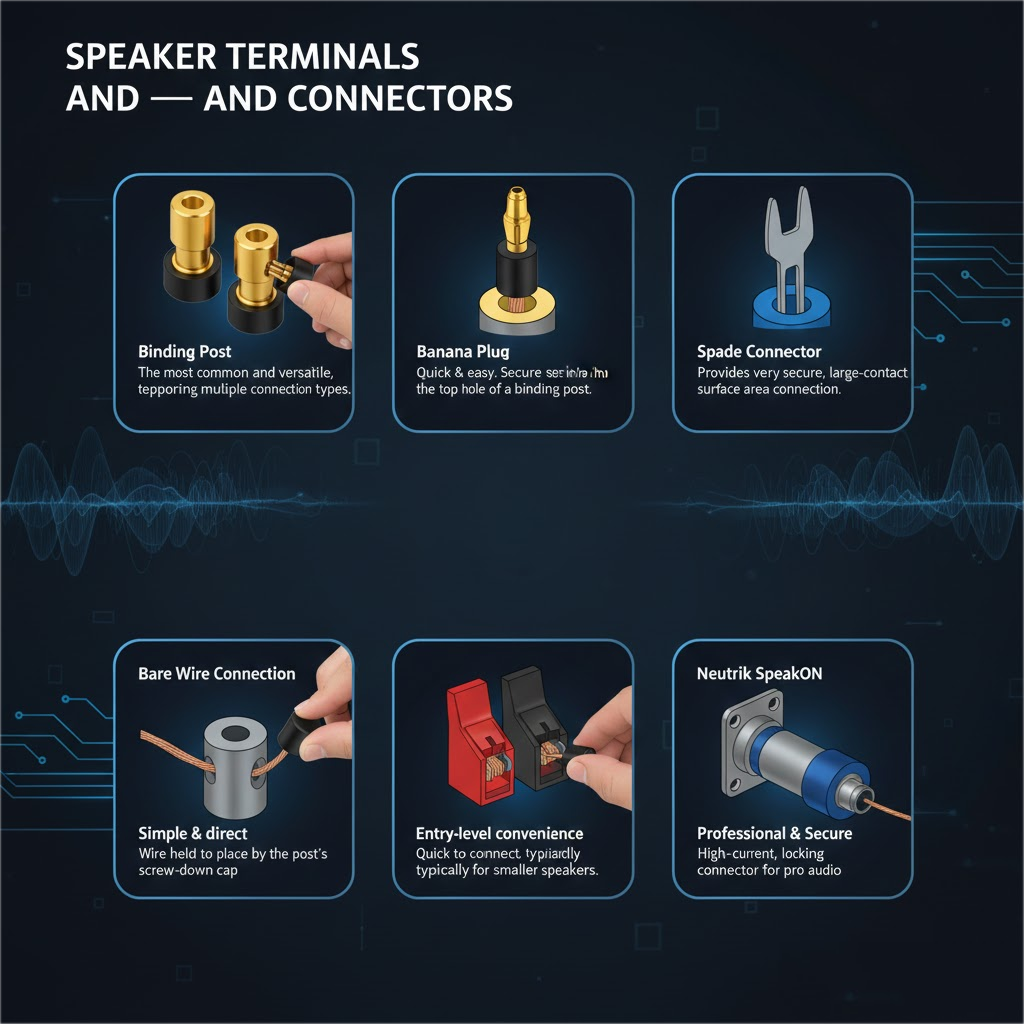
Multi-room and Home theater Speaker Terminals (Binding Posts) Deep Dive
The Ultimate Contact Interface: Analyzing Signal Integrity from Material Science in Amplifier Terminals
Keywords: Contact Resistance, Signal Integrity, Gold Plating, Rhodium, Binding Post Mechanics, Speaker Terminals, Amplifier Connection
In a top-tier Hi-Fi system, the connector interface between the amplifier and the loudspeaker is the final microscopic contact interface in the signal transmission chain. The material, structure, and contact pressure of this seemingly simple interface directly determine whether the amplifier’s power can be converted into acoustic energy with minimal loss and maximum fidelity.
This article examines the engineering philosophy behind high-performance terminals.
1. The Physics Core: Minimizing Contact Resistance (Rc)
The essence of connection quality lies in minimizing Contact Resistance (Rc). Even slight resistance, under high current flow, leads to power loss, dissipated as heat, which negatively impacts the sound’s dynamics and transient response.
The power lost due to contact resistance is given by:
$$P_{\text{loss}} = I^2 \times R_c$$
- Design Challenge:Excellent terminal design must leverage high clamping pressure and highly conductive materials to push $R_c$ to its absolute minimum.
- Bare Wire Shortcomings:Bare wire connections are prone to oxidation, and the resulting layer of corrosion dramatically increases $R_c$, leading to immediate signal degradation over time.
The conductive material of the binding post (typically brass or copper) and its external plating are critical determinants of signal integrity.
3. Terminal Structure: The Mechanical Locking Force
Professional Binding Posts are more than simple knobs; they are high-precision mechanical locking devices.
- Multi-Directional Locking:High-quality posts use a multi-piece structure to generate uniform and powerful mechanical pressure, ensuring the cable is tightly joined to the terminal body, whether using banana plugs, spades, or bare wire.
- Stress Relief:Good design dissipates external tensile stress from the speaker cable, preventing concentrated strain on the contact interface, thus guaranteeing connection stability and consistent $R_c$.
4. Engineering Choices for Connection Methods