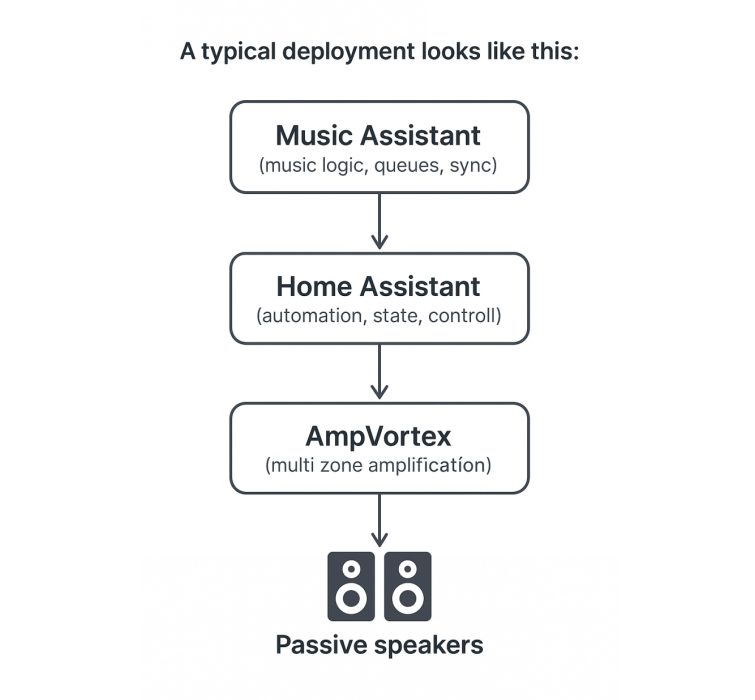
Data and Control Flow
- Music dataflows downward from MA to AmpVortex
- Control signals(power, volume, zone enable) flow from HA to AmpVortex
- State feedbackflows upward to HA
This clear directionality reduces coupling and simplifies troubleshooting.
5. Practical Integration Scenarios
Scenario 1: Manual Music Control
- User browses music in Music Assistant
- Selects an AmpVortex zone as the playback target
- Audio is streamed via AirPlay 2
- AmpVortex handles amplification only
Scenario 2: AutomationDriven Playback
- Motion detected or timebased trigger in Home Assistant
- HA powers on a specific AmpVortex zone
- HA instructs Music Assistant to start playback
- Music continues independently until stopped
Scenario 3: WholeHome Scenes
- “Morning” scene triggers:
- AmpVortex zones in kitchen and living room turn on
- Music Assistant resumes a playlist
- Volume levels are set per zone
In all cases, each component operates strictly within its domain.
6. Why This Architecture Scales Better Than Closed Ecosystems
Compared to smartspeakercentric systems, MA + HA + AmpVortex offers:
- No vendor lockin
- Independent upgrade cycles
- Better longterm maintainability
- Installerfriendly hardware
- True separation between software intelligence and audio delivery
This is especially important for:
- Large homes
- Commercial spaces
- Hospitality projects
- Longlifecycle installations
7. Strategic Implications for AmpVortex
By aligning with Music Assistant and Home Assistant, AmpVortex positions itself as:
- An open audio platform, not a closed ecosystem
- A professional alternative to smart speakers
- A stable foundation for future control layers
Rather than competing with software platforms, AmpVortex benefits from their innovation while remaining focused on hardware excellence.
Conclusion
Music Assistant, Home Assistant, and AmpVortex form a cleanly layered audio architecture:
- Music Assistant decides whatto play
- Home Assistant decides when and whereit plays
- AmpVortex ensures it plays reliably and at scale
This separation is not accidental — it is what makes the system powerful, flexible, and futureproof.
For anyone building serious wholehome or commercial audio, this combination represents one of the most robust open architectures available today.
For more information, please visit www.ampvortex.com

 (317)516-7460
  service@ampvortex.com