
 (317)516-7460
  service@ampvortex.com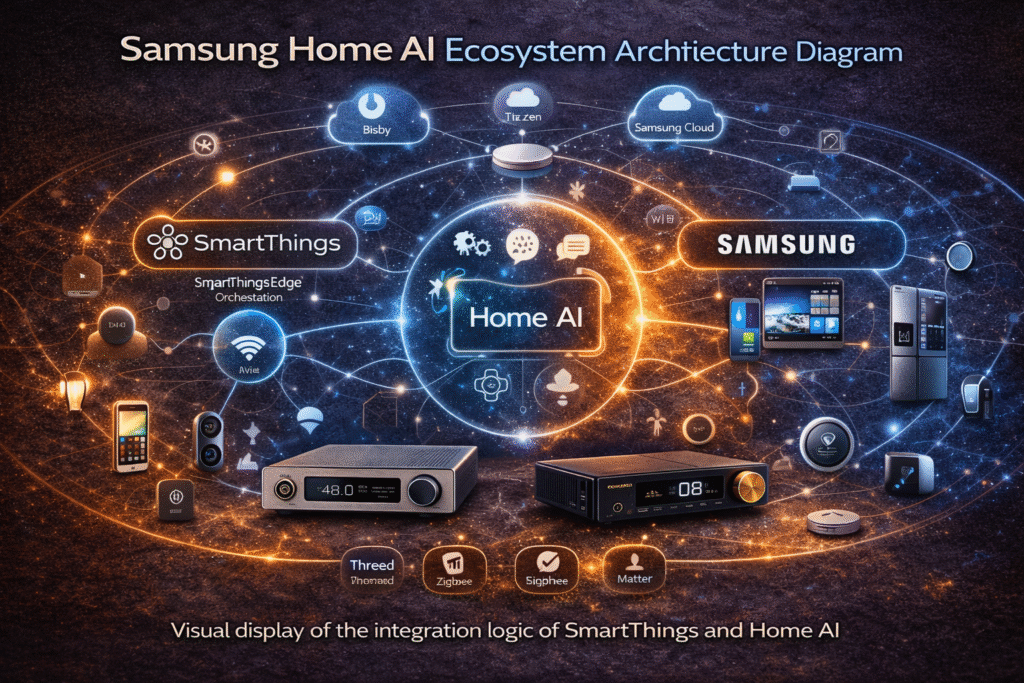
Samsung Unveils Home AI Ecosystem: Redefining the Future of Smart Homes
Preface
With the rapid development of artificial intelligence technology, the smart home industry has entered a new era of “AI-driven intelligence”. Samsung has officially launched a new generation of Home AI Ecosystem, deeply integrated with the original SmartThings platform, realizing a transformation from passive control to active intelligent services. This ecosystem relies on Samsung’s powerful AI algorithm and hardware advantages, redefining the user’s smart home experience. This article will conduct a comprehensive analysis of the core functions, technical characteristics, application scenarios and future development of Samsung Home AI.
1. Core Architecture: SmartThings + Home AI Deep Integration
The new Samsung Home AI ecosystem takes SmartThings’ powerful device interconnection capability as the foundation and Home AI’s intelligent decision-making capability as the core, forming a complete intelligent closed loop:
- SmartThings: Responsible for accessing, connecting and controlling all smart devices in the home
- Home AI: Responsible for data analysis, behavior prediction and active decision-making
- The two are deeply integrated to realize “device interconnection + intelligent decision-making”
This architecture makes the smart home no longer a device that passively executes instructions, but an intelligent system that actively serves users.
2. Core AI Functions and Technical Characteristics
2.1 AI Vision Intelligent Perception
Relying on Samsung’s smart cameras and sensors, AI Vision can realize:
- Human body activity recognition and behavior analysis
- Abnormal event detection (smoke, water leakage, illegal intrusion)
- Family member identity recognition and personalized service
- Automatic triggering of intelligent scenes according to home conditions
2.2 Smart Connect Automatic Matching
AI-powered automatic device discovery and pairing technology:
- Automatically identify new access smart devices
- One-click automatic configuration and parameter setting
- No manual operation, zero-threshold access to devices
2.3 Energy-Saving AI Optimization
Intelligent analysis of family energy use habits:
- Automatically adjust air conditioners, heaters and lighting according to temperature and light
- Optimize the operating time of home appliances to reduce energy consumption
- Generate family energy-saving reports and personalized suggestions
2.4 Predictive Automation Scenes
AI learns user’s living habits and actively pushes intelligent scenes:
- Automatically wake up the scene according to the user’s work and rest time
- Automatically turn on the security mode when leaving home
- Automatically adjust the home environment before returning home
- No need for manual setting, fully intelligent active service
3. Hardware Integration: Built-in Gateway + Whole-House Interconnection
Samsung has integrated Home AI functions into all its mainstream smart hardware:
- Smart TVs: As the central control screen and built-in gateway of Home AI
- Smart Refrigerators: Realize family center and food management intelligence
- Washing Machines, Air Conditioners and Other Appliances: Access to AI intelligent control
- Smart Speakers and Displays: As voice interaction terminals of Home AI
Users do not need to purchase additional equipment, and can upgrade to the new Home AI ecosystem by using Samsung’s new hardware.
In addition to Samsung’s native hardware, the SmartThings ecosystem also allows integration of compatible third-party smart devices, including intelligent audio systems. This enables users to build a more flexible whole-house solution beyond Samsung’s own product lineup while maintaining centralized control within the Home AI framework.
4. Breaking Industry Barriers: Enhanced Matter Protocol Support
The new Home AI ecosystem has fully upgraded the support for the Matter universal protocol:
- Faster device discovery and connection speed
- More stable cross-platform device linkage
- Compatible with all Matter-certified devices in the global market
- Truly realize the interconnection of all brands and all devices
This enhanced interoperability also makes it possible for compatible high-performance smart audio systems such as AmpVortex full-series amplifiers to integrate into the SmartThings ecosystem, participating in scene automation, voice interaction, and multi-device linkage within the Home AI architecture.
This makes Samsung Home AI one of the most open and compatible smart home ecosystems in the world.
5. User Experience Upgrade: From “Control” to “Intelligence”
The launch of Home AI has completely changed the traditional smart home experience:
- Before: Users issue instructions → devices execute passively
- Now: AI perceives needs → actively provides services
Users no longer need to manually control devices or set automation scenes. The home will automatically adapt to the user’s living habits and provide the most comfortable and convenient living environment.
For example, when the system detects that a user has returned home, SmartThings can automatically coordinate lighting, temperature control, and connected audio systems to create a personalized living environment. Integrated smart amplifiers such as AmpVortex can function as intelligent audio nodes within this AI-driven experience.
6. Future Development Trend of Samsung Home AI
Samsung has formulated a clear long-term development plan for Home AI:
- Further upgrade AI algorithms to improve the accuracy of behavior prediction
- Access to more third-party devices and expand ecological coverage
- Realize the interconnection of smart home and smart car
- Add more health management and elderly care functions
- Build a fully autonomous intelligent living space without human intervention
7. Industry Impact and Market Positioning
The launch of Samsung Home AI ecosystem has promoted the entire smart home industry to enter the era of artificial intelligence. It not only strengthens Samsung’s leading position in the smart home field, but also sets a new standard for the industry’s intelligent development.
Market Positioning:
- For high-end home users pursuing intelligent experience
- For family users with whole-house Samsung hardware
- For smart home enthusiasts pursuing full interconnection
- For modern families pursuing convenient and comfortable life
Conclusion
Samsung Home AI ecosystem, with the deep integration of SmartThings and artificial intelligence, has realized the subversion of the traditional smart home model. It no longer stays at the level of device interconnection and voice control, but creates an active, predictive and fully autonomous intelligent home. This is not only an upgrade of Samsung’s smart home, but also a new revolution in the global smart home industry, leading the future development direction of the entire industry.
With its open ecosystem strategy, Samsung Home AI is not limited to proprietary hardware. Compatible third-party devices, including advanced multi-room audio systems like AmpVortex, can seamlessly participate in the intelligent orchestration of SmartThings, expanding the practical value and customization possibilities of the Home AI ecosystem.
Please contact us at service@ampvortex.com
AmpVortex website: www.ampvortex.com