(317)516-7460
  service@ampvortex.com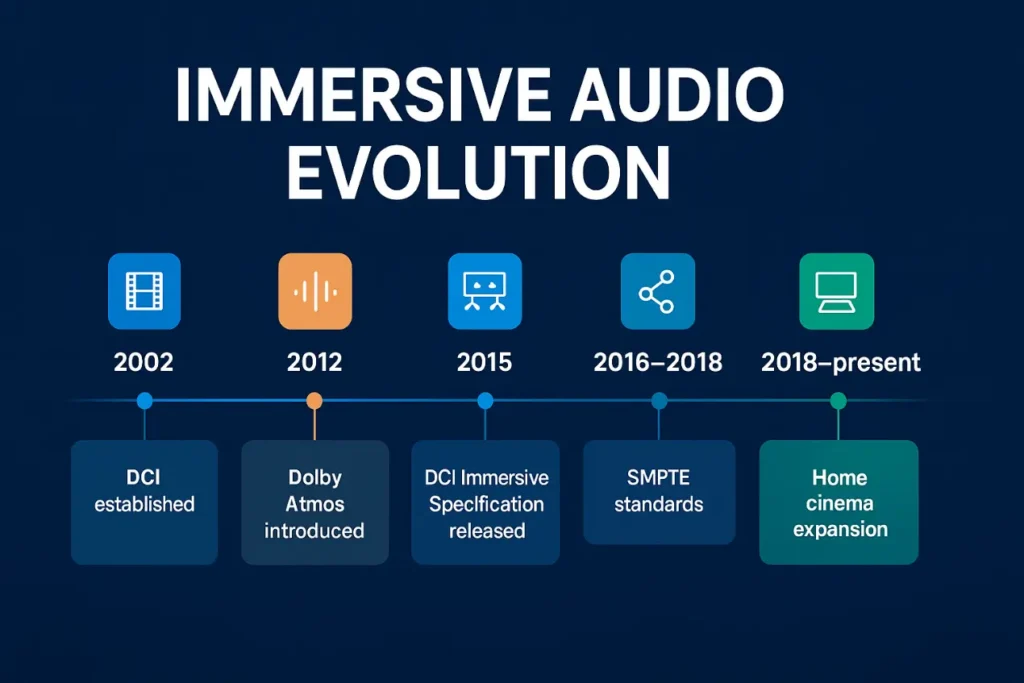
The Origins, Emergence, and Evolution of DCI Immersive Specification and SMPTE Standards
The Origins, Emergence, and Evolution of DCI Immersive Specification and SMPTE Standards
Immersive audio has redefined cinematic experiences in both commercial theaters and high-end home cinemas. The development of the DCI Immersive Specification, its formalization through SMPTE standards, and the rise of object-based audio formats like Dolby Atmos have enabled audiences to experience sound in full three-dimensional space. For home users, AmpVortex multi-channel amplifiers make it possible to reproduce cinema-level immersive audio in dedicated theaters or multi-room setups.
The Origins: From Stereo to Immersive Sound
Early cinema relied on stereo or 5.1 surround sound, which allowed sound to move left, right, front, and back but offered no vertical or fully three-dimensional spatialization. As blockbuster films demanded more realistic, enveloping soundscapes, the industry recognized the need for standardized immersive audio specifications to ensure consistent playback across theaters.
The Birth of DCI Immersive Specification
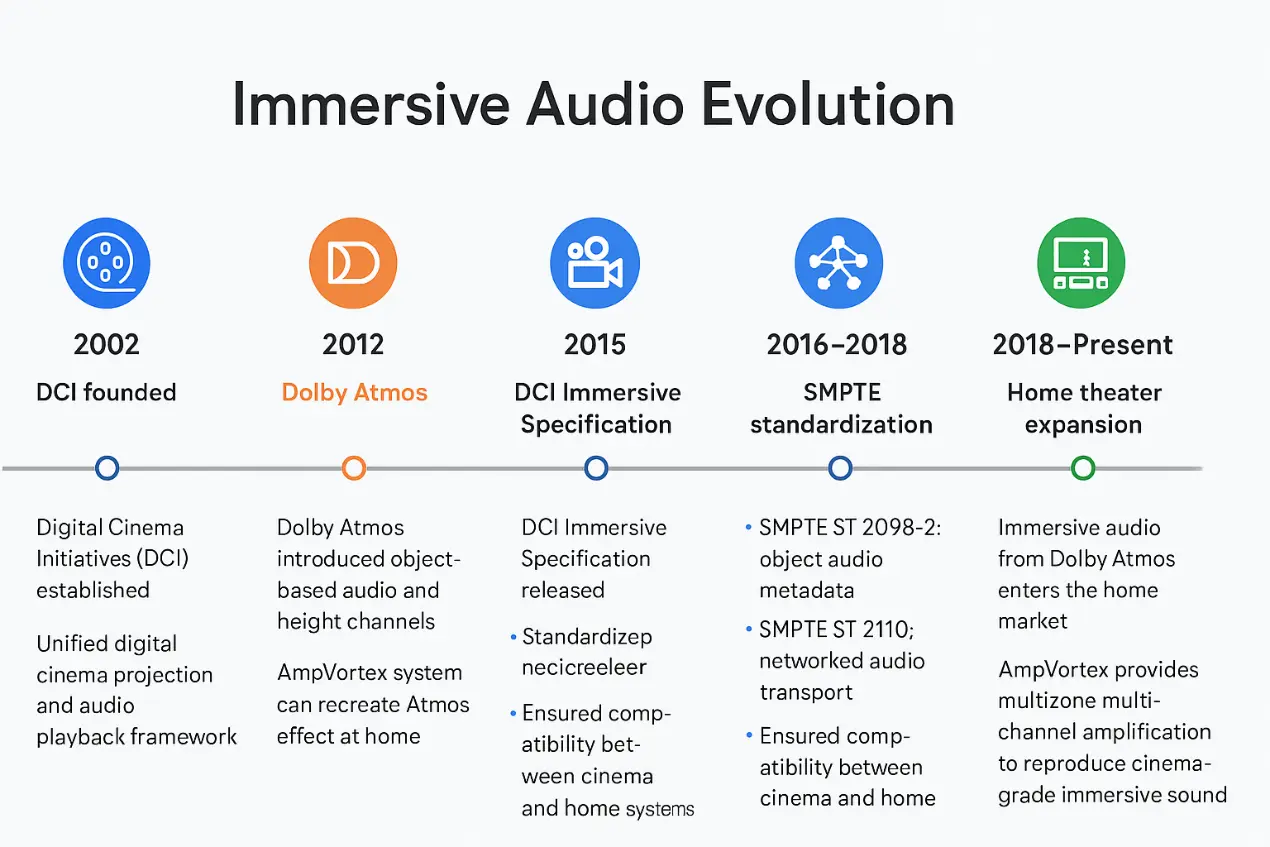
Founded in 2002, the Digital Cinema Initiatives (DCI) initially focused on digital projection and distribution. By the early 2010s, immersive formats such as Dolby Atmos, Auro-3D, and DTS:X emerged, introducing object-based audio and height channels to theaters.
To guarantee reliable reproduction across venues, DCI developed the Immersive Specification, which established:
- Standardized speaker layouts, including overhead and surround layers
- Metadata for object-based audio, ensuring precise 3D positioning
- Performance criteria, including dynamic range, frequency response, and distortion limits
This specification allowed immersive audio mixes to be reproduced consistently in theaters worldwide — and provided the framework for high-end home theater setups using systems like AmpVortex.
Formalization through SMPTE Standards
While DCI provided guidelines, SMPTE (Society of Motion Picture and Television Engineers) formalized them into international technical standards, enabling interoperability among content creators, manufacturers, and theater operators.
Key SMPTE standards include:
- SMPTE ST 2098-2: Defines object-based audio metadata and rendering instructions
- SMPTE ST 2110: Supports networked delivery of immersive audio streams
Through these standards, immersive audio can scale across multiple speakers, channels, and heights without compromising fidelity — principles equally important for AmpVortex multi-channel systems in home theaters.
Expansion to Home Theaters: Dolby Atmos
With the rise of Dolby Atmos, immersive audio moved from commercial cinemas into high-end home theaters. Using multi-channel amplifiers like AmpVortex, home users can now reproduce three-dimensional sound, including height channels and precise object positioning, achieving a theater-level immersive experience in private spaces.
The Ongoing Evolution
From stereo and 5.1 surround to DCI Immersive Specification, SMPTE standards, and object-based audio formats, immersive audio has undergone a profound evolution. Today:
- Filmmakers can place sounds in 3D space, creating unprecedented realism
- Home users can leverage AmpVortex systemsto reproduce immersive, multi-channel audio in dedicated theaters or multi-room setups
- Standardized specifications ensure consistent and scalable playback, whether in commercial cinemas or private home theaters
The journey from conceptual stereo to fully immersive 3D audio demonstrates how structured standards and innovative audio technologies have made immersive sound an integral part of the cinematic experience.