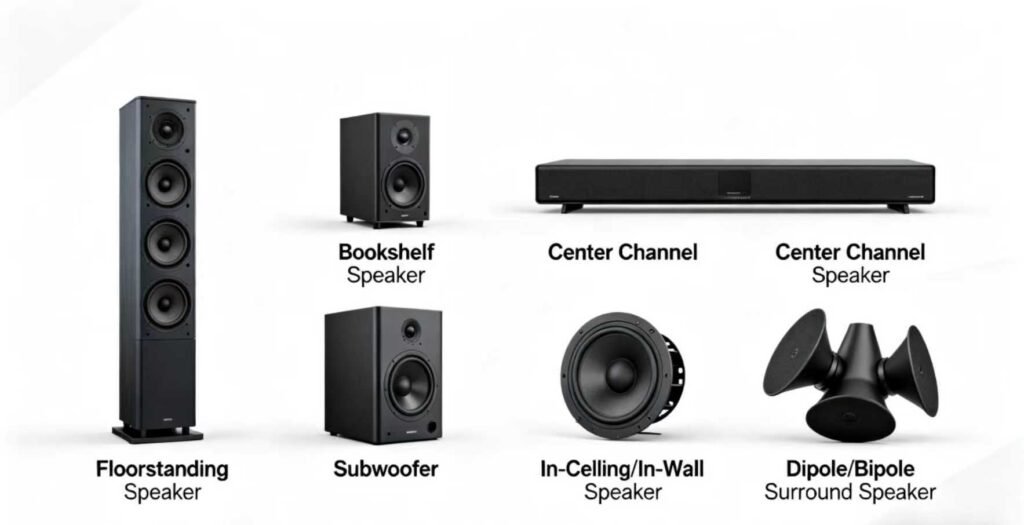
2. The Fidelity Priority: Bookshelf and Floorstanding Speakers
If a room (e.g., a dedicated listening space) is the focus for high-fidelity (Hi-Fi) listening, traditional cabinet speakers are indispensable.
- Advantage:Independent cabinets offer deeper, more accurate bass extension, a wider soundstage, and superior dynamic range compared to built-in solutions.
- Application:Ideal for audiophiles prioritizing critical listening over discreet aesthetics.
3. Extending the System: Outdoor and Weatherproof Speakers
For patios, terraces, or pool areas, specialized speakers are required.
- Key Requirements:Must have an appropriate IP Rating (e.g., IPX5 for water jets) and be constructed from UV-resistant and corrosive-proof materials.
- Types:Traditional Wall-Mounted speakers, Rock-Disguise speakers, or Planter-style speakers.
Part II: Home Theater Loudspeaker Strategy
The essence of Home Theater lies in immersion, dynamic impact, and precise sonic localization.
1. The Foundation of Channel Configuration
- Traditional (5.1/7.1):Positions sound around the listener on a single plane.
- Immersive (5.1.4/7.1.4):Introduces Height Channels to enable Dolby Atmos or DTS:X, creating a vertical sound field.
2. The Front Three: LCR Matching Principle
- Left and Right Main Channels (L/R):Handle music and major sound effects. They should be highly sensitive speakers with large dynamic capabilities.
- Center Channel:The Most Crucial Speaker. Dedicated to dialogue. It is vital that the Center speaker is acoustically matched to the L/R speakers (timbre-matched) to ensure consistent tone as sounds move across the screen.
3. Vertical and Surround Channels
- Height Channels:In-Ceiling Speakers are the best choice for Height Channels (the “.4” in 5.1.4), allowing for pinpoint overhead localization of sound events (e.g., helicopters, rain).
- Surround Channels:Can be bookshelf speakers or In-Wall Speakers, depending on space constraints and aesthetic preferences.
Part III: Deep Dive into Critical Technical Parameters
Regardless of the speaker type, successful system integration depends on matching the speaker’s electrical properties with your amplifier.
1. Sensitivity
- Definition:The sound pressure level (SPL) a speaker produces at 1 meter when fed 1 watt of power ($\text{dB/1W/1m}$).
- Significance:Higher sensitivity means the speaker is easier to drive. An $88 \text{ dB}$ speaker requires half the power of an $85 \text{ dB}$ speaker to achieve the same volume.
- Selection Tip:For large Multi-Room Systems, choose speakers with sensitivity above $88 \text{ dB}$ to reduce the load on your AmpVortex amplifier, allowing it to operate cleaner and cooler.
2. Impedance
- Definition:The electrical resistance of the speaker to the amplifier’s current flow (measured in Ohms, $\Omega$). Common ratings are $8 \Omega$ and $4 \Omega$.
- Impact on Amplifier (Crucial):Low impedance (e.g., $4 \Omega$) demands significantly higher current output from the amplifier. This increases the amplifier’s thermal load and stress.
- AmpVortex Matching Principle:In large Multi-Room Systems, you must calculate the final impedance when wiring multiple speakers in parallel or series. High-current amplifiers like AmpVortex are designed to handle complex, low-impedance loads (often down to $4 \Omega$ or $2 \Omega$ stable), but it is vital to check the specification to prevent triggering the amplifier’s protection circuitry.
3. Power Handling
- Definition:The safe maximum power (RMS/Continuous) a speaker can manage.
- Principle:The amplifier’s output power (e.g., AmpVortex’s $100 \text{W/ch}$) should be within the speaker’s safe operating range. It is generally safer to have a slightly more powerful amplifier than speaker, as clipping (when an underpowered amplifier is overdriven) is the leading cause of speaker failure.
Conclusion: Versatility is the Key to High-End Systems
An advanced system, especially one powered by an AmpVortex amplifier, must be versatile enough to drive this diverse mix of speakers flawlessly.
When making your final selection, prioritize Sensitivity and Impedance to ensure they are perfectly matched with your multi-channel amplifier, whether you are playing gentle background music, enjoying Hi-Fi stereo, or immersing yourself in the latest Dolby Atmos blockbuster.
Do you need an amplifier capable of safely driving all your in-ceiling, outdoor, and low-impedance home theater speakers simultaneously? Discover how AmpVortex utilizes its high-current design to effortlessly manage any complex impedance load.
For more information, please visit www.ampvortex.com

 (317)516-7460
  service@ampvortex.com