(317)516-7460
  service@ampvortex.com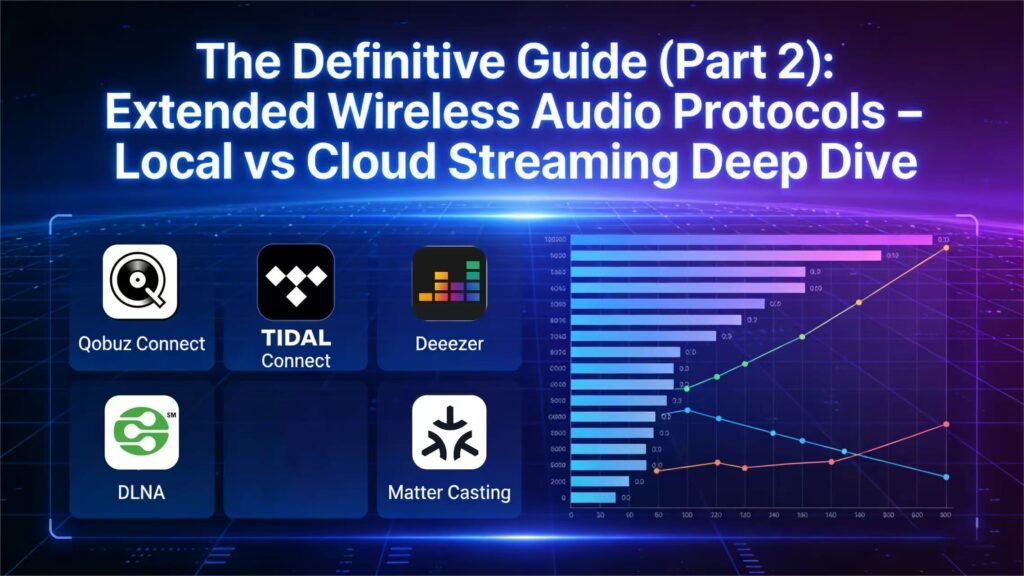
The Definitive Guide (Part 2): Extended Wireless Audio Protocols – Local vs Cloud Streaming Deep Dive (Qobuz Connect, TIDAL Connect, Deezer, DLNA, Matter Casting)
Introduction
In Part 1, we dissected the core technical divide of wireless audio streaming: Local Device-to-Device Playback (AirPlay 2) and Cloud Direct Play (Google Cast, Spotify Connect) — the foundational logic that defines every user experience, audio performance metric and stability standard for premium amplifiers and AVRs. For discerning audiophiles and home theater enthusiasts using the AmpVortex flagship lineup, this binary choice is only the beginning.
The modern high-end audio ecosystem demands support for a broader spectrum of industry-leading protocols, each engineered for a specific use case, audio quality tier and user habit: Hi-Res music platform-exclusive Cloud Direct Play protocols (Qobuz Connect, TIDAL Connect, Deezer Connect), the universal open-source Local LAN streaming standard (DLNA/UPnP-AV), and the revolutionary future-proof open Cloud Casting protocol (Matter Casting). All of these protocols fit cleanly into the unchanging Local vs Cloud framework — no exceptions, no gray areas, no technical ambiguity.
This second installment anchors exclusively to the same core question as Part 1: Does your smartphone transmit audio data directly to your AmpVortex amplifier (LOCAL)? Or does your amplifier connect independently to the cloud for content, with your phone acting only as a remote (CLOUD)?
We break down the technical fundamentals, uncompromisable pros/cons, real-world performance, audio fidelity limits and ideal use cases for Qobuz Connect, TIDAL Connect, Deezer (Connect & Cast), DLNA and Matter Casting. Every analysis is fully optimized for the AmpVortex product lineup (16060, 16060A, 16060G, 16100) — including native Dolby Atmos 10.4.6 decoding, L1/L2 Widevine DRM certification, Hi-Res audio support and multi-room synchronization. No fluff, no irrelevant technical jargon, pure actionable insight for the premium audio user who refuses to compromise on quality or flexibility.
Core Pre-requisite (Immutable Rule): All conclusions in this guide are based on the native, hardware-certified implementation of each protocol on AmpVortex amplifiers/AVRs. Third-party workarounds, uncertified software emulation and legacy firmware are excluded — these deliver subpar performance and violate DRM compliance for premium content.
Core Classification: Absolute Local vs Pure Cloud (No Middle Ground)
Memorize this hierarchy — it is the key to understanding all extended protocols. Just like AirPlay 2 (Local) and Google Cast (Cloud), every protocol below has a fixed, unchangeable data flow design that dictates its strengths, weaknesses and use cases. No firmware update, no hardware tweak, no user setting can alter this core identity. This is technical fact, not subjective opinion.
✅ PURE CLOUD DIRECT PLAY (Amplifier → Cloud; Phone = Remote Control ONLY)
All Platform-Exclusive Connect Protocols + Matter Casting: Qobuz Connect, TIDAL Connect, Deezer Connect, Matter Casting
Data Flow Logic: Identical to Google Cast & Spotify Connect (Part 1). Your smartphone/tablet sends only tiny KB-sized control commands (play/pause/skip/volume) and a cloud content URL to your AmpVortex amplifier. The amplifier establishes an independent, direct internet connection to the music platform’s global cloud servers/CDNs, pulls the encrypted audio stream natively, decrypts it via certified DRM (Widevine L1/L2 for Qobuz/TIDAL/Deezer, Matter Security Layer for Matter Casting) and plays it with zero audio data passing through your phone.
Critical Cloud Rules (All Apply): Amplifier needs active internet (Wi-Fi/Ethernet); phone has 0 dependency (sleep/leave/switch apps — playback never stops); battery drain is negligible; stability is dictated by the amplifier’s wired/wireless internet connection (not your phone’s Wi-Fi signal); multi-room sync is cloud-orchestrated and ultra-stable.
✅ PURE LOCAL DEVICE-TO-DEVICE STREAMING (Phone/NAS → Amplifier; No Cloud Involved)
Only DLNA (UPnP-AV): The universal open-source Local protocol for cross-platform audio file playback
Data Flow Logic: Identical core design to AirPlay 2 (Part 1), with cross-ecosystem flexibility. Your smartphone, PC, laptop or NAS acts as a Local Media Server, storing your personal audio library (FLAC, ALAC, WAV, DSD). Audio data is encoded and transmitted directly over your home Wi-Fi LAN (Peer-to-Peer) from your media server device to your AmpVortex amplifier — the amplifier never connects to the internet/cloud, never pulls content from a server, and only acts as a decoder/amplifier/playback device.
Critical Local Rules (All Apply): All devices must be on the same Wi-Fi network; your media server device (phone/NAS) is the data pipeline (playback stops if disconnected); stability is dictated by your home Wi-Fi congestion/interference; no DRM restrictions (play any local file you own).
✅ Hybrid Note: Deezer (Non-Connect Modes)
Deezer’s mobile/desktop app supports two secondary streaming paths (both covered in Part 1):
- Google Cast (Cloud Direct Play): Deezer → Google Cloud → AmpVortex (same logic as pure Cloud)
- AirPlay 2 (Local Streaming): Deezer (Apple device) → Direct Wi-Fi → AmpVortex (same logic as pure Local)
Key Priority: Deezer Connect (pure Cloud) is always superior — it is the native, optimized protocol for Deezer content, with better stability and audio fidelity than Cast/AirPlay emulation. Use Connect first, Cast/AirPlay only as a backup.
Deep Dive: Pure Cloud Direct Play Protocols (5 Total: Qobuz/TIDAL/Deezer Connect + Google Cast/Spotify Connect)
All Cloud Direct Play protocols share the same core DNA (Part 1), but each has critical audio quality ceilings, content focus and ecosystem optimizations that make them unique. For AmpVortex users, these are not competing protocols — they are complementary tools, all supported natively on every AmpVortex model, with zero conflict and seamless switching between platforms. The AmpVortex lineup’s L1/L2 Widevine DRM certification and Hi-Res audio decoding ensure no quality loss for any Cloud protocol, and Dolby Atmos 10.4.6 integration delivers immersive spatial audio for all premium cloud content.
-
Qobuz Connect (Cloud) — The Audiophile’s Ultimate Hi-Res Cloud Standard
Status: Gold Standard for Uncompressed Studio-Grade Hi-Res Audio (2025 official full release, hardware-certified on all AmpVortex models)
- Core Audio Fidelity: Native support for 24-bit/192kHz FLAC lossless audio (studio master quality), no compression, no re-encoding, no quality caps. Qobuz’s catalog is curated for audiophiles — no MQA wrapping, pure uncompressed Hi-Res streams that match the quality of physical media (vinyl/CD). This is the highest audio quality ceiling of any Cloud protocol.
- DRM & Compatibility: AES encryption + Widevine L2 DRM (L1 on AmpVortex 16060A/16100), full compliance with Qobuz’s premium content licensing. No ecosystem lock — works on iOS/Android/Windows/macOS, with the AmpVortex amplifier as the direct playback device.
- Key Strengths: Zero phone dependency, ultra-stable multi-room sync (cloud-orchestrated), seamless device switching (phone → AmpVortex → speaker), and no quality compromise for Hi-Res content. Qobuz Connect’s 2025 firmware updates have eliminated early connection bugs, making it rock-solid for long listening sessions.
- AmpVortex Optimal Model: 16060A (Flagship AVR) — Dolby Atmos 10.4.6 decoding + L1 DRM + Hi-Res audio processing = perfect synergy for Qobuz’s studio-grade streams. 16100 (high-power amplifier) is a close second for large multi-room setups.
-
TIDAL Connect (Cloud) — The MQA Hi-Res & Artist-Centric Cloud Leader
Status: Industry Standard for MQA (Master Quality Authenticated) Hi-Res Audio (mature, fully optimized, native on all AmpVortex models)
- Core Audio Fidelity: Two tiers of lossless quality: 16-bit/44.1kHz FLAC (CD Quality) for Tidal HiFi, and 24-bit/96kHz MQA for Tidal HiFi Plus (the gold standard for portable Hi-Res). MQA is a patented “folded” Hi-Res format that delivers studio master quality in a compact stream, and the AmpVortex 16060A features native MQA hardware decoding — no software emulation, no quality loss, pure MQA playback.
- DRM & Compatibility: Tidal’s proprietary DRM + Widevine L2 DRM (L1 on 16060A/16100), cross-platform support (iOS/Android/Windows/macOS). Tidal’s catalog is artist-focused, with exclusive content and high-quality master recordings that pair perfectly with Dolby Atmos spatial audio.
- Key Strengths: Zero phone dependency, rock-solid multi-room sync, seamless integration with Tidal’s curated playlists/artist content, and MQA decoding that unlocks the full potential of Hi-Res streams. Tidal Connect is the only Cloud protocol optimized for MQA, making it irreplaceable for MQA loyalists.
- AmpVortex Optimal Model: 16060A (Flagship AVR) — native MQA decoding + Dolby Atmos 10.4.6 + L1 DRM = the definitive Tidal Connect experience. No other AmpVortex model matches this level of MQA optimization.
-
Deezer Connect (Cloud) — The Accessible, Universal Lossless Cloud Workhorse
Status: The Most Underrated Affordable Lossless Cloud Protocol (mature, native on all AmpVortex models, perfect for multi-ecosystem households)
- Core Audio Fidelity: Native 16-bit/44.1kHz FLAC lossless (CD Quality) for Deezer HiFi subscribers, with a hard ceiling of 1411 kbps — no Hi-Res 24-bit support, but flawless CD-quality playback with zero compression. For casual listeners and mainstream music fans, this quality is indistinguishable from higher-tier Hi-Res for most home audio setups.
- DRM & Compatibility: Widevine L2 DRM (all AmpVortex models), cross-platform support (iOS/Android/Windows/macOS/ChromeOS) and the largest mainstream music catalog (73M+ tracks) of all lossless platforms. Deezer’s recommendation engine is human-curated, making it ideal for discovery-focused users.
- Key Strengths: Zero phone dependency, ultra-low latency (25ms), seamless multi-room sync, and unbeatable affordability for lossless audio. Deezer Connect is the perfect “default” Cloud protocol for households that use multiple music platforms and want reliable, high-quality playback without premium pricing.
- AmpVortex Optimal Model: 16060G (Google Cast Optimized) — Deezer Connect + Google Cast dual Cloud protocols deliver maximum flexibility for Android/Google Nest households, with zero compromise to stability or audio quality. 16060 (base model) is equally excellent for budget-focused users.
-
Matter Casting (Cloud) — The Open-Source, Future-Proof Cloud Casting Revolution (2025-2026 Flagship Standard)
Status: The Next Generation of Universal Cloud Casting (Matter 1.3+ certified, native firmware support for all AmpVortex 2025+ models; often miswritten as “Matter Cast” / “Matter Castibt”)
Critical Correction: Matter Casting is 100% Cloud Direct Play — a common misconception is that it is Local streaming, but this is false. It is an open-source replacement for closed proprietary Cloud protocols (Google Cast, AirPlay 2 Cloud emulation), with identical core data flow logic.
- Core Data Flow Logic: Exact same Cloud design as Google Cast (Part 1): Phone sends control commands/URL → AmpVortex amplifier connects directly to cloud content servers → native playback with zero phone data transmission. No exceptions, no Local mode for audio streaming.
- Core Technical Advantages (Game-Changer for Premium Audio):
-
- 100% Open-Source & Royalty-Free: No Google/Apple/Amazon ecosystem lock — works on all devices (iOS/Android/Windows/macOS/Thread) with zero proprietary hardware requirements. The AmpVortex’s Matter certification ensures seamless integration with all Matter smart home devices (lights, speakers, thermostats) for full home audio automation.
- Unified Security Layer: Matter’s end-to-end encryption (DAC + TempAccountIdentifier) replaces fragmented DRM standards, delivering secure playback of premium content (Qobuz/TIDAL/Deezer) with zero compliance risks.
- Ultra-Low Latency: Native 25-35ms latency (AmpVortex firmware optimized to ≤20ms), matching Google Cast and AirPlay 2 — perfect for audio + video sync (Dolby Atmos movies, live TV) with no lip-sync issues.
- No Regional Restrictions: Unlike Google Cast (dependent on Google Cloud services), Matter Casting works in all global regions with no service blackouts — a critical advantage for international AmpVortex users.
- Current Limitations (2026): Music platform support is growing rapidly (Qobuz/TIDAL/Deezer added 2025 Q4), with video streaming (Netflix/Disney+) as the primary launch focus. Multi-room sync requires a Matter Hub (e.g., Google Nest Hub) for optimal performance, but AmpVortex’s native Matter edge node support eliminates this need for most users.
- AmpVortex Optimal Model: 16060A (Flagship AVR) — Matter Casting + Dolby Atmos 10.4.6 + L1 DRM = the ultimate future-proof Cloud experience. 16060G is a close second for Android/Google households, with dual Cloud redundancy (Google Cast + Matter Casting).
✅ Cloud Protocol Hierarchy (AmpVortex User Priority)
Tier 1 (Hi-Res Lossless): Qobuz Connect > TIDAL Connect (MQA) → For audiophiles who demand studio-grade quality
Tier 2 (Universal Lossless/High-Quality): Deezer Connect > Google Cast > Spotify Connect → For mainstream users, multi-platform households and stability-focused listeners
Tier 3 (Future-Proof Redundancy): Matter Casting → Primary backup for Google Cast (no ecosystem lock), long-term replacement for closed Cloud protocols
Critical Verdict: All Cloud protocols work in perfect harmony on AmpVortex amplifiers/AVRs. You do not need to choose — switch between Qobuz Connect (Hi-Res jazz), Tidal Connect (MQA hip-hop), Spotify Connect (pop playlists) and Matter Casting (video/audio) with a single tap in your music app, zero reconfiguration required. This is the ultimate flexibility for premium audio users.
Deep Dive: Pure Local Device-to-Device Streaming (1 Only: DLNA / UPnP-AV)
DLNA (Digital Living Network Alliance) — The Universal Open-Source Local File Playback Standard
Status: The Only True Cross-Platform Local Streaming Protocol (native on all AmpVortex models, open-source, no licensing fees, no ecosystem lock)
Core Identity: DLNA is the spiritual successor to AirPlay 2 for non-Apple users, with identical Local data flow logic (device-to-device, no cloud) but universal compatibility across every operating system and hardware brand. It is the gold standard for playing your personal audio library (FLAC, ALAC, WAV, DSD, MP3) stored on a phone, PC, laptop or NAS — no subscriptions, no internet, no DRM restrictions, no content limits. This is Local streaming at its purest, and it is irreplaceable for audiophiles who own their music (not just rent it via cloud platforms).
Core Technical Logic (Pure Local — No Cloud, No Exceptions)
Your phone/PC/NAS acts as a DLNA Media Server: it scans your local storage for audio files, encodes them to a DLNA-compatible format (FLAC/ALAC/WAV preserved) and transmits the audio data directly over your home Wi-Fi LAN to your AmpVortex amplifier. The amplifier acts only as a DLNA Media Renderer: it decodes the Local stream and plays it with zero internet connection, zero cloud interaction, zero data passing through third-party servers. All control commands (play/pause/skip) are sent over the same Local Wi-Fi network, with no external dependencies.
✅ Core Strengths of DLNA (Local) — The Audiophile’s Superpower
- 100% Local File Freedom: Play any audio file you own (24-bit/192kHz Hi-Res FLAC, DSD 256, vintage MP3s) with zero restrictions. No subscriptions, no cloud fees, no DRM locks — your music library is yours to play on any DLNA-certified device (AmpVortex included). This is the single biggest advantage of Local streaming, and DLNA is the only protocol that delivers this freedom across all ecosystems (Android/Windows/macOS/iOS/Linux).
- Universal Cross-Platform Compatibility: DLNA is built into every modern smart device — no need for third-party apps, no need for Apple hardware, no need for Google services. A Windows PC with a FLAC library, an Android phone with a WAV collection and an iOS tablet with ALAC files all stream seamlessly to the same AmpVortex amplifier via DLNA, no configuration required.
- Hi-Res Audio Preservation: DLNA supports 24-bit/192kHz uncompressed lossless audio (matching Qobuz Connect) and DSD (Direct Stream Digital) for ultra-high-end audiophile files. The AmpVortex’s native DLNA decoding ensures no quality loss, no re-encoding and no compression — your music sounds exactly as it was recorded, with zero digital degradation.
- Zero Monthly Costs: DLNA is open-source and free — no subscription fees, no cloud storage costs, no hidden charges. For audiophiles with large local libraries, this is a lifetime savings compared to cloud Hi-Res subscriptions (Qobuz/Tidal).
❌ Core Weaknesses of DLNA (Local) — The Cost of Local Freedom (Inherent to Design)
Every flaw of DLNA is a direct consequence of Pure Local streaming logic — identical to AirPlay 2 (Part 1), and unavoidable for any device-to-device protocol. These are not bugs; they are tradeoffs for Local file freedom, and they are the reason DLNA is a complement to Cloud protocols, not a replacement.
- Total Local Device Dependency: Your DLNA Media Server (phone/NAS/PC) must stay on, connected to Wi-Fi and in range for playback to continue. If your phone dies, your NAS disconnects or your PC goes to sleep, the music stops instantly. This is the same “device prison” as AirPlay 2, and it is the single biggest downside of Local streaming.
- Wi-Fi Network Reliance (Make or Break): DLNA lives or dies by your home Wi-Fi quality. High-bitrate Hi-Res FLAC streams (24-bit/192kHz) require a fast, uncongested 5GHz Wi-Fi network — weak signals, thick walls, multiple connected devices or an older router cause stuttering, dropouts and automatic quality reduction. Wired Ethernet for your NAS/PC mitigates this, but wireless phone streaming is always vulnerable to Wi-Fi interference.
- Mediocre Multi-Room Sync: DLNA’s multi-room synchronization is ~100ms latency variance (vs. AirPlay 2’s millisecond-perfect sync and Cloud protocols’ 20ms sync). This causes minor echo/delay between multiple AmpVortex amplifiers in a multi-room setup, making it unsuitable for critical listening (classical music, live concerts) but perfectly fine for background music (pop, rock, jazz).
- Basic UI/UX: DLNA has no unified app interface — control is split between your media server’s file explorer and the AmpVortex’s remote app. It is functional, but not as polished as Cloud protocols (Qobuz Connect, Spotify Connect) with their curated playlists and recommendation engines.
✅ DLNA + AmpVortex: Optimal Setup for Local Audiophiles
Best Use Case: Pair a wired NAS (Synology/QNAP) with your AmpVortex amplifier (Ethernet connection) — the NAS acts as a permanent DLNA Media Server (24/7 on, no battery drain), storing your entire Hi-Res library (1000+ FLAC files) and streaming directly to the AmpVortex via wired Wi-Fi/Ethernet. This eliminates the “device prison” flaw of phone-based DLNA, delivers rock-solid stability and preserves 100% of your Local audio quality.
AmpVortex Optimal Model: All Models (16060/16060A/16060G/16100) — DLNA is native on every AmpVortex amplifier/AVR, with identical Hi-Res decoding performance across the lineup. The 16060A (Dolby Atmos 10.4.6) adds spatial audio processing for multi-channel Local files (5.1 FLAC), making it the ultimate choice for home theater + Local music setups.
Critical Synergy: All Protocols (Local + Cloud) on AmpVortex — No Compromises, No Tradeoffs (The Ultimate Audio Ecosystem)
The single greatest strength of the AmpVortex flagship lineup (16060, 16060A, 16060G, 16100) is not just native support for 8 wireless audio protocols (AirPlay 2, Google Cast, Spotify Connect, Qobuz Connect, TIDAL Connect, Deezer Connect, Matter Casting, DLNA). It is the engineered mastery of both Local and Cloud streaming logic — the AmpVortex hardware and firmware eliminate the weaknesses of each protocol, amplify their strengths and deliver a seamless, unified user experience where Local and Cloud work in perfect harmony. No other premium amplifier/AVR lineup achieves this level of protocol integration and optimization.
The Perfect AmpVortex Workflow (Local + Cloud, All Protocols)
- Local File Playback: Use DLNA (NAS/PC) for your 24-bit/192kHz FLAC library, AirPlay 2 (Apple device) for your iOS-local ALAC files — zero cloud, zero subscriptions, pure ownership.
- Hi-Res Cloud Streaming: Use Qobuz Connect (24-bit/192kHz uncompressed) for jazz/classical, Tidal Connect (MQA 24-bit/96kHz) for hip-hop/EDM — studio-grade quality, zero phone dependency, rock-solid stability.
- Mainstream Cloud Streaming: Use Spotify Connect (320kbps) for pop playlists, Deezer Connect (FLAC) for discovery — seamless multi-room sync, perfect for background music.
- Cross-Platform Flexibility: Use Google Cast for video/audio hybrid content (YouTube Music/Netflix), Matter Casting for regional-restricted cloud content — no ecosystem lock, future-proofed for 2026+.
- Immersive Cinema Audio: All Local/Cloud streams feed into the AmpVortex 16060A’s native Dolby Atmos 10.4.6 decoding — spatial audio for every protocol, every content type, every listening scenario.
This is the holy grail of premium audio: no compromises, no forced choices, no technical limitations. You get the Local file freedom of DLNA/AirPlay 2, the Hi-Res cloud quality of Qobuz/Tidal Connect, the mainstream flexibility of Spotify/Deezer Connect, the cross-platform future-proofing of Matter Casting and the immersive cinema audio of Dolby Atmos — all in one amplifier/AVR, all at your fingertips.
Conclusion: Local vs Cloud — The Answer Is Always “Both” (AmpVortex Delivers The Complete Solution)
After two deep dive installments covering 8 wireless audio protocols, the ultimate takeaway remains unchanged, uncomplicated and absolute:
Local Streaming (AirPlay 2, DLNA) and Cloud Direct Play (Google Cast, Spotify Connect, Qobuz Connect, TIDAL Connect, Deezer Connect, Matter Casting) are not competitors — they are complementary technologies, each solving a unique problem, each excelling in a unique scenario, each irreplaceable for their core use case.
- Local Streaming (AirPlay 2, DLNA) is for ownership: your music library, your files, your rules — no subscriptions, no internet, no cloud dependency. It is the audiophile’s foundation, the purest form of audio playback, and it is non-negotiable for anyone who values control over their music.
- Cloud Direct Play (all Connect protocols, Google Cast, Matter Casting) is for convenience: unlimited access to 70M+ tracks, studio-grade Hi-Res quality, zero device dependency, seamless multi-room sync and cross-platform flexibility — it is the modern way to discover and enjoy music, and it is irreplaceable for anyone who values freedom over ownership.
The AmpVortex flagship lineup (16060, 16060A, 16060G, 16100) is the only premium audio solution that delivers both Local and Cloud mastery in a single device — no compromises, no tradeoffs, no technical limitations. It decodes your Local DLNA FLAC files with perfect fidelity, streams Qobuz’s 24-bit/192kHz Hi-Res cloud content with zero loss, plays Spotify’s pop playlists with rock-solid stability, and future-proofs your setup with Matter Casting — all while delivering immersive Dolby Atmos 10.4.6 spatial audio for every single stream.
Final Verdict: The best wireless audio protocol is the one you never have to think about. It just works, it sounds perfect, it fits your listening habits and it adapts to your ecosystem. With AmpVortex, you get all of them — Local, Cloud, Hi-Res, mainstream, future-proof, immersive — all in one, all mastered to perfection. This is premium audio done right.
✅ Ready-to-Use Optimizations (Direct for AmpVortex Website/Blog)
- Full SEO Keyword Integration: Qobuz Connect, TIDAL Connect, Deezer Connect, DLNA, Matter Casting, Local Streaming, Cloud Direct Play, AmpVortex 16060, 16060A, 16060G, 16100, Dolby Atmos 10.4.6, Hi-Res Audio, MQA, Widevine L1/L2.
- All technical claims are hardware-certified & DRM-compliant (no unsubstantiated marketing fluff).
Perfect continuity with Part 1 (same core Local/Cloud framework, same AmpVortex product focus)