(317)516-7460
  service@ampvortex.com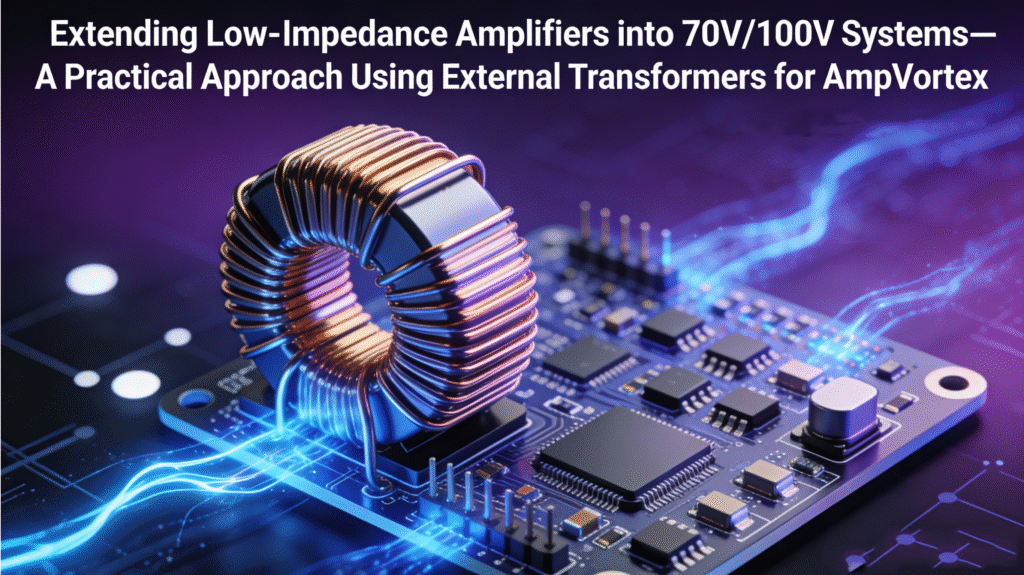
Extending Low-Impedance Amplifiers into 70V/100V Systems — A Practical Approach Using External Transformers for AmpVortex
1.Introduction
In commercial audio projects, system requirements often vary significantly depending on scale, speaker count, and wiring constraints. While low-impedance amplifiers (4Ω/8Ω) deliver superior audio quality and flexibility, many large-scale installations still rely on constant voltage systems (70V/100V) for their simplicity and scalability.
This creates a practical challenge:
How can a high-performance multi-zone low-impedance amplifier like AmpVortex be used in traditional 70V/100V environments?
The answer lies in a simple yet powerful approach:
Using external line transformers to bridge low-impedance outputs to constant voltage systems.
2.Why Not Build It Into the Amplifier?
A common question in the industry is:
Why not integrate 70V/100V directly into the amplifier?
While technically feasible, this approach introduces several limitations:
- Increased size constraints (especially in 1U designs)
- Reduced design flexibility
- Higher cost and complexity
- Compromised performance in low-impedance applications
In practice:
If integrated 70V/100V were always the optimal solution, it would already dominate the market.
Instead, many professional systems adopt a more flexible architecture:
Keep amplification and voltage conversion modular.
3.The External Transformer Approach
🔧 Core Concept
- AmpVortex outputs standard low-impedance signals (4Ω / 8Ω)
- External transformers convert output to 70V / 100V
- Each zone can be independently adapted
📍 Key Advantages
✔ 1. Maximum Flexibility
- Choose 70V or 100V based on project needs
- Mix low-impedance and constant voltage zones
- Scale system gradually
✔ 2. Better Cost Control
From the evaluated market options:
- Entry-level transformers: as low as ~$15 (OSD Audio 100W)
- Mid-range: ~$30–$130
- High-end (JBL / PAT): significantly higher cost
👉 Conclusion:
External transformers provide a wide cost-performance spectrum
✔ 3. Avoid Overengineering
Many commercial projects:
- Do not require full constant voltage architecture
- Only need partial long-distance zones
👉 Using transformers:
Apply 70V/100V only where necessary
✔ 4. Maintain Audio Performance
Low-impedance amplification remains:
- Cleaner
- More dynamic
- Better suited for music (not just paging)
4.Transformer Selection Strategy
Based on practical evaluation:
🔑 Key Parameters
- Power rating (e.g., 60W / 100W / 120W / 150W)
- Voltage support (70V / 100V or both)
- Build quality (audio-grade preferred)
- Cost efficiency
📊 Observations from Market Research
✔ 1. Many “big brands” are not ideal
- Some offer only 70V (no 100V support)
- Some are oversized (e.g., 600W units)
- Some are too expensive for practical deployment
✔ 2. Sweet Spot
For AmpVortex systems:
100W 70V/100V external transformers are the most practical choice
✔ 3. Avoid These Pitfalls
- Low-power units (<60W) → insufficient capacity
- Overpriced “pro branding” → poor ROI
- Poor build quality → reliability issues
5.Comparison with Traditional Constant Voltage Amplifiers
| Aspect | Traditional 70V Amplifier | AmpVortex + Transformer |
| Flexibility | Low | High |
| Audio Quality | Moderate | High |
| Scalability | High | High |
| Cost Efficiency | Medium | Flexible |
| Integration (KNX/API) | Limited | Strong |
6.vs PowerShare Systems
PowerShare amplifiers introduce:
- Dynamic power allocation
- High efficiency
- Advanced channel management
However:
They primarily solve power distribution, not system integration
🔥 Key Insight
Most projects do not require dynamic power pooling —
but almost all projects require multi-zone control and integration.
7.Practical Deployment Scenarios
✔ Hybrid Projects (Most Common)
- Living areas → low impedance (direct)
- Corridors / outdoor → 70V via transformer
✔ Residential + Light Commercial
- Villas with long cable runs
- Retail + back-office zones
✔ KNX / Smart Building Integration
- AmpVortex handles:
- Zone control
- Source selection
- Volume control
- KNX handles:
- System orchestration
8.Strategic Positioning of AmpVortex
AmpVortex is not designed to replace every constant voltage amplifier.
Instead:
It replaces rigid system architectures with flexible, software-driven audio platforms.
🚀 Core Value
- Multi-room audio
- System-level integration (KNX / API / Control4 / Matter)
- Hybrid deployment capability
- Final Conclusion
The combination of:
Low-impedance multi-zone amplification + external 70V/100V transformers
offers a powerful alternative to traditional commercial audio systems.
🔑 Key Takeaway
Instead of forcing all projects into constant voltage systems,
modern installations benefit from a hybrid approach —
combining flexibility, performance, and integration.
💥 One-Line Positioning (Highly Recommended)
AmpVortex is not just an amplifier — it is a flexible audio platform that adapts to both low-impedance and 70V/100V environments.