(317)516-7460
  service@ampvortex.com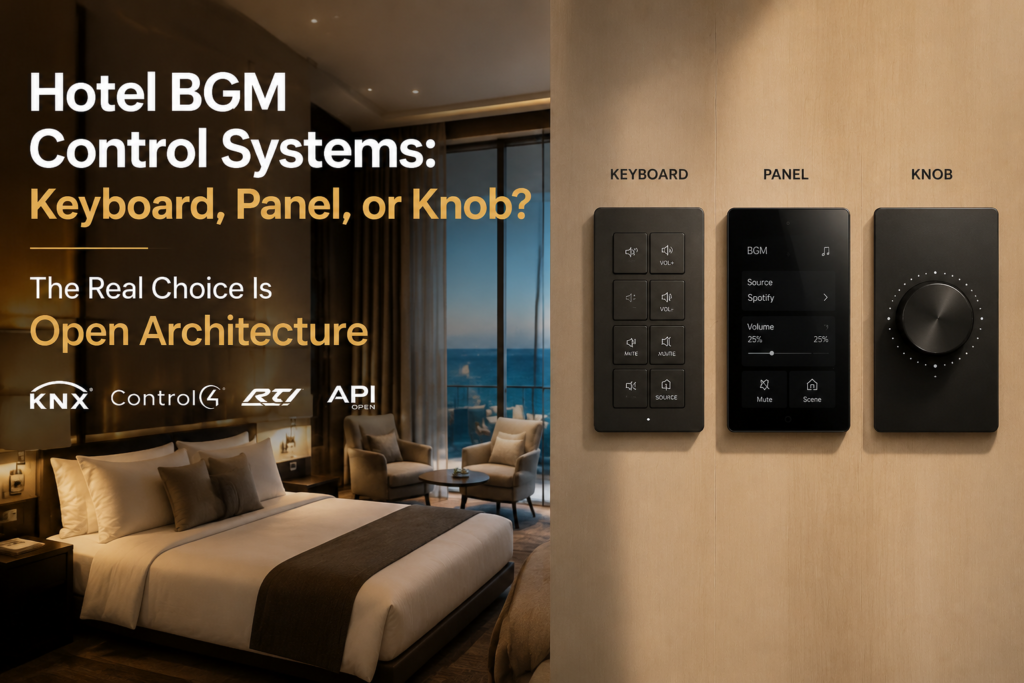
Hotel BGM Control Systems: Keyboard, Panel, or Knob? The Real Choice Is Open Architecture
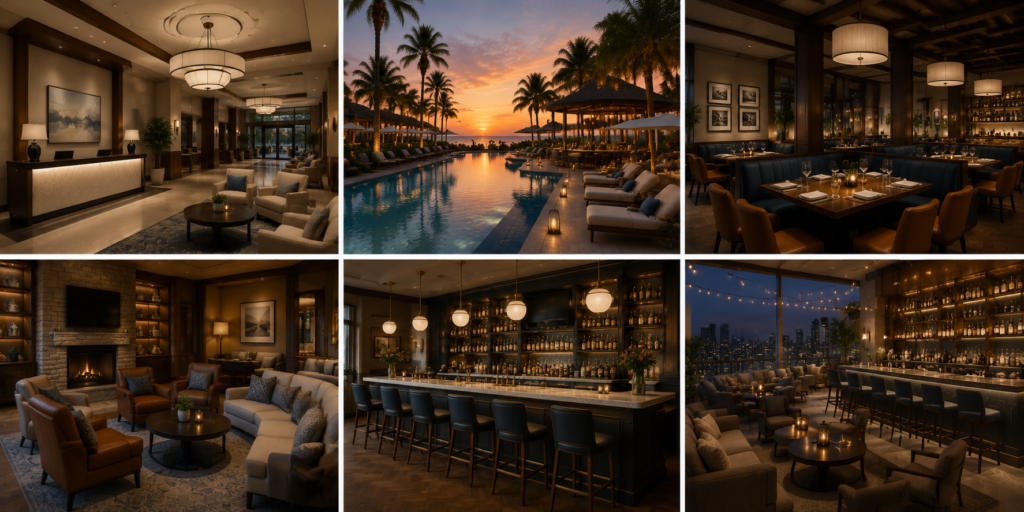
1. Three Common Control Interfaces for Hotel BGM Systems
Different hospitality environments require different user experiences.
There is no single “best” control interface.
The right choice depends on the application, design concept, and operational requirements.
Keyboard Control: Simple, Reliable, and Efficient
Physical button controllers remain popular in many commercial environments because of their simplicity and reliability.
Typical functions include:
- Volume up/down;
- Mute;
- Source selection;
- Scene activation.
Advantages:
- Easy to operate;
- Low learning curve;
- High reliability;
- Cost-effective.
Keyboard controllers are particularly suitable for:
- Service areas;
- Restaurant zones;
- Standardized hotel environments;
- Applications where fast operation is important.
For many commercial spaces, simplicity is a strength.
Touch Panels: A Premium Interface for Modern Hospitality
Touch panels are widely used in high-end hospitality projects where aesthetics and multifunction control are important.
Advantages:
- Clean visual appearance;
- Flexible interface design;
- Multiple system controls in one device.
A touch panel can combine:
- Audio control;
- Lighting control;
- Curtain control;
- HVAC control;
- Scene management.
For example:
A “Dining Scene” button could activate:
- Recommended lighting level;
- Background music;
- Volume setting;
- Overall atmosphere.
This creates a more integrated guest experience.
Physical Knob Control: Intuitive and User-Friendly
Physical knobs remain highly valued in certain hospitality environments.
Advantages:
- Immediate operation;
- Excellent tactile feedback;
- No menu navigation required.
They are especially suitable for:
- Boutique hotels;
- Bars;
- Restaurants;
- Design-focused hospitality spaces.
Guests and staff can adjust volume naturally with a simple rotation.
2. The Real Challenge: Avoiding Control System Lock-In
While keyboard, panel, and knob interfaces all have their advantages, the bigger challenge is not the interface itself.
The challenge is the underlying architecture.
A traditional closed audio ecosystem often follows this model:
Audio System
↓
Dedicated Controller
↓
Brand-Specific Interface
This approach may simplify initial installation, but it creates long-term limitations.
Design Limitations
Modern hotels usually require a consistent interior design language.
Lighting, curtains, HVAC, and automation systems are often based on open ecosystems such as KNX.
Hotels may want to use:
- KNX switches;
- Smart touch panels;
- Designer wall controls;
- Custom interfaces.
If the audio system requires a proprietary controller, the hotel may lose the ability to maintain a unified design.
Higher Lifecycle Risk
Hotels are long-term assets.
A hospitality project may operate for:
- 10 years;
- 15 years;
- even longer.
During this period, hotels need to consider:
- Product availability;
- Maintenance;
- Replacement options;
- Future upgrades.
A closed ecosystem creates dependency on one supplier.
If a product is discontinued, replacement options may become limited.
Limited Integration Capability
Modern hotels increasingly integrate:
- Building automation systems;
- PMS platforms;
- Guest experience platforms;
- Smart building solutions.
Audio should not remain an isolated system.
It should become part of the overall technology ecosystem.

3. Open Architecture: Giving Hotels Freedom of Choice
The principle of open architecture is simple:
The audio system should provide capabilities, not restrictions.
An open audio platform allows hotels to choose:
- Different control interfaces;
- Different automation platforms;
- Different design solutions.
The audio system becomes an infrastructure layer rather than a closed product ecosystem.
4. AmpVortex: An Open Audio Platform for Hospitality
AmpVortex is designed around an open integration philosophy.
Instead of forcing hotels into one control ecosystem, AmpVortex allows integration with modern hospitality technologies.
Native KNX Integration
With native KNX support, AmpVortex can integrate with KNX-based control environments.
Hotels can use different KNX interfaces, including:
- Button controllers;
- Touch panels;
- Smart room controls.
This allows audio control to match the overall room and building automation design.
Multi-Platform Integration
AmpVortex supports:
- KNX;
- Control4;
- RTI;
- Web API.
This provides flexibility for different project requirements and technology architectures.