(317)516-7460
  service@ampvortex.com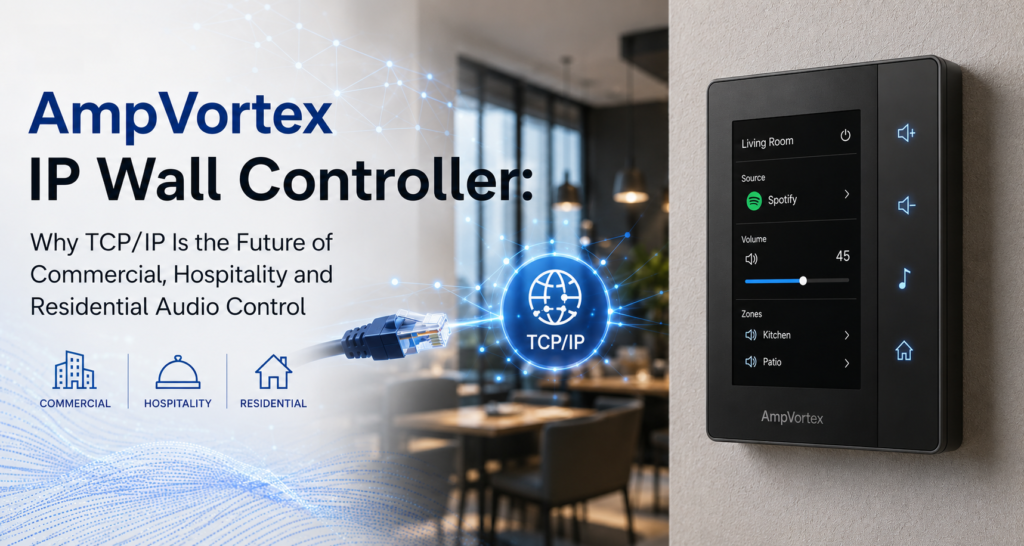
AmpVortex IP Wall Controller: Why TCP/IP Is the Future of Commercial, Hospitality and Residential Audio Control
For decades, wall-mounted audio controllers have remained surprisingly unchanged.
Whether in homes, hotels, offices or restaurants, most installations still rely on either analog volume knobs or manufacturer-specific digital keypads. While these technologies have served the industry for many years, they were designed for an era before streaming audio, smart buildings and IP networks became the standard.
Today, users expect much more than simple volume adjustment. They expect seamless integration with streaming music services, building automation, mobile applications and intelligent control systems.
That is why AmpVortex is introducing a new generation of wall-mounted audio control.
Meet the AmpVortex IP Wall Controller — a native TCP/IP wall controller designed for modern multi-zone streaming audio systems.
Unlike traditional analog volume controls or proprietary digital keypads, the AmpVortex IP Wall Controller is built around standard Ethernet networking and open integration, making it an ideal solution for residential, hospitality and commercial audio projects.
Why Traditional Analog Volume Controls Are No Longer Enough
Analog volume controls have been used for decades because they are simple and inexpensive.
However, their design is based on one assumption:
The wall controller only needs to reduce the audio signal.
Modern audio systems require far more functionality.
A contemporary multi-room audio system needs to support:
- Multi-zone audio management
- Music streaming
- Source selection
- Scene control
- Building automation
- Mobile applications
- Cloud services
- Remote management
None of these capabilities are possible with a traditional analog volume knob.
Analog Controls Can Only Control Volume
An analog wall controller physically attenuates the speaker signal.
It cannot:
- Select different music sources
- Change streaming services
- Switch audio zones
- Play or pause music
- Trigger automation scenes
- Display playback information
- Synchronize with mobile applications
- Communicate with smart home or building systems
As buildings become increasingly connected, a single-function controller simply cannot meet modern expectations.
Speaker Cable Installation Is Expensive and Inflexible
Traditional analog volume controls are normally installed between the amplifier and the speakers.
This means installers must route high-power speaker cables through every wall controller.
The result is:
- Longer speaker cable runs
- Higher installation costs
- Increased labor
- More difficult future upgrades
- Limited installation flexibility
The AmpVortex IP Wall Controller completely changes this architecture.
Instead of routing speaker signals through the wall, only a standard Ethernet cable is required.
The amplifier remains safely installed inside the equipment rack while all control commands are transmitted digitally over the network.
This simplifies installation, reduces wiring complexity and makes future expansion significantly easier.
No More Out-of-Sync Volume Knobs
One of the biggest limitations of analog controls is the complete lack of system awareness.
Imagine adjusting the music volume using:
- A mobile app
- A KNX touch panel
- A Control4 interface
- A Home Assistant dashboard
The analog knob on the wall never knows the change happened.
Its physical position no longer represents the actual system volume.
This creates confusion for both users and installers.
Because the AmpVortex IP Wall Controller communicates directly with the amplifier using TCP/IP, every controller always knows the current system status.
Volume changes remain synchronized across:
- Wall controllers
- Mobile applications
- Touch panels
- Automation systems
- Web interfaces
The user always sees the correct system state.
The Limitations of Proprietary Digital Keypads
Many professional AV manufacturers replaced analog controls with digital keypads.
While these products introduced additional functionality, they often created another problem:
Closed ecosystems.
Most proprietary keypads require dedicated communication buses or manufacturer-specific protocols.
Examples include:
- RS-485
- CAN Bus
- Custom serial protocols
- Proprietary control networks
Although functional, these solutions often increase installation complexity while limiting future system expansion.
Standard TCP/IP Instead of Proprietary Networks
The AmpVortex IP Wall Controller uses one of the world’s most widely adopted communication standards:
TCP/IP over standard Ethernet.
This provides several important advantages.
Existing Network Infrastructure
No proprietary control wiring is required.
Installers can simply connect the controller to the existing network infrastructure.
Standard Ethernet switches, structured cabling and enterprise networking practices can all be used.
Easier Expansion
Need another wall controller?
Simply connect another Ethernet cable.
Need multiple controllers controlling the same audio zone?
No additional control bus is necessary.
Need to relocate a controller during renovation?
Move the network connection.
The installation becomes dramatically more flexible compared with traditional systems.
Faster Deployment
Because the controller communicates over standard IP networks, installation becomes significantly faster.
System integrators no longer need to learn proprietary communication buses or purchase manufacturer-specific accessories.
This reduces installation time while lowering project costs.
Built for Open Integration
Perhaps the biggest advantage of the AmpVortex IP Wall Controller is its open architecture.
Rather than locking users into a single ecosystem, the controller is designed to integrate with modern automation platforms.
Supported integrations include:
- KNX
- Control4
- RTI
- Web API
- Third-party automation systems
This enables consultants, system integrators and developers to create customized user experiences without being restricted by proprietary hardware.
Open integration also protects long-term investment by making future upgrades much easier.
More Than Just a Volume Knob
Calling it a “volume knob” doesn’t fully describe what the AmpVortex IP Wall Controller can become.
Depending on system configuration, it can provide access to:
- Volume control
- Zone selection
- Source selection
- Mute
- Play/Pause
- Previous/Next track
- Favorite presets
- Scene recall
- Automation triggers
- Two-way status feedback
- Real-time synchronization
Instead of acting as a passive analog device, it becomes an intelligent network endpoint within the entire AmpVortex ecosystem.
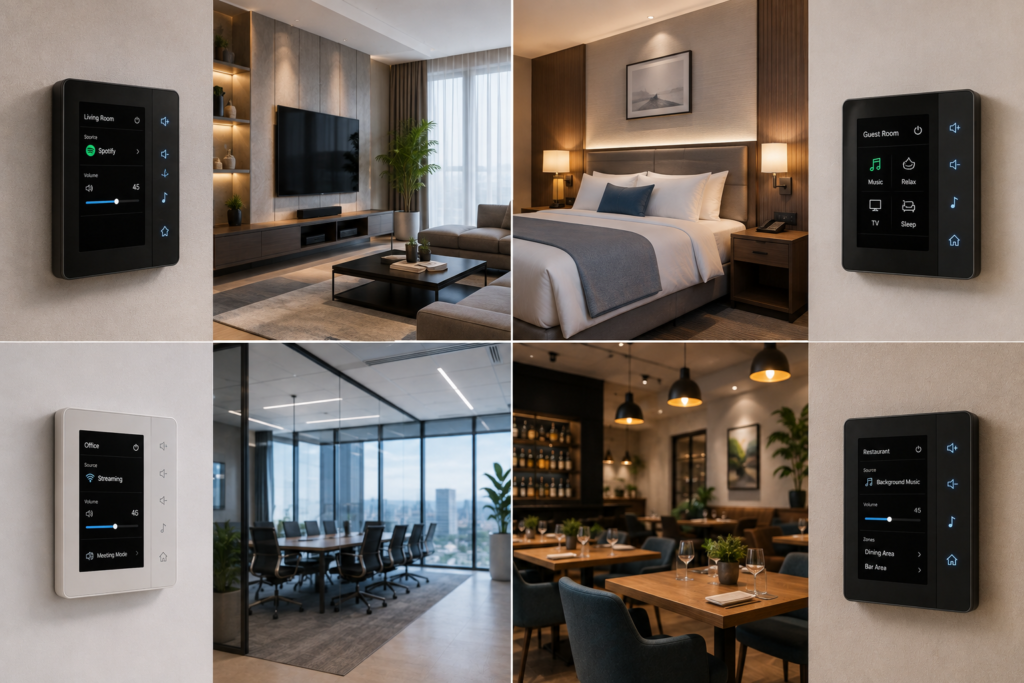
Designed for Residential Projects
In modern smart homes, users increasingly expect every room to have intuitive audio control.
The AmpVortex IP Wall Controller allows homeowners to instantly control multi-room music without relying solely on smartphones.
It integrates naturally with:
- AirPlay 2
- Google Cast
- Spotify Connect
- Home automation systems
- Whole-home audio installations
Whether installed beside a light switch or integrated into a luxury smart home, it provides a clean and familiar user experience.
Perfect for Hospitality Applications
Hotels continue to adopt connected technologies to improve guest experience while simplifying operations.
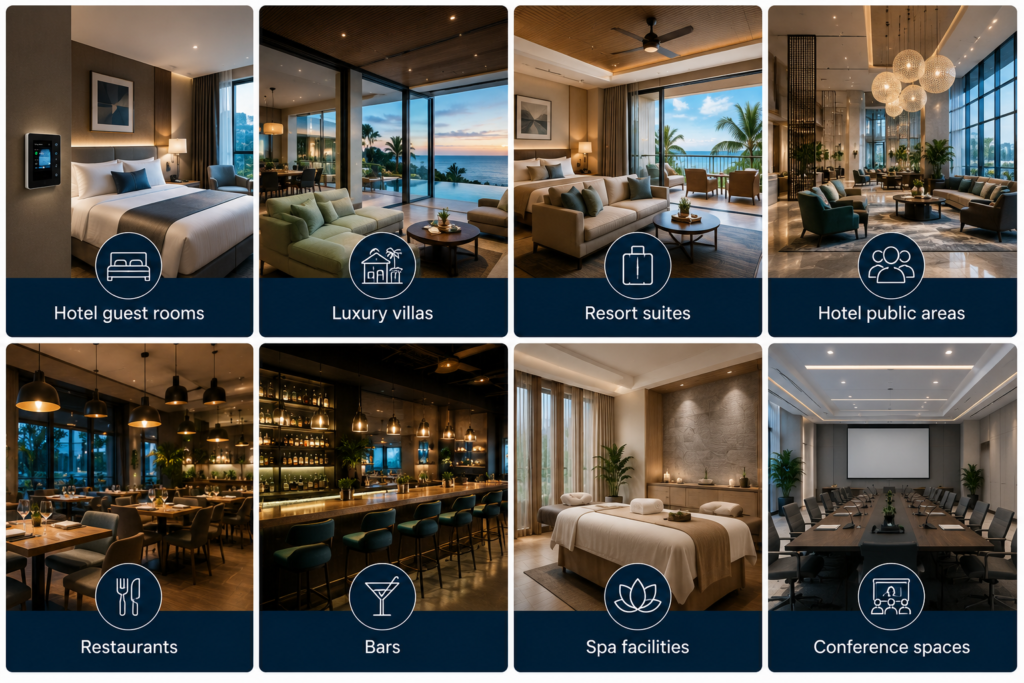
The AmpVortex IP Wall Controller is ideal for:
- Hotel guest rooms
- Luxury villas
- Resort suites
- Hotel public areas
- Restaurants
- Bars
- Spa facilities
- Conference spaces
Guests receive intuitive local control while operators maintain centralized system management through the AmpVortex platform.
Built for Commercial Audio Systems
Commercial environments require control systems that are reliable, scalable and easy to maintain.
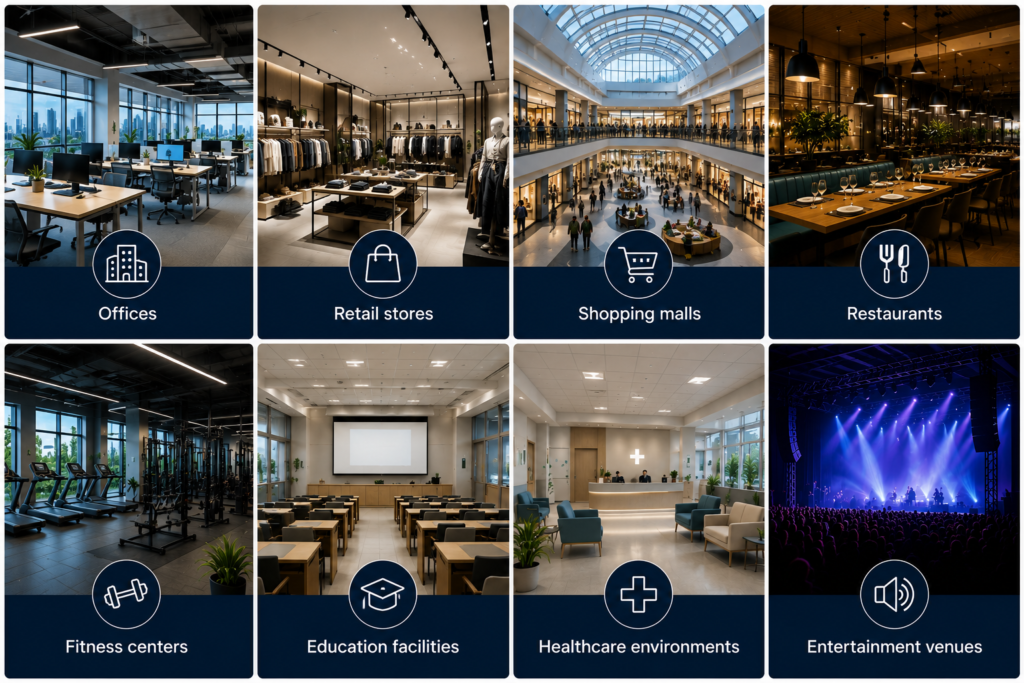
The AmpVortex IP Wall Controller is well suited for:
- Offices
- Retail stores
- Shopping malls
- Restaurants
- Fitness centers
- Education facilities
- Healthcare environments
- Entertainment venues
Because everything communicates over standard IP networking, expansion becomes significantly easier as projects grow.
Why TCP/IP Represents the Future of Audio Control
The audio industry has already embraced IP technology for music streaming.
Building automation has embraced IP.
Enterprise networking has embraced IP.
Cloud services run on IP.
Remote management runs on IP.
It only makes sense that wall-mounted audio control should evolve in the same direction.
The AmpVortex IP Wall Controller brings audio control into the modern networking era by replacing analog signal attenuation and proprietary communication buses with a flexible, open, intelligent TCP/IP architecture.
At a Glance
Feature | Analog Volume Control | Proprietary Digital Keypad | AmpVortex IP Wall Controller |
Communication | Analog speaker signal | Proprietary bus | Native TCP/IP |
Wiring | Speaker cable | Dedicated control bus | Standard Ethernet |
Installation | Complex | Moderate | Simple |
Multi-zone Support | Limited | Yes | Yes |
Two-way Feedback | No | Limited | Yes |
Mobile Synchronization | No | Vendor dependent | Yes |
Automation Integration | No | Limited | Open APIs |
Future Expansion | Difficult | Vendor dependent | Easy |
Smart Building Ready | No | Partial | Yes |
The Future Starts Here
The way we control audio is changing.
Wall controllers should no longer be isolated analog devices or proprietary accessories tied to a single manufacturer.
They should be intelligent, connected and built around open standards.
The AmpVortex IP Wall Controller represents this next step—combining native TCP/IP communication, modern multi-zone control and open integration into a single platform designed for residential, hospitality and commercial environments.
Whether you are designing a luxury smart home, a five-star hotel, a corporate office or a multi-building commercial project, the future of wall-mounted audio control is no longer analog.
It is IP.
Coming Soon
AmpVortex IP Wall Controller
Native TCP/IP. Open Integration. Intelligent Multi-Zone Control. Built for the Future of Audio.
For more details, please visit www.ampvortex.com