(317)516-7460
  service@ampvortex.com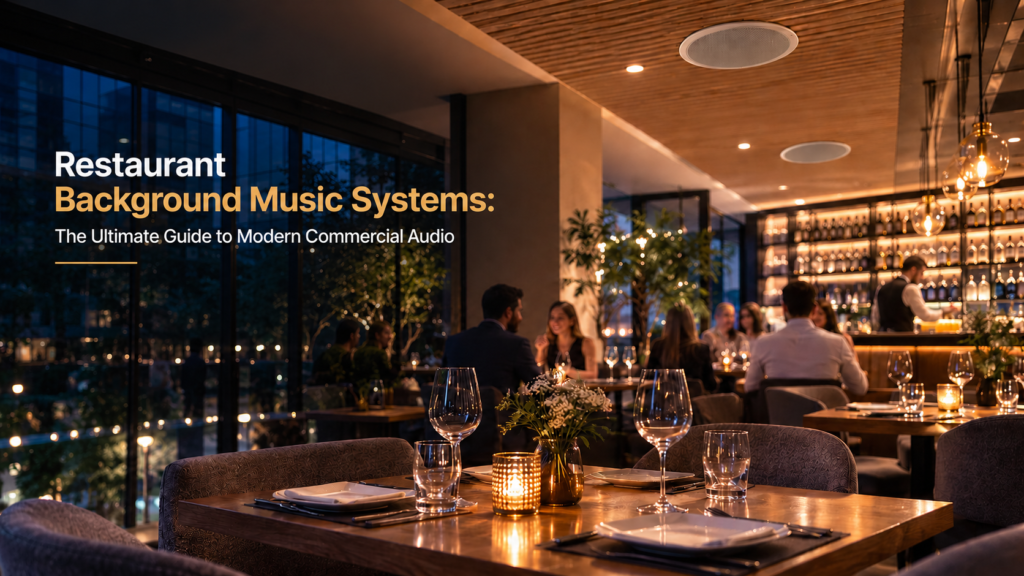
Restaurant Background Music Systems: The Ultimate Guide to Modern Commercial Audio
AmpVortex Commercial Audio Solutions Series
Professional Guides for Designing Modern Multi-Zone Commercial Audio Systems
Background music plays an important role in the restaurant experience. From fine dining and cafés to bars, lounges and hotel restaurants, the right music helps create atmosphere, reinforce brand identity and improve the overall guest experience.
But a professional restaurant audio system is more than speakers connected to an amplifier. Modern venues often contain several areas with different acoustic conditions, operating schedules and volume requirements.
A well-designed restaurant background music system should therefore combine multi-zone audio, reliable amplification, DSP, streaming and simple control within one scalable architecture.
Why Multi-Zone Audio Matters
Most restaurants are naturally divided into different spaces:
- Main dining area
- Bar or lounge
- Reception
- Private dining rooms
- Outdoor terrace
- VIP areas
These spaces rarely require exactly the same volume or even the same music.
A multi-zone restaurant audio system allows each area to operate independently. The dining room can play comfortable background music while the bar uses a different playlist at a higher level. Outdoor areas can follow separate schedules, while private rooms can have their own source and volume control.
This flexibility is one of the most important differences between a basic sound system and a professionally designed commercial audio platform.
Choosing the Right Commercial Amplifier
Amplifier selection should consider much more than total wattage.
System integrators need to evaluate the number of zones, loudspeaker type, cable distance, required sound pressure level and future expansion.
Restaurant systems generally use two speaker architectures:
4Ω / 8Ω
Low-impedance systems are ideal where higher sound quality and more precise speaker control are required, particularly in:
- Fine-dining restaurants
- Bars and lounges
- VIP rooms
- Smaller premium spaces
70V / 100V
Constant-voltage systems are particularly effective when many loudspeakers need to cover larger areas or longer cable distances.
Typical applications include:
- Large dining areas
- Hotel restaurants
- Food courts
- Outdoor terraces
- Corridors
- Multi-floor venues
For larger hospitality projects, a combination of low-impedance and 70V/100V commercial audio may provide the best result.
Streaming Is Changing Restaurant BGM
Traditional restaurant BGM systems often depend on a separate music player connected to an amplifier.
Modern commercial audio is increasingly network-based.
Professional venues may use commercial music services alongside technologies such as Spotify Connect, AirPlay 2 and Internet Radio.
AmpVortex supports commercial music and streaming environments including SoundMachine, Soundtrack and MusicStyling, allowing restaurants and hospitality operators to build their music experience around the requirements of each venue.
For commercial installations, operators should always ensure that the selected music service and licensing arrangement is suitable for public performance in their market.
DSP Makes a Real Difference
Restaurants can be acoustically challenging environments.
Glass, concrete, stone and other hard surfaces create reflections, while background noise changes significantly between an empty restaurant and a busy dinner service.
Built-in DSP processing allows integrators to optimize each zone independently through functions such as:
- EQ
- Filtering
- Gain adjustment
- Limiting
- Audio routing
- Speaker optimization
Integrating DSP directly into the commercial amplifier can also reduce the need for separate processors and simplify system commissioning.
Simple Control for Restaurant Staff
A powerful audio system should still be easy to operate.
Restaurant staff should not need specialist AV knowledge simply to adjust dining-room volume or change a source.
Modern network control can provide quick access to:
Volume · Source · Zone · Mute · Playback · Scenes
Wall-mounted IP controllers, mobile interfaces and building automation systems can all provide access to the same audio platform with real-time status synchronization.
Audio Can Be Part of Restaurant Automation
Restaurant operation normally follows predictable schedules.
For example:
10:00 — Preparation
Low-volume background music starts automatically.
12:00 — Lunch
The dining room recalls its lunch audio scene.
18:00 — Dinner
Music and lighting switch to the evening atmosphere.
21:00 — Bar Mode
Bar volume increases independently from the dining areas.
Closing — System Off
Selected zones shut down automatically.
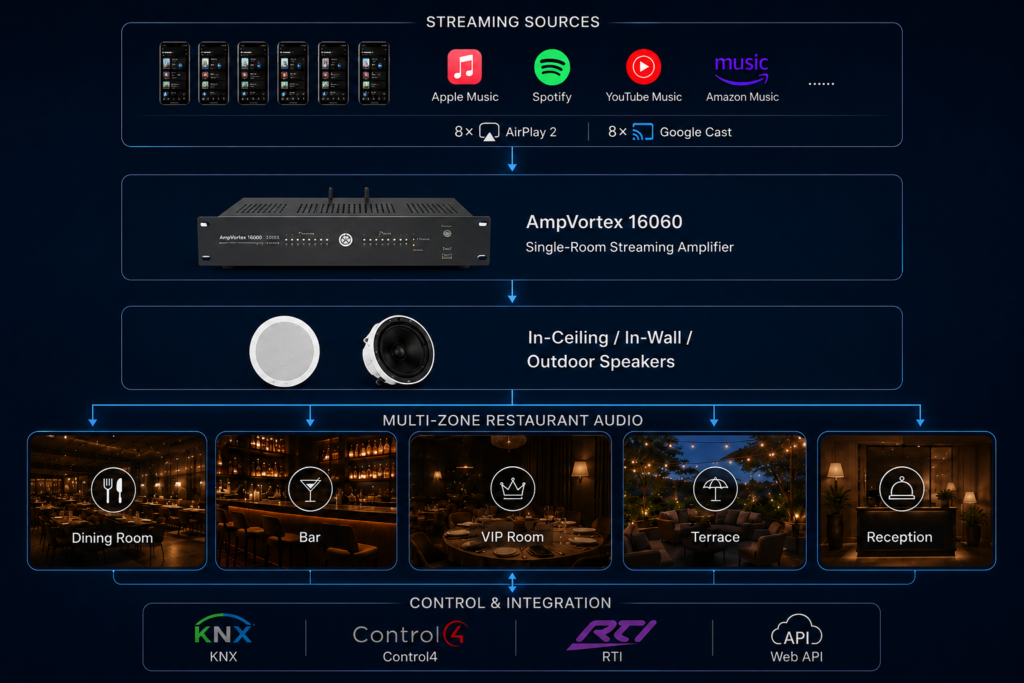
Through integration with KNX, Control4, RTI and Web API, audio can become part of the wider building automation environment rather than remaining an isolated AV system.
A Typical Restaurant Audio Architecture
Consider a restaurant with five zones:
Zone 1 — Reception
Low-level ambient music
Zone 2 — Main Dining Room
Primary restaurant background music
Zone 3 — Bar
Independent source and higher playback level
Zone 4 — Private Dining
Independent music and volume control
Zone 5 — Outdoor Terrace
Scheduled background music
Each zone can have independent volume, DSP, source and scheduling while remaining centrally managed.
This architecture gives restaurant operators flexibility today while making future expansion much easier.
Why AmpVortex?
AmpVortex approaches commercial audio as an integrated platform rather than simply an amplifier.
Instead of combining multiple independent devices for streaming, DSP, routing, amplification and automation, AmpVortex brings these functions together within a unified architecture.
For restaurant and hospitality applications, the platform provides:
- Multi-zone audio distribution
- Native network streaming
- Built-in DSP and audio routing
- 4Ω / 8Ω / 70V / 100V system support
- Commercial music platform integration
- KNX, Control4 and RTI integration
- Open Web API
- Network-based wall and system control
The result is fewer devices, simpler commissioning and a more flexible infrastructure for modern commercial audio.
Building Better Restaurant Audio
A modern restaurant background music system should do more than play music.
It should allow different spaces to operate independently, adapt to changing operating conditions, integrate with building automation and provide restaurant staff with simple, intuitive control.
By combining streaming, DSP, multi-zone routing, commercial amplification and open integration, restaurants can create an audio infrastructure that is easier to operate today and ready to evolve with the venue in the future.
AmpVortex — Open Audio Architecture for Modern Commercial Spaces.
For more information, please visit www.ampvortex.com