(317)516-7460
  service@ampvortex.com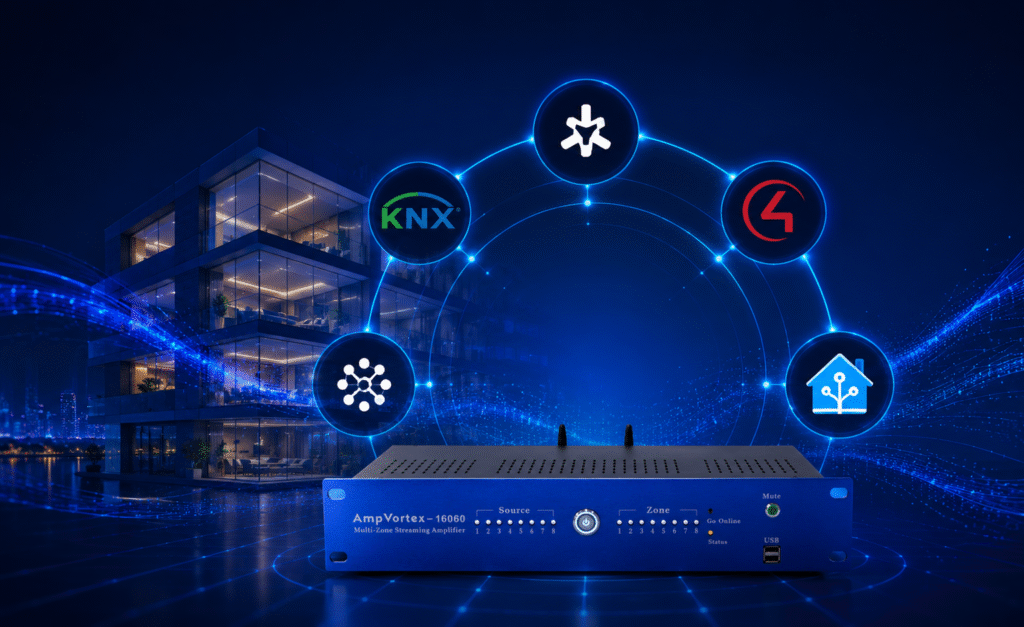
The Automation Journey of AmpVortex One Multi-Room Audio Platform for KNX, Control4, Matter, Home Assistant and Beyond
The smart audio industry is changing rapidly.
In the past, commercial audio systems, smart homes and distributed music systems often existed in separate ecosystems:
- Commercial audio focused on amplification and speaker distribution
- Smart homes focused on lighting, automation and UI control
- Streaming platforms focused on consumer convenience
- DIY systems focused on customization and APIs
But modern projects no longer fit into a single category.
Today’s users expect:
- High-quality multi-room audio
- Native streaming
- Smart automation
- Cross-platform compatibility
- Flexible control methods
- Open integration architecture
This is exactly the philosophy behind the AmpVortex platform.
Rather than forcing users into one ecosystem, AmpVortex is designed as an automation-flexible distributed audio platform capable of adapting to different markets, project types and user preferences.
Different Markets Require Different Automation Ecosystems
One of the biggest realities in the global smart audio market is that automation preferences vary dramatically by region.
There is no single universal control platform.
A smart audio solution successful in Europe may fail in North America, while a platform loved by DIY enthusiasts may be irrelevant to mainstream users.
AmpVortex was designed with this reality in mind.
KNX: The Backbone of European Smart Building Audio
In Europe and many international commercial projects, KNX Association KNX remains one of the most important smart building standards.
KNX is widely used in:
- Luxury villas
- Hotels
- Commercial buildings
- Smart apartments
- Energy-efficient buildings
Unlike consumer-focused ecosystems, KNX emphasizes:
- Reliability
- Long-term infrastructure stability
- Decentralized automation
- Professional integration
For audio systems, this creates unique requirements:
- Zone-based automation
- Scene triggering
- Audio integration with lighting and HVAC
- Centralized building management
AmpVortex was designed with native KNX integration to support these deployment models directly.
This allows integrators to create intelligent building-wide audio experiences without relying on third-party middleware.
Control4, RTI and Crestron: The North American Integration Model
In North America, the smart home industry evolved differently.
Instead of KNX dominance, the market became centered around custom integration ecosystems such as:
- Control4
- RTI
- Crestron
These platforms focus heavily on:
- Unified touch-panel control
- AV integration
- Media room management
- Luxury smart home experiences
In this ecosystem, audio is not treated as an isolated system — it is part of a complete automation environment.
AmpVortex supports integration with these platforms to allow:
- Unified room control
- Source selection
- Scene automation
- Audio routing
- Zone synchronization
This makes the platform suitable for:
- Custom AV integrators
- Smart home installers
- High-end residential projects
- Hospitality suites
Matter: The Future for Apple Home and Google Home Users
The rise of Connectivity Standards Alliance Matter represents a major shift in smart home interoperability.
Consumers increasingly expect devices to work seamlessly across ecosystems such as:
- Apple Home
- Google Home
- Amazon Alexa
For many users, simplicity matters more than deep customization.
They want:
- Easy setup
- Native voice control
- Unified device discovery
- Cross-brand compatibility
Matter is rapidly becoming the bridge between consumer smart homes and professional automation systems.
AmpVortex’s Matter-oriented strategy is designed to support this next-generation interoperability model, enabling distributed audio to become part of the broader connected home ecosystem.
Home Assistant: The Ecosystem for Power Users and Enthusiasts
While mainstream users prioritize simplicity, another group values flexibility above all else.
This is where Home Assistant plays a major role.
Home Assistant has become one of the world’s most influential open smart home platforms because it enables:
- Deep automation customization
- Local-first control
- Advanced scripting
- Cross-platform device integration
- Community-driven innovation
For advanced users, audio automation can go far beyond simple playback:
- Dynamic room-based routing
- Presence-aware music
- Energy-aware automation
- Multi-platform synchronization
- Custom dashboards
AmpVortex integrates naturally into these highly customizable environments, making it attractive for:
- Smart home enthusiasts
- DIY integrators
- Advanced automation users
- Local-control advocates
Native App Control: Simplicity for Everyday Users
Not every user wants advanced automation.
In reality, many residential and commercial users simply want:
- Reliable streaming
- Easy zone selection
- Simple volume control
- Stable playback
For these users, native app control remains the most important interface.
AmpVortex’s app-centric approach provides direct access to:
- Multi-room playback
- Source management
- Streaming services
- Zone grouping
- Basic DSP adjustment
This simplicity is especially important for:
- Families
- Restaurants
- Retail stores
- Small hospitality projects
- Non-technical users
Good automation should not always feel complex.
Sometimes the best experience is simply intuitive.
Web API: Maximum Freedom for Custom Projects
At the highest level of integration, some projects require complete customization.
These projects may include:
- Enterprise control systems
- Hotel platforms
- Custom dashboards
- Proprietary automation environments
- Specialized AV workflows
For these scenarios, open Web API access becomes essential.
AmpVortex’s API-oriented architecture allows developers and integrators to build:
- Custom interfaces
- Advanced scheduling systems
- Cloud integrations
- Proprietary automation workflows
- Cross-platform orchestration
This approach is especially valuable for:
- Large-scale smart building projects
- Enterprise AV integration
- Software-driven automation platforms
- Future-proof system design
One Platform, Multiple Automation Philosophies
What makes modern distributed audio difficult is not amplification.
It is ecosystem fragmentation.
Different regions, installers and users all expect different control experiences.
AmpVortex was designed around the idea that no single automation ecosystem should dominate every project.
Instead, the platform adapts to:
- Professional KNX buildings
- North American CI ecosystems
- Consumer Matter environments
- DIY Home Assistant systems
- Direct app-based usage
- Fully customized API-driven deployments
This flexibility allows the same hardware platform to serve radically different project requirements.
The Future of Distributed Audio Automation
The future of commercial and residential audio is no longer just about sound quality.
It is about integration.
Modern audio platforms increasingly need to function as part of larger intelligent environments that include:
- Lighting
- Climate
- Security
- Occupancy sensing
- Voice assistants
- Building automation
- Cloud services
The automation journey of AmpVortex reflects this transformation.
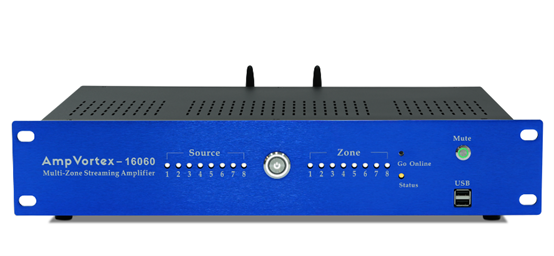
Instead of being only a multi-room amplifier, the platform is evolving into a flexible distributed audio infrastructure layer capable of participating in virtually any modern automation ecosystem.
For more information, please visit www.ampvortex.com