
 (317)516-7460
  service@ampvortex.com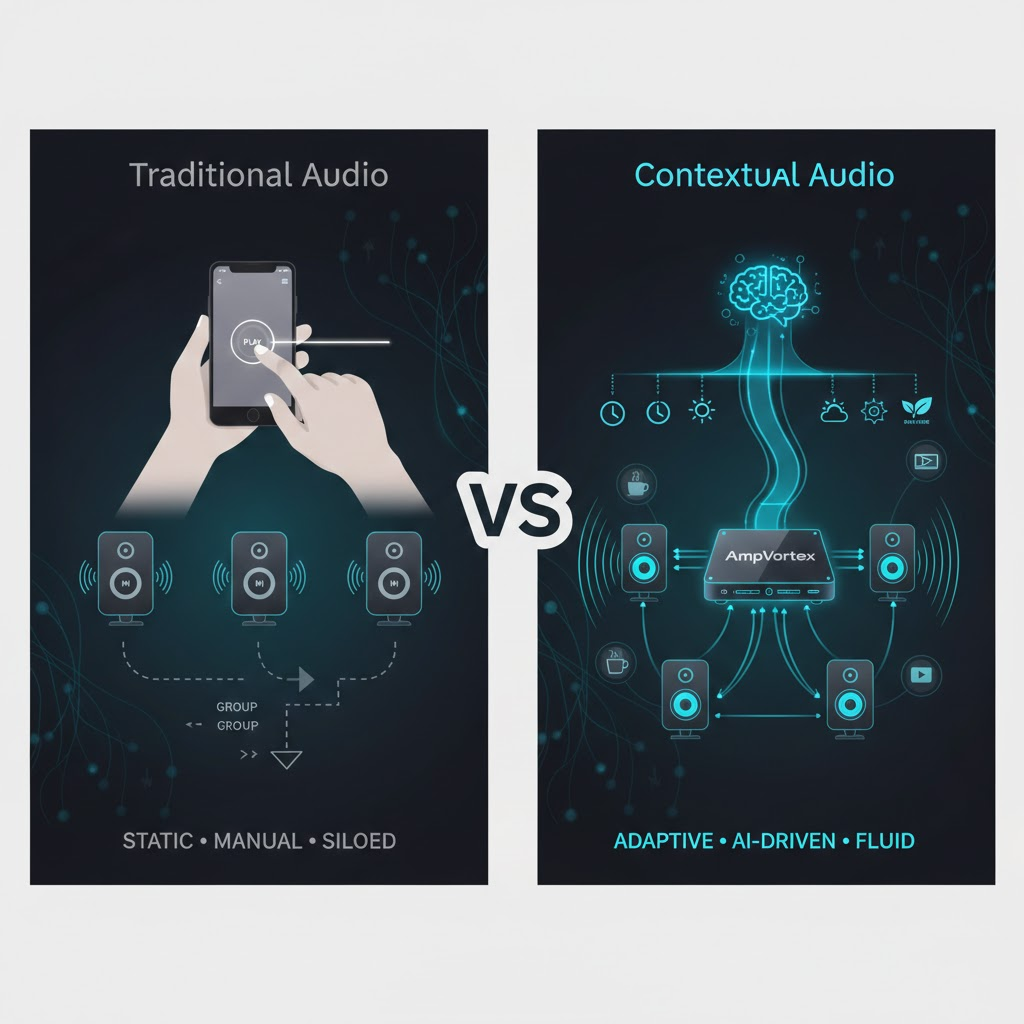
Contextual Audio vs Traditional Multi-Room Audio: Why Intelligent Sound Environments Are the Future
Contextual Audio vs. Traditional Multi-Room Audio
Why the Future of Home Sound Is Context-Aware
Introduction: From Multi-Room to Meaningful Audio
Multi-room audio has become a standard feature in modern homes. The ability to play music in multiple rooms, synchronize playback, and control everything from a phone was once revolutionary.
But as homes grow larger, smarter, and more automated, a limitation becomes clear:
Traditional multi-room audio systems are room-aware, but not context-aware.
Contextual Audio represents the next evolution—one that shifts audio from manual control to environmental intelligence.
Defining the Two Paradigms
Traditional Multi-Room Audio
Traditional multi-room audio systems focus on distribution.
They answer questions like:
- Which rooms should play music?
- Should playback be synchronized?
- Which source is selected?
Control is primarily user-driven and app-centric.
Contextual Audio
Contextual Audio focuses on intent and environment.
It answers deeper questions:
- Why should audio play right now?
- Where does sound matter in this moment?
- How should audio adapt as conditions change?
Control shifts from manual interaction to automation and orchestration.
Core Architectural Differences
| Dimension | Traditional Multi-Room Audio | Contextual Audio |
| Control Model | App-driven, manual | Automation-driven, intent-based |
| Primary Trigger | User interaction | Context (time, presence, scenes) |
| System Awareness | Room-based | Environment-based |
| Audio Behavior | Static once started | Dynamic and adaptive |
| User Experience | Foreground interaction | Ambient, background intelligence |
User Interaction: Command vs. Intent
Traditional Systems
Users must:
- Open an app
- Select rooms
- Group zones
- Adjust volume manually
- Repeat the process when context changes
This works—but does not scale well.
Contextual Audio Systems
Users define rules and intent, such as:
- “Play background music when the kitchen is occupied”
- “Lower volume automatically after 10 PM”
- “Switch to focused audio during work hours”
The system handles execution.
Less control does not mean less power—it means less friction.
Role of Automation
Traditional multi-room audio systems treat automation as optional.
Contextual Audio treats automation as foundational.
| Automation Aspect | Traditional | Contextual |
| Presence-based playback | Rare / Limited | Native |
| Time-based behavior | Basic timers | Rule-based, adaptive |
| Scene integration | Partial | Core design principle |
| Cross-system coordination | Minimal | Expected |
Automation platforms (Home Assistant, Control4, Crestron) act as orchestration layers, not audio engines.
Hardware Requirements: Why Execution Matters
Contextual Audio places higher demands on hardware.
| Requirement | Traditional Systems | Contextual Audio |
| Zone independence | Limited | Essential |
| Reliability under automation | Not guaranteed | Mandatory |
| Latency tolerance | Higher | Lower |
| Power headroom | Moderate | High |
| Control granularity | Basic | Fine-grained |
Consumer-grade wireless speakers are optimized for on-demand playback, not for continuous automated behavior.
Where AmpVortex Fits
AmpVortex multi-room streaming amplifiers are designed for execution under orchestration.
In a contextual audio system:
- Automation platforms decide when audio should change
- System intelligence decides how audio should be structured
- AmpVortex executes those decisions reliably
Key advantages:
- True multi-zone amplification
- Deterministic behavior per zone
- Stable performance under frequent state changes
- Clean integration with automation systems
AmpVortex does not attempt to replace apps or ecosystems—it enables them to work together.
Scalability: From Small Homes to Complex Environments
Traditional multi-room systems work well in:
- Apartments
- Small homes
- Single-use spaces
Contextual Audio scales better to:
- Large homes
- Mixed-use spaces
- Commercial environments
- Automation-heavy installations
As system complexity increases, context becomes more important than control interfaces.
Future-Proofing Audio Systems
Traditional systems age quickly because they rely on:
- Fixed apps
- Fixed ecosystems
- Fixed interaction models
Contextual Audio systems age more gracefully:
- Content platforms can change
- Protocols can evolve
- Automation logic can expand
- Hardware remains relevant
This layered approach reduces lock-in and increases longevity.
Summary Comparison
| Category | Traditional Multi-Room | Contextual Audio |
| Core Philosophy | Distribution | Adaptation |
| Control Style | Manual | Intent-based |
| Automation | Optional | Essential |
| User Effort | High | Low |
| Hardware Role | Playback device | Execution platform |
| Long-term Flexibility | Limited | High |
Conclusion: From Playing Music to Designing Sound
Traditional multi-room audio solved the problem of where music plays.
Contextual Audio solves the problem of when, why, and how sound belongs in an environment.
As homes evolve into intelligent systems, audio must evolve with them—away from apps and toward architecture.
AmpVortex fits this future not by controlling the experience, but by executing it correctly.
In contextual audio environments, that distinction makes all the difference.