(317)516-7460
 service@ampvortex.com
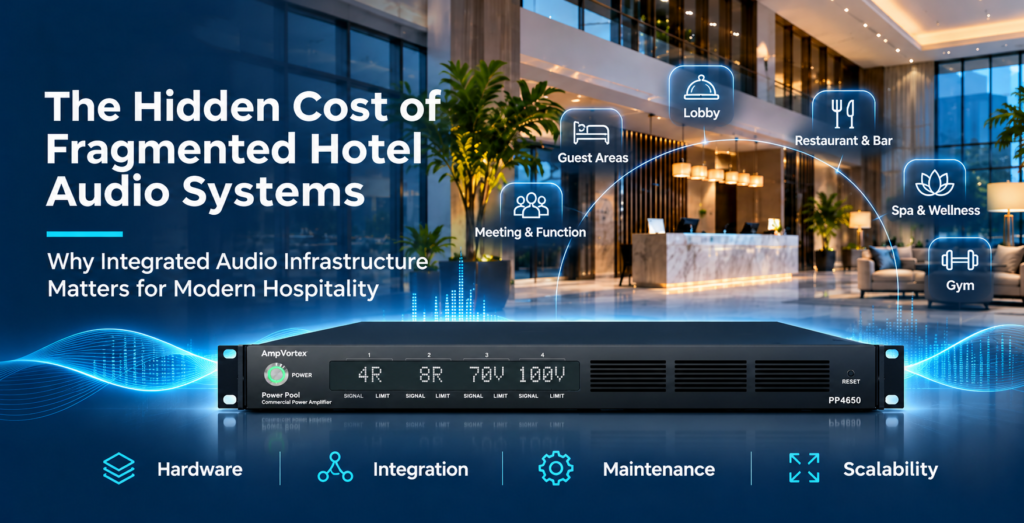
The Hidden Cost of Fragmented Hotel Audio Systems
Why Hotels Should Look Beyond the Price of Individual Audio Components
When hotels evaluate an audio system, the conversation often starts with hardware.
How much does the amplifier cost? How many channels are required? Which DSP should be used? What streaming player should be specified?
These are important questions. But they do not necessarily reveal the true cost of the audio system over its lifetime.
For hotels, audio is rarely a single-room application. Music may be required across the lobby, restaurants, bars, spa, gym, pool, retail areas, meeting spaces and other public areas — often with different content, schedules, volume levels and control requirements.
As the number of spaces increases, a collection of individual audio products can gradually become a fragmented technology system.
The more relevant question therefore becomes:
What does the complete audio platform cost to install, integrate, operate, maintain and expand over time?
That is where Total Cost of Ownership, or TCO, becomes important.
Purchase Price Is Only One Part of the Cost
A traditional commercial audio architecture may involve multiple independent components:
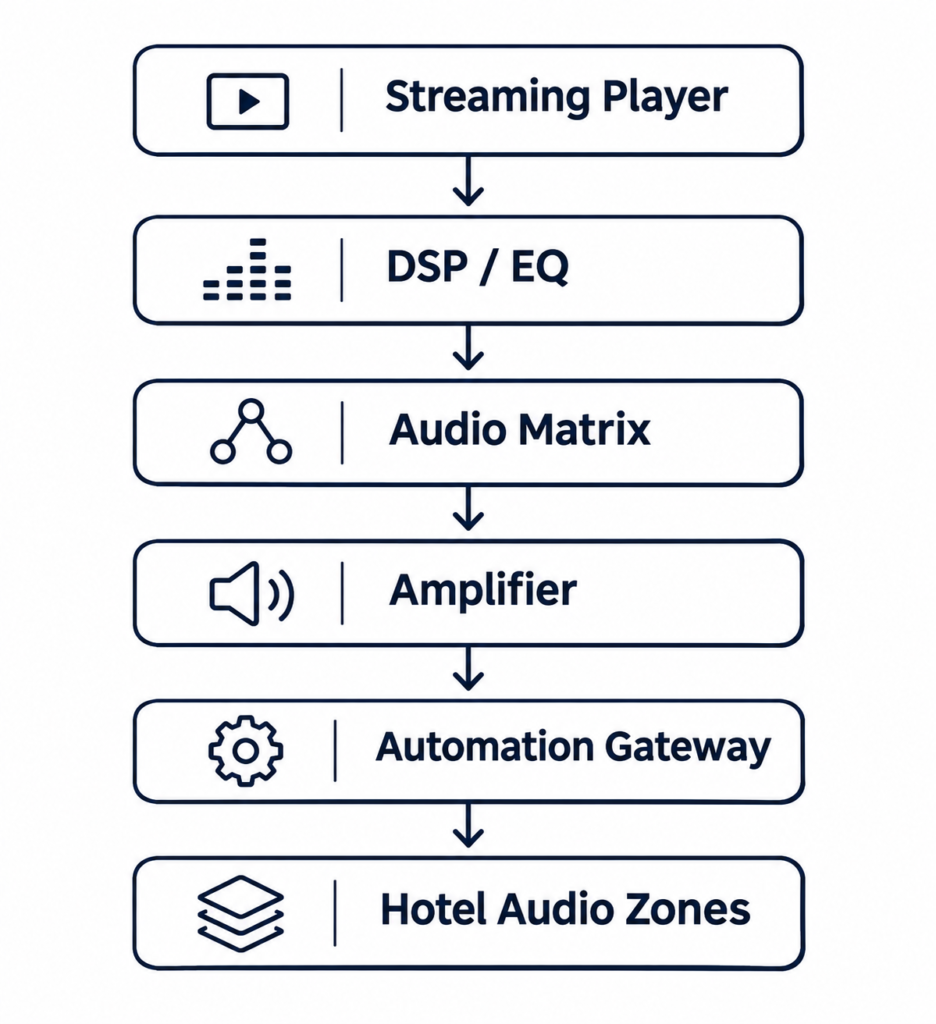
Each component may be perfectly capable on its own.
The complexity appears when these products must operate as one system.
Different devices may require different configuration software, network connections, control protocols and integration work. A change to one part of the system can affect another. When something goes wrong, the integrator may need to determine whether the problem originates in the streaming device, DSP, matrix, amplifier, network or automation layer.
The purchase price of each box therefore represents only part of the investment.
Hotels and integrators should also consider:
- installation and commissioning time;
- system integration and programming;
- additional cabling and rack space;
- network and control dependencies;
- troubleshooting and maintenance;
- software and firmware management;
- future expansion and system changes;
- coordination between different technology vendors.
A system that appears less expensive on a component-by-component basis may not necessarily remain the lower-cost solution throughout its operating life.
More Devices Mean More Integration Points
Every additional component introduces another connection — and potentially another point that must be configured, documented, maintained and diagnosed.
Consider a hotel that needs independent music across several areas.
The streaming source must communicate with the DSP. The DSP must route audio through the matrix. The matrix must feed the correct amplifier channels. The automation system must then control volume, mute, source selection and other functions across those devices.
This architecture can work well.
But it also creates multiple integration points.
And every integration point introduces a question:
Who is responsible when it stops working?
The answer becomes particularly important in hospitality, where operational teams should not need to understand the architecture behind the music simply to keep a restaurant, lobby or spa operating normally.
The objective should therefore not be to eliminate specialist technology.
It should be to eliminate unnecessary complexity.
From Separate Components to an Integrated Audio Platform
A different approach is to bring more of the audio chain into one coordinated platform.
Instead of:
Streaming + DSP + Matrix + Amplifier + Automation Gateway
an integrated platform can combine:
Streaming
DSP / EQ
Audio Matrix
Amplification
Zone Control
API / Automation Integration
within a common architecture.
For the hotel, this can mean fewer devices to deploy and maintain.
For the system integrator, it can mean fewer interfaces to configure and fewer dependencies to troubleshoot.
For the consultant, it can provide a more standardized architecture that can be repeated across different areas — or potentially across multiple properties.
The value is therefore not simply that one product performs more functions.
The real value is that the overall system becomes simpler.
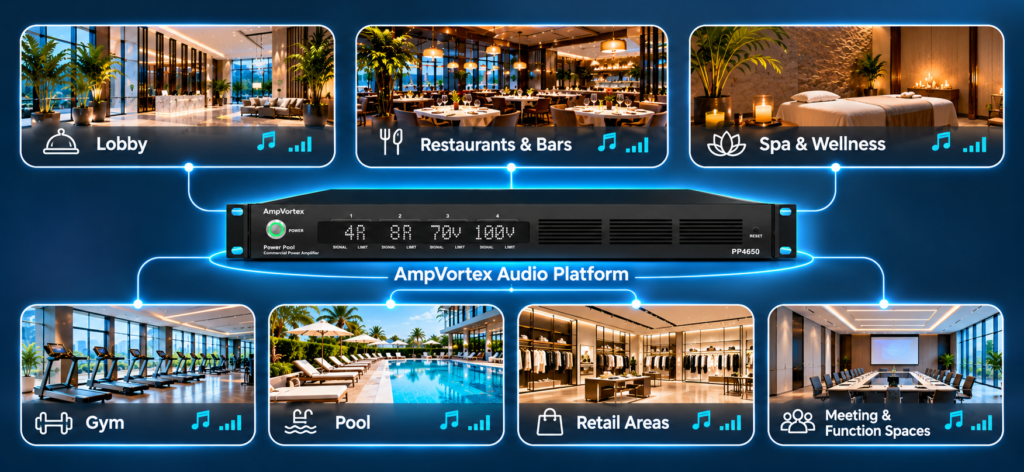
Different Hotel Spaces Still Need Different Audio
Integration should not mean forcing every area of a hotel into the same configuration.
A lobby has different requirements from a restaurant.
A spa has different requirements from a pool area.
A meeting space may require very different power, routing and control from background music in a corridor.
An integrated audio platform should therefore provide a common infrastructure while still allowing each zone to operate independently.
That may include:
Different music in different spaces
Independent volume control
Independent source selection
Zone grouping when required
DSP and EQ optimized for each space
Scheduled or automated operation
Integration with hotel or building control systems
This balance between standardization and flexibility is particularly important for larger properties.
The Operational Cost of Troubleshooting
System complexity becomes most visible when something fails.
Imagine that music stops in a hotel restaurant.
With a fragmented architecture, the problem could involve:
the streaming player,
the network,
the DSP,
the matrix,
the automation gateway,
the amplifier,
or the connection between any two of them.
Hotel staff may contact the integrator. The integrator may then need to access several products or coordinate with several manufacturers before identifying the cause.
Even when the hardware failure itself is inexpensive, the operational cost can be much greater.
Time is spent diagnosing the problem.
Engineers may need to revisit the property.
Hotel staff become involved.
And the affected guest space may operate without the intended audio experience while the issue is being resolved.
Reducing unnecessary system layers can therefore reduce more than hardware cost.
It can reduce the cost of complexity itself.
Think Beyond Installation Day
Hotel technology should not be designed only for opening day.
Properties change.
Restaurants are renovated. New spaces are added. Music services change. Automation platforms evolve. Hotel groups introduce new technology standards.
An audio architecture should therefore be evaluated not only by what it can do today, but also by how easily it can adapt tomorrow.
Questions worth asking include:
Can additional zones be added without redesigning the entire system?
Can different music services be introduced?
Can the audio platform integrate with existing or future automation systems?
Can configurations be managed and updated efficiently?
Can the same architecture be standardized across multiple properties?
These questions increasingly matter when hotel groups move from individual projects toward portfolio-wide technology strategies.
A Practical TCO Question for Hotel Audio
Before comparing two audio proposals, hotels and consultants can ask a simple question:
How many separate products, interfaces and integration points are required to deliver the complete result?
Then look beyond the equipment list.
Consider:
Hardware Cost
Installation
Programming & Integration
Commissioning
Maintenance
Troubleshooting
Future Expansion
=
Total Cost of Ownership
This does not mean that the architecture with the fewest products will always be the best.
It means that system complexity should have a clear reason to exist.
If two architectures deliver the required performance, but one requires significantly fewer devices, interfaces and integration dependencies, that difference deserves to be included in the commercial evaluation.
AmpVortex: An Integrated Approach to Hotel Audio
AmpVortex is developing its commercial audio platform around this principle.
Solutions such as the AmpVortex PP4650 combine network streaming, DSP and EQ, audio matrix functionality, amplification and automation capabilities within an integrated architecture.
For hotel applications, this approach can support independent audio across spaces such as:
Lobby
Restaurants & Bars
Spa & Wellness
Gym
Pool
Retail Areas
Meeting & Function Spaces
Each area can maintain its own audio requirements while remaining part of a common platform.
The objective is not simply to put more features into an amplifier.
It is to reduce the number of separate systems required to create, control and maintain a complete hotel audio environment.
Fewer Integration Points. One Connected Audio Platform.
The future of hotel technology is increasingly connected.
As networks, automation, guest technology and building systems become more integrated, audio should not remain an isolated collection of boxes.
Hotels should evaluate audio infrastructure the same way they increasingly evaluate other technology investments:
not only by the purchase price,
but by how easily the system can be deployed, integrated, operated, supported and evolved over its entire lifecycle.
For hotel owners, operators, consultants and system integrators, that shift in perspective can reveal costs that are often invisible on a traditional equipment quotation.
The question is no longer simply: “How much does the amplifier cost?”
It is:
“How much complexity does the complete audio system require us to own?”
And sometimes, the most effective way to reduce Total Cost of Ownership is simply to reduce the number of moving parts.
AmpVortex — Integrated Audio Infrastructure for Modern Hospitality.
Learn more at www.ampvortex.com.