(317)516-7460
 service@ampvortex.com
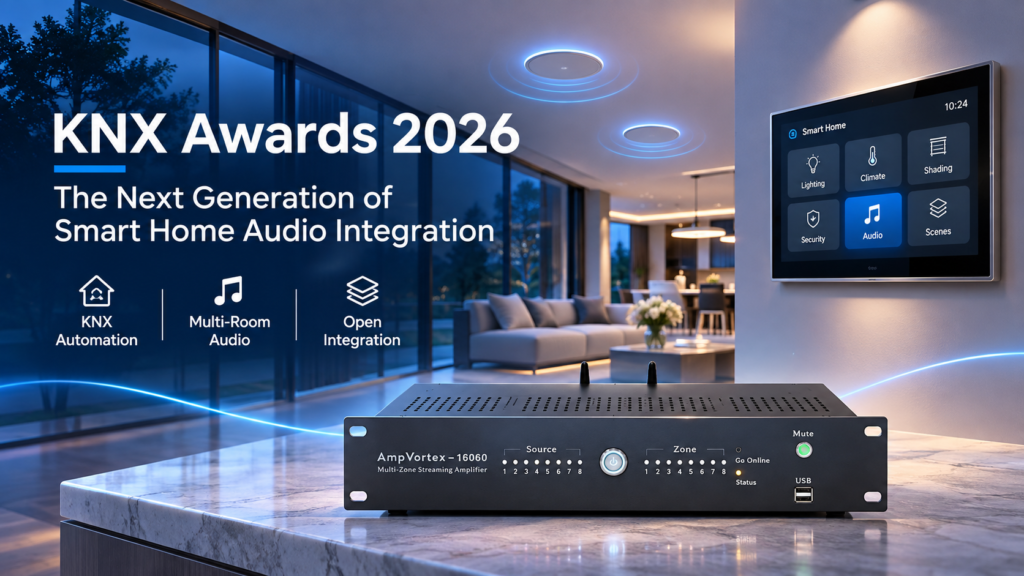
KNX Awards 2026: Why KNX Audio Integration Matters in the Next Generation of Smart Homes
From intelligent building automation to integrated multi-room audio — exploring how connected audio can become an essential part of the KNX smart home ecosystem.
The KNX Awards 2026, organized by the KNX Association, once again highlighted the innovation and technical achievements shaping the future of smart homes and buildings.
Among this year’s winners, NEXhome – Shanghai ITG & CRCC City Park, developed by NEXhome Smart Technologies Co., Ltd. in China, received the Smart Home Award – Asia.
The project demonstrates how KNX can serve as the foundation for large-scale residential developments, integrating lighting, shading, HVAC, floor heating, fresh air and security into a connected smart home environment. Its 15.6-inch NEXhome EdgePad S also brings centralized control and AI-based scenario management into the residential experience.
Another interesting aspect of the project is its broader application scope, which includes audio and video control according to the KNX project documentation.
This reflects an important development in the smart home industry: building automation is no longer limited to lighting, climate and shading. Entertainment and multi-room audio are also becoming part of the connected living experience.
But how can professional multi-room streaming audio be integrated into a KNX-based smart home without creating another isolated control system?
This is where KNX Audio Integration becomes particularly important.
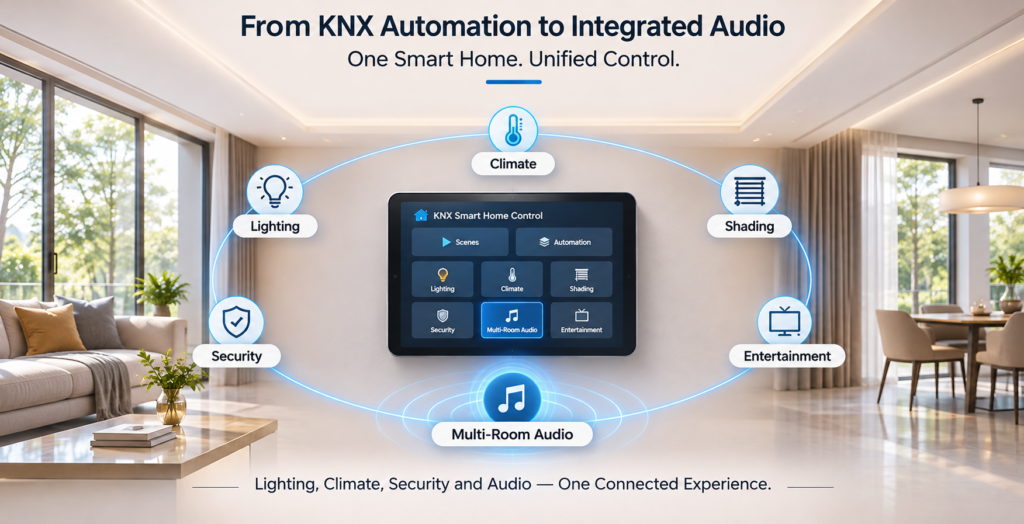
1. From KNX Automation to Integrated Audio
Modern smart homes increasingly rely on a unified control experience. Residents expect lighting, climate, shading, security and entertainment systems to work together seamlessly.
Audio should be no exception.
A properly integrated multi-room audio platform allows homeowners to control music across different rooms through their existing smart home interfaces, while retaining the specialized streaming, DSP, routing and amplification capabilities of a dedicated audio system.
At AmpVortex, we believe that open integration between KNX and professional multi-room audio is an important step toward more complete smart home ecosystems.
With KNX integration, homeowners can:
- Control music playback directly from their smart home control interface.
- Adjust volume independently in different rooms.
- Mute or unmute individual audio zones.
- Select music sources and manage playback.
- Group multiple rooms for synchronized music.
- Display music information, including artist, album and track metadata.
Instead of switching between separate applications and control interfaces, residents can manage their audio experience through the same smart home environment.
For system integrators, this also creates a more consistent installation and commissioning experience.
2. Understanding the Relationship Between KNX and Multi-Room Audio
KNX and multi-room audio serve different but complementary purposes.
KNX provides the building automation infrastructure, while a dedicated audio platform manages music streaming, audio processing, amplification and distribution.
A typical integrated architecture can be divided into three layers.
Layer 1 – KNX Smart Home Infrastructure
The KNX system manages:
- Lighting and scene control
- HVAC and climate management
- Blinds and shading
- Security and access control
- User interfaces and touch panels
- Automation and scheduled operations
Layer 2 – Audio Platform
A dedicated multi-room audio platform provides:
- Independent music streaming across multiple zones
- Multiple streaming technologies
- DSP and equalization
- Audio matrix routing
- Multi-channel amplification
- Zone grouping and volume management
Layer 3 – Integration and Control
Communication between the two systems allows KNX interfaces and automation logic to interact with the audio platform.
Depending on the integration capabilities, this can include:
- Zone power and mute control
- Volume adjustment
- Source selection
- Playback control
- Group management
- Music metadata and status feedback
This architecture allows each system to perform its specialized functions while providing a unified user experience.
3. Native KNX Integration vs. Gateway-Based Integration
One important consideration when selecting an audio platform is how it communicates with the KNX infrastructure.
There are different approaches to achieving integration.
Gateway-Based Integration
Some audio products require an additional gateway, controller or custom interface to communicate with KNX.
This can introduce additional hardware, configuration steps and potential maintenance requirements.
Native KNXnet/IP Integration
An audio platform with native KNXnet/IP support can communicate with a KNX installation through compatible KNX IP infrastructure, without requiring an additional third-party protocol conversion gateway.
This approach can simplify system architecture and reduce integration complexity.
For system integrators, the ability to configure audio control through documented KNX communication objects and parameters is particularly valuable.
The exact functionality depends on the audio platform’s supported KNX objects and integration implementation.
4. AmpVortex: Multi-Room Audio Designed for Smart Building Integration
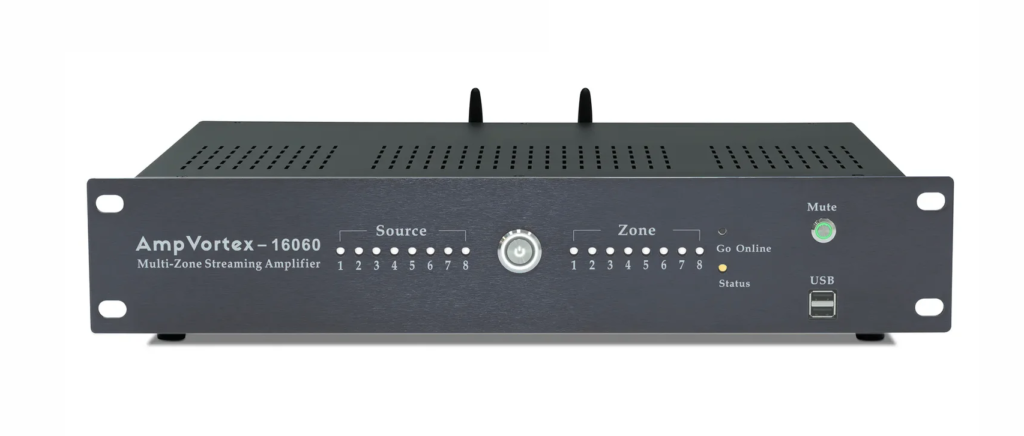
At AmpVortex, we develop professional multi-room streaming audio platforms designed for residential and commercial integration projects.
Our approach combines streaming, DSP, matrix routing, amplification and automation integration within a centralized audio platform.
Native KNXnet/IP Integration
AmpVortex supports native KNXnet/IP communication, enabling integration with KNX-based smart home and building automation systems.
Integration parameters and KNX group addresses can be configured using ETS6, allowing system integrators to incorporate audio control into their existing KNX projects.
Supported control and feedback functions include:
- Zone volume control
- Mute and unmute
- Source selection
- Zone status
- Playback control
- Music metadata, including title, artist and album information
The available functions depend on the specific integration and supported firmware.
Flexible Multi-Room Streaming
AmpVortex multi-zone platforms support multiple independent streaming sessions, allowing different rooms to enjoy different music simultaneously.
Supported streaming technologies include:
- AirPlay 2
- Spotify Connect
- Google Cast on supported models
- Qobuz Connect
- DLNA and Bluetooth
This gives homeowners greater flexibility in choosing their preferred music services and streaming methods.
Centralized Audio Distribution
Instead of deploying separate streaming amplifiers in every room, centralized multi-zone amplification provides a more organized architecture for larger residential installations.
The platform combines:
- Multi-zone amplification
- DSP and equalization
- Audio matrix routing
- Independent zone control
- Centralized system management
For commercial applications, AmpVortex also offers solutions supporting 70V/100V distributed speaker systems.
Open Integration Ecosystem
In addition to KNX, AmpVortex supports integration with:
- Control4
- Home Assistant
- RTI
- Crestron
- Web API
This allows system integrators to incorporate audio into different automation environments according to project requirements.
5. Making Multi-Room Audio Easier to Deploy
For large residential developments, installation efficiency and commissioning complexity are important considerations.
A well-designed audio platform should provide:
- Centralized configuration
- Clearly defined zone assignments
- Consistent network communication
- Flexible audio routing
- Documented integration interfaces
- Straightforward commissioning procedures
These capabilities can help system integrators standardize audio deployment across multiple residential units.
When combined with an open KNX infrastructure, a dedicated multi-room audio platform can become a natural extension of the overall smart home solution.
6. Building a More Connected Smart Home Ecosystem
The KNX Awards 2026 demonstrate the continuing evolution of intelligent homes and buildings.
Projects such as NEXhome – Shanghai ITG & CRCC City Park illustrate how KNX-based infrastructure can support increasingly sophisticated residential environments, while integrating different technologies and services.
Audio is an important part of this evolution.
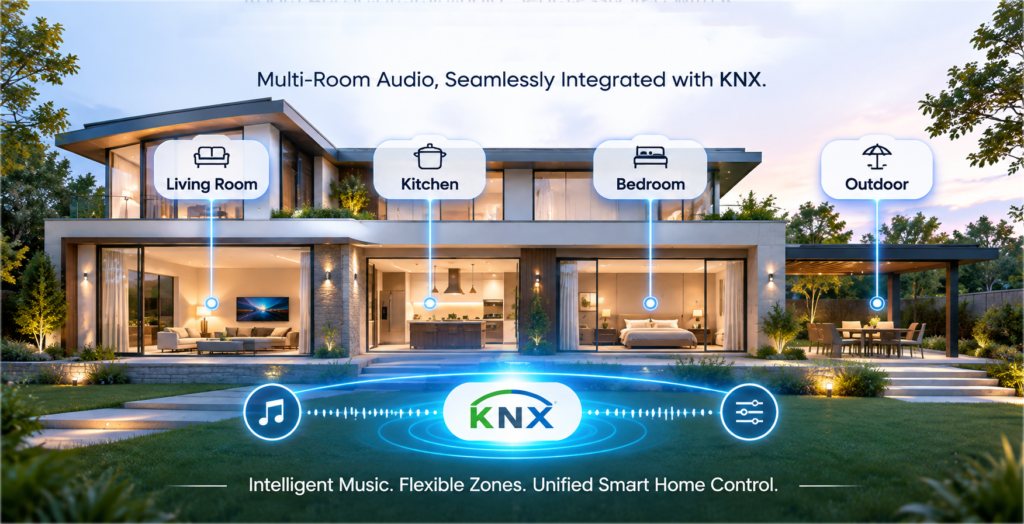
From background music in the kitchen to synchronized playback across living spaces, a properly integrated multi-room audio platform can extend the smart home experience beyond traditional building automation.
At AmpVortex, we believe the future of smart homes is not simply about connecting more devices. It is about making different systems work together through open integration, flexible control and a consistent user experience.
One smart home. One connected experience. Including audio.
Learn More About AmpVortex
Explore our multi-room streaming audio platforms and discover how native KNXnet/IP integration can bring professional audio distribution into modern smart homes and buildings.
Website: https://www.ampvortex.com/