(317)516-7460
 service@ampvortex.com
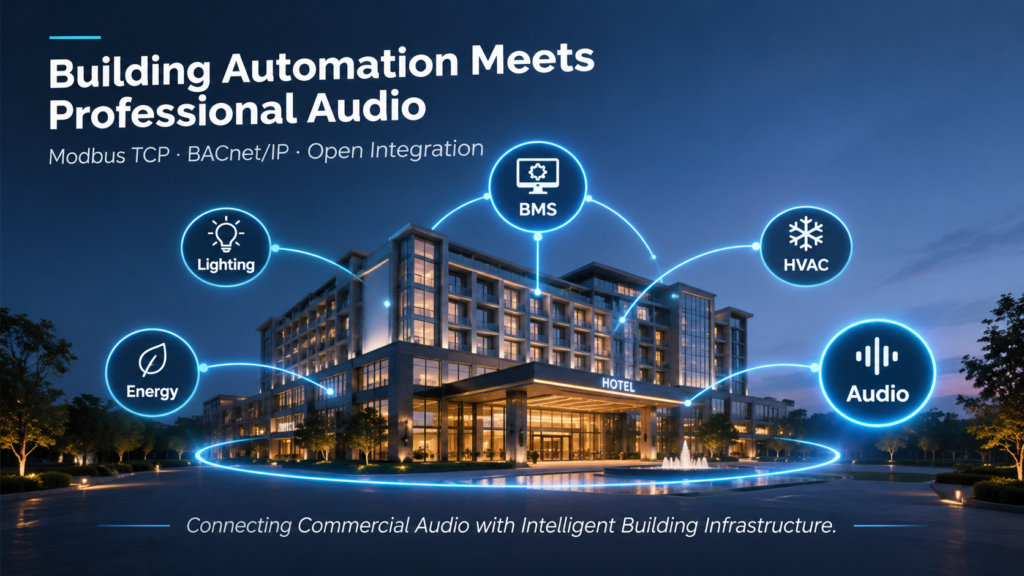
Integrating Commercial Audio with Building Management Systems: Modbus TCP vs. BACnet/IP
How standardized building automation protocols can connect professional audio systems with hotel management, commercial building controls, and centralized BMS platforms.
Modern commercial buildings rely on increasingly interconnected technologies. Lighting, HVAC, energy management, security, and other building services are often coordinated through centralized Building Management Systems (BMS).
Yet professional audio systems frequently operate as independent installations, managed through dedicated applications, wall controllers, or proprietary interfaces.
As hotels, offices, retail facilities, and mixed-use developments move toward more integrated building infrastructure, a practical question emerges:
Why should commercial audio remain separate from the systems that manage the rest of the building?
Two established communication protocols, Modbus TCP and BACnet/IP, offer different approaches to connecting professional audio equipment with building automation platforms.
Understanding their differences can help system integrators and building operators select the most appropriate integration strategy.
Why Commercial Audio Needs BMS Integration
Background music is an essential part of many commercial environments, but its operation is often closely connected to building activities.
Consider a hotel with multiple audio zones:
- The lobby requires background music throughout the day.
- Restaurants operate according to breakfast, lunch, and dinner schedules.
- Meeting rooms require independent audio control.
- Fitness centers and recreational areas follow different operating hours.
- Public areas may need centralized volume adjustments or temporary muting.
Traditionally, these functions might be managed through a separate audio control platform.
With BMS integration, compatible audio systems can become part of broader building automation workflows.
For example, a building controller could activate background music when a restaurant opens, adjust volume levels according to predefined operating schedules, or mute selected zones during a building-wide announcement.
The result is a more coordinated operating environment, with fewer independent control procedures.
What Is Modbus TCP?
Modbus is one of the most widely established communication protocols in industrial automation and equipment control.
Originally developed for industrial controllers, Modbus is now commonly used in building automation, energy monitoring, HVAC equipment, and other connected infrastructure.
Modbus TCP extends Modbus communication over standard Ethernet networks using TCP/IP.
Its operation is relatively straightforward.
A Modbus TCP client, such as a building controller or automation gateway, communicates with a Modbus TCP server, such as a compatible audio amplifier.
The client reads or writes registers that represent specific device functions.
For a commercial audio system, these registers could represent:
- Audio zone power status
- Volume levels
- Mute status
- Input source selection
- Device operating status
- Supported fault indicators
For example, a designated holding register might represent the volume level of Zone 1. A building controller could write a new value to that register to adjust the output level.
The exact register addresses, supported functions, and value ranges are defined by the equipment manufacturer.
Advantages of Modbus TCP
1. Straightforward Implementation
Its register-based communication model makes Modbus TCP relatively easy to implement in embedded devices and automation controllers.
2. Broad Controller Compatibility
Many industrial controllers, building gateways, and automation platforms support Modbus TCP.
3. Efficient Basic Control
Modbus TCP is well suited to simple functions such as volume adjustment, muting, source selection, and status monitoring.
4. Ethernet Connectivity
Unlike Modbus RTU, which commonly uses serial communication over RS485, Modbus TCP operates over an IP network without requiring a dedicated serial interface.
Limitations of Modbus TCP
Modbus TCP does not provide a standardized semantic model specifically for audio equipment.
A building controller must understand the manufacturer’s register map to interpret and control each function.
It also does not provide native device discovery or event subscriptions comparable to those available in BACnet.
Consequently, Modbus TCP is particularly attractive when straightforward equipment control is the primary requirement.
What Is BACnet/IP?
BACnet, short for Building Automation and Control Networks, is a communication standard developed specifically for building automation.
It is widely used in HVAC, building supervision, energy management, and other commercial building applications.
BACnet/IP enables BACnet communication over IP networks.
Unlike Modbus TCP, which primarily exchanges register values, BACnet uses a structured object-oriented data model.
A BACnet device exposes objects representing functions, values, and operating states.
For commercial audio equipment, potential BACnet objects could include:
- Binary Value:Zone mute or enable status
- Analog Value:Zone volume level
- Multi-state Value:Audio source selection
- Binary Input:Supported equipment alarm or fault status
- Analog Input:Available device monitoring measurements
These are illustrative mappings. Actual implementations depend on the device’s supported BACnet object types and application requirements.
Advantages of BACnet/IP
1. Designed for Building Automation
BACnet provides standardized mechanisms for representing and accessing building equipment information.
2. Device Discovery
Compatible BACnet devices can announce themselves and respond to discovery requests, simplifying initial identification within a building automation network.
3. Structured Data Representation
BACnet objects and properties provide a more descriptive interface than a collection of manufacturer-specific numerical registers.
4. Change-of-Value Notifications
Where supported, BACnet Change of Value (COV) services allow building controllers to receive updates when monitored values change, reducing the need for repeated polling.
5. Building Management Integration
BACnet is widely supported by professional BMS platforms, making it particularly relevant to large commercial buildings and hotel infrastructure.
Limitations of BACnet/IP
BACnet implementations are generally more complex than Modbus TCP.
Developers must define device objects, properties, supported services, communication behavior, and interoperability requirements.
BACnet/IP compatibility also does not automatically guarantee seamless integration with every BMS platform.
Successful deployment depends on supported services, device profiles, network configuration, and interoperability testing.
Modbus TCP vs. BACnet/IP: Key Differences
Both protocols can support commercial audio integration, but their architectures and typical applications differ.
|
Feature |
Modbus TCP |
BACnet/IP |
|
Primary origin |
Industrial automation |
Building automation |
|
Network transport |
TCP/IP |
Typically UDP/IP |
|
Data model |
Registers and coils |
Objects and properties |
|
Device discovery |
Not native |
Supported |
|
Event-based value updates |
Typically polling |
COV supported where implemented |
|
Integration complexity |
Relatively low |
Moderate to high |
|
Typical applications |
Equipment control, PLCs, gateways |
BMS, HVAC, commercial buildings |
|
Audio control suitability |
Excellent for basic controls |
Strong for structured BMS integration |
Neither protocol is universally superior.
The appropriate choice depends on the existing building infrastructure, required functions, and integration expectations.
Practical Applications in Hotels and Commercial Buildings
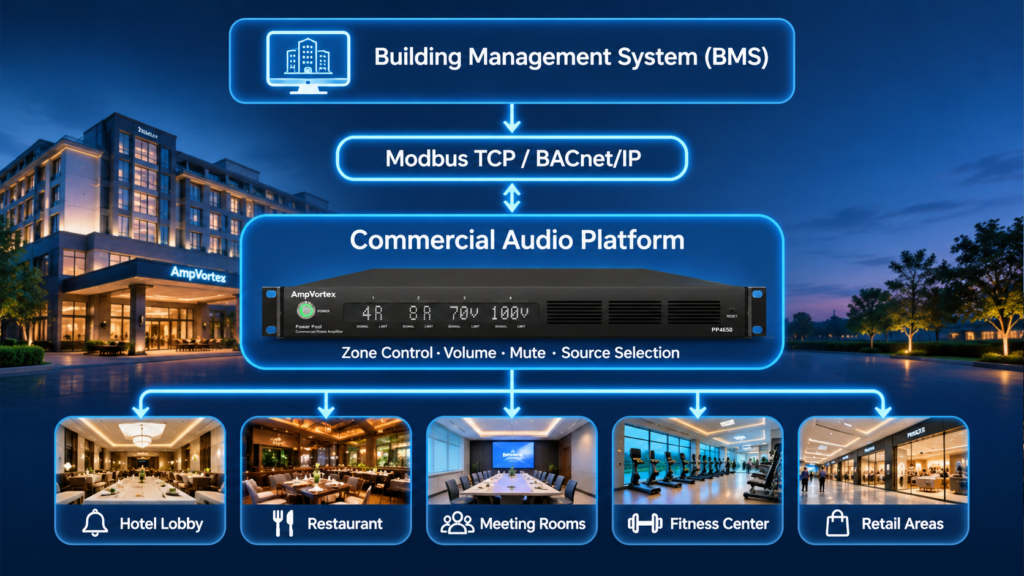
1. Hotel Background Music Automation
Hotels often operate multiple audio zones with different schedules.
A BMS-connected audio system could allow the building controller to coordinate music operation across lobbies, restaurants, lounges, and recreational areas.
For example, a restaurant’s background music could be enabled automatically at opening time and muted after closing.
2. Centralized Commercial Building Control
In office buildings and mixed-use developments, facility operators may need to supervise audio across multiple floors or shared areas.
Integrating compatible amplifiers into the BMS could provide centralized access to volume, mute, source selection, and operating status.
3. Retail and Shopping Centers
Retail facilities often require consistent background music across public areas while maintaining independent control of individual zones.
Modbus TCP or BACnet/IP integration could allow audio settings to follow predefined operating schedules or building automation scenarios.
4. Conference and Event Facilities
Meeting rooms, conference centers, and event spaces frequently require flexible audio configurations.
Building automation integration can help coordinate basic audio settings with room operating modes, occupancy information, or scheduled events.
For more complex audio routing, mixing, and playback functions, dedicated audio control interfaces may still be necessary.
5. Equipment Monitoring and Maintenance
Where an amplifier exposes relevant diagnostic information, a BMS can potentially monitor equipment availability, fault conditions, or other operating parameters.
This can help facility teams identify problems without accessing a separate audio management interface.
However, monitoring capabilities depend on the actual diagnostic data supported by the equipment.
Modbus TCP, BACnet/IP, and KNX: Different Roles in Building Automation
Modbus TCP and BACnet/IP are not the only protocols relevant to integrated commercial audio.
KNX is another important standard, particularly in smart buildings, hospitality projects, and room automation.
These technologies often serve complementary purposes.
KNX is commonly used for room-level automation, including lighting, shading, HVAC, and user control interfaces.
Modbus TCP is frequently used for straightforward equipment-level communication between controllers and connected devices.
BACnet/IP is particularly relevant to building-level management and supervision.
In a hotel, KNX might manage individual guestroom functions, while BACnet/IP connects central building systems to a BMS. Modbus TCP may provide additional communication with equipment controllers or automation gateways.
The actual architecture varies by project, and these protocols can overlap in their capabilities.
For audio manufacturers, supporting multiple integration methods can provide greater flexibility across different building environments.
Why Open Integration Matters for Commercial Audio
Commercial audio equipment often remains installed for many years.
During that time, building management platforms, automation controllers, and operational requirements may change.
A system that depends entirely on one proprietary control interface can become difficult to integrate with future infrastructure.
Open and documented communication interfaces help address this challenge.
For commercial audio systems, an effective integration strategy may include:
- Standard building automation protocols for basic control and monitoring
- Web APIs for more advanced audio functions
- Native automation integrations where appropriate
- Local network control to reduce unnecessary dependence on external cloud services
These approaches are complementary rather than mutually exclusive.
For example, BACnet/IP could provide centralized volume and mute control through a BMS, while a Web API handles more advanced functions such as playback management, metadata retrieval, or audio configuration.
The objective is not to replace dedicated audio management software, but to make professional audio easier to incorporate into the broader building environment.
AmpVortex PP Series: Moving Toward Broader Building Integration
AmpVortex develops professional multi-zone audio solutions for commercial and hospitality applications.
The AmpVortex PP Series includes professional amplifiers designed for installations requiring flexible amplification, audio processing, and system integration.
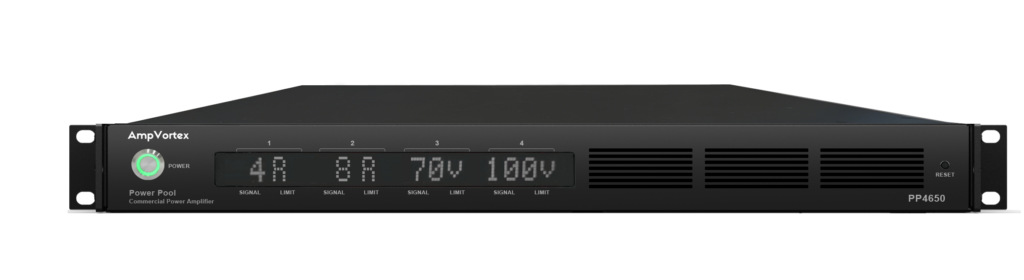
The PP4650 combines streaming capabilities, DSP processing, audio matrix functionality, amplification, and automation features within an integrated platform.
As part of its commercial audio development roadmap, AmpVortex is exploring Modbus TCP and BACnet/IP integration to extend compatibility with building management and automation environments.
The objective is to enable supported audio functions to be accessed through standardized building control interfaces, complementing existing audio management capabilities.
Planned integration areas include zone control, volume adjustment, mute management, source selection, and relevant device status information.
Supported models, final functionality, and availability will be confirmed following development and interoperability validation.
Conclusion: Making Audio Part of the Connected Building
As commercial buildings become more integrated, professional audio should no longer be treated as an isolated subsystem.
Modbus TCP offers a practical, straightforward approach to equipment-level control, while BACnet/IP provides a structured framework designed for building automation and centralized supervision.
Both can play valuable roles in connecting commercial audio with modern BMS infrastructure.
For hotels, offices, retail developments, and other commercial facilities, the goal is not simply to add another communication protocol.
It is to create an audio infrastructure that can operate more naturally alongside the rest of the building.
Open Integration. Centralized Control. Long-Term Flexibility.
To discuss commercial audio integration requirements for your next project, visit www.ampvortex.com