(317)516-7460
  service@ampvortex.com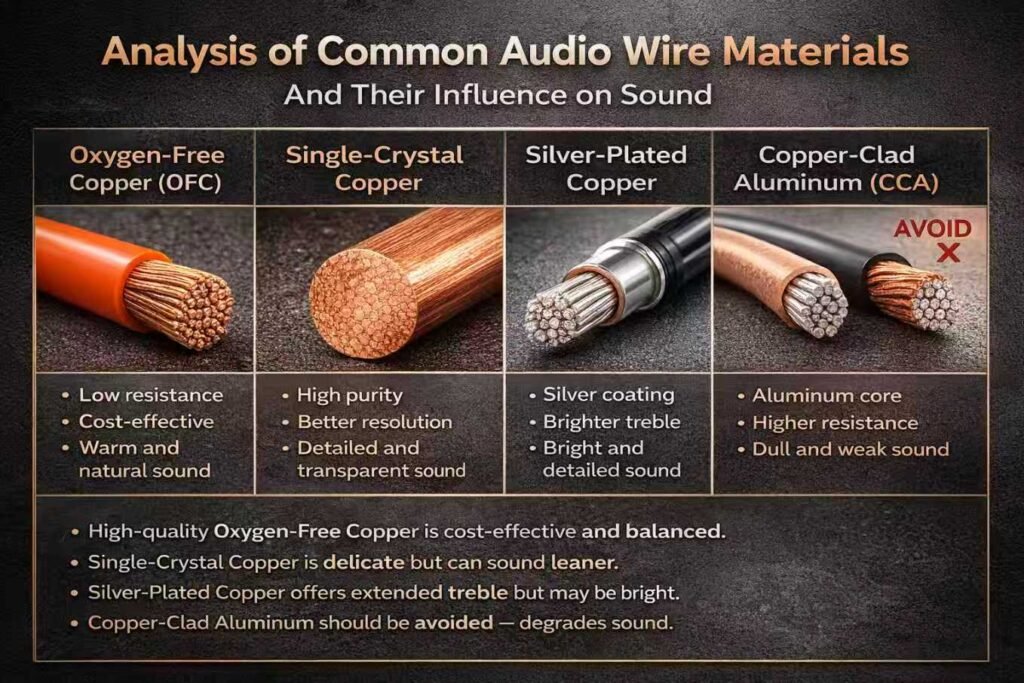
Analysis of Common Audio Wire Materials And Their Influence on Sound Character
1️⃣ Why Material Character Matters in System Matching
Different conductor materials exhibit different electrical properties, which may subtly influence signal transmission behavior.
While cables do not redefine a system’s fundamental performance, they can:
- Preserve tonal balance
- Slightly adjust perceived warmth or brightness
- Influence system synergy
AmpVortex amplifiers are designed with a sound signature that is:
- Balanced and natural
- Full in the mid-low frequencies
- Detailed yet smooth in high frequencies
Understanding cable material characteristics allows users to optimize tonal matching rather than pursue unnecessary upgrades.
2️⃣ Oxygen-Free Copper (OFC): The Balanced Reference Standard
Electrical Characteristics:
- Low resistance
- Stable impedance behavior
- Reliable long-term conductivity
Perceived Sound Character:
- Warm and natural
- Solid mid-bass foundation
- Smooth and non-fatiguing treble
- Clear vocal presentation
OFC is the most cost-effective and widely adopted conductor material.
For AmpVortex systems:
✔ Highly compatible with the amplifier’s tonal balance
✔ Enhances mid-low fullness
✔ Maintains natural vocal clarity
✔ Suitable for most music genres
Especially effective when paired with speakers that have slightly bright high-frequency tuning.
3️⃣ Single-Crystal Copper: High-Resolution Upgrade Option
Electrical Characteristics:
- Lower grain boundary interference
- Improved conductivity stability
- Reduced microscopic signal scattering
Perceived Sound Character:
- Greater high-frequency transparency
- More refined micro-detail
- Clearer instrument separation
- Slightly leaner tonal presentation
Single-crystal copper is suitable for:
- Classical music
- Jazz
- Acoustic recordings
- Systems emphasizing resolution
When paired with AmpVortex amplifiers:
✔ Enhances high-frequency delicacy
✔ Improves micro-detail retrieval
✔ Best matched with speakers that retain warmth
⚠ If paired with already “cool” or analytical speakers, tonal balance may become overly lean.
4️⃣ Silver-Plated Copper: High-Frequency Emphasis
Electrical Characteristics:
- Improved surface conductivity
- Enhanced high-frequency transmission
- Reduced skin effect impact
Perceived Sound Character:
- Brighter treble
- Extended high-frequency presence
- Agile midrange articulation
- Tighter bass perception
Best suited for:
- Vocal-focused listening
- Light instrumental music
- Systems that require added brilliance
With AmpVortex amplifiers:
✔ Can improve perceived treble extension
✔ Requires warm-toned speakers for balance
Limitations:
- Higher cost
- Greater sensitivity to oxidation
- Potential tonal sharpness if mismatched
Not recommended for most users seeking neutral balance.
5️⃣ Copper-Clad Aluminum (CCA): Budget but Compromised
Electrical Characteristics:
- Higher resistance
- Lower current capacity
- Significant signal attenuation
Perceived Sound Character:
- Reduced bass solidity
- Dry midrange
- Weaker dynamic response
CCA is generally unsuitable for:
- Hi-Fi systems
- Home theater systems
- High-power amplification
AmpVortex strongly advises against using CCA cables due to reduced transmission efficiency and potential safety concerns in high-power applications.
6️⃣ How to Match Cable Material with System Character
Proper cable selection should consider:
- Amplifier tonal profile
- Speaker voicing
- Listening preference
- Music genre
- Installation distance
Practical Matching Logic for AmpVortex Users:
| Listening Goal | Recommended Material |
| Balanced everyday listening | Oxygen-Free Copper |
| Higher detail & resolution | Single-Crystal Copper |
| Brighter vocal emphasis | Silver-Plated Copper (careful matching) |
| Budget entry use | Avoid CCA |
7️⃣ The Rational Upgrade Principle
Material upgrades should be:
✔ Proportional to system level
✔ Matched to tonal balance
✔ Within reasonable budget range
✔ Based on AWG specification requirements
For AmpVortex users:
Primary recommendation:
High-purity oxygen-free copper + Correct AWG matching
Optional upgrade:
Single-crystal copper for targeted refinement
Silver-plated copper:
Conditional use only when system warmth is sufficient
Please contact us at service@ampvortex.com
AmpVortex website: www.ampvortex.com