(317)516-7460
  service@ampvortex.com
BEST BGM Solution for Cinema 2026
A Deep-Dive into the Future of Cinema Audio Beyond the Screen
1. Introduction: Why BGM Becomes a Strategic Variable in 2026
For decades, cinema audio investment has focused almost entirely inside the auditorium—driven by technologies like Dolby Laboratories and its Dolby Atmos ecosystem.
These systems deliver extraordinary immersion, supporting up to 128 audio objects and dozens of speaker channels.
However, a critical reality has been overlooked:
Audiences spend over 70–80% of their time outside the auditorium — in lobbies, concession areas, corridors, and VIP lounges.
In 2026, cinema competition has shifted from:
Movie Experience” → “Total Experience”
And at the center of this transformation lies Background Music (BGM).
2. Current Industry Landscape: BGM is Still Underdeveloped
2.1 Local Playback (Still Dominant Globally)
- USB drives / PCs / basic players
- Analog amplifiers + constant-voltage speakers
- Often non-compliant or semi-compliant music sources
Key Issues:
- No centralized control
- Inconsistent music across locations
- No brand identity
2.2 B2B Music Platforms (Mainly in Western Markets)
Examples include companies like Mood Media.
- SaaS-based music delivery
- Typically single-zone or limited multi-zone
Key Issues:
- Weak hardware integration
- Limited scalability for complex cinema layouts
2.3 TMS / Digital Signage Add-ons
- Cinema management systems with basic playback features
Core Problem:
BGM has never been designed as a system-level infrastructure
3. Key Trends Defining Cinema BGM in 2026
3.1 Multi-Zone Audio is No Longer Optional
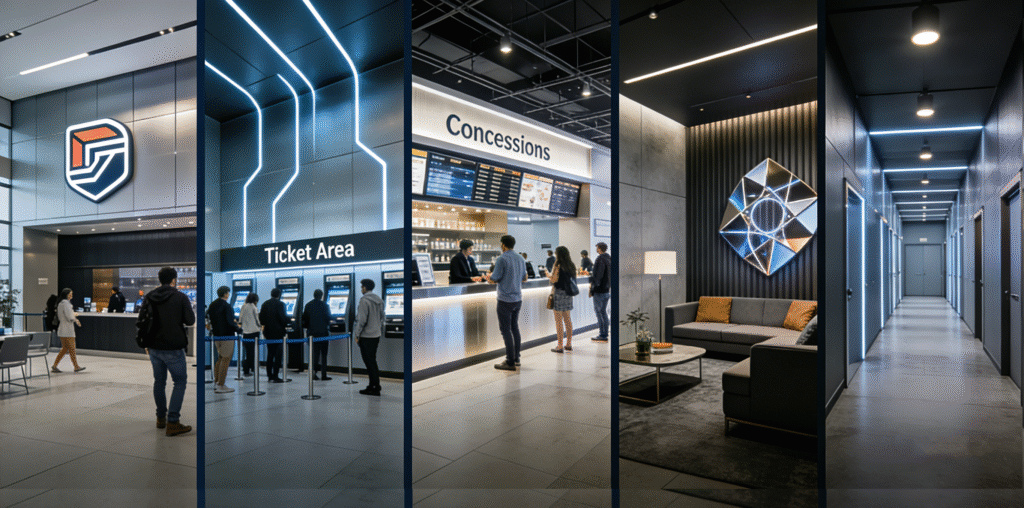
Modern cinema spaces require distinct audio environments:
Zone | Audio Strategy |
Lobby | Brand-driven ambient music |
Ticket Area | Calm, low-tempo |
Concessions | Energetic, sales-driven |
VIP Lounge | Premium, private |
Corridors | Transitional, subtle |
Single-zone systems are obsolete
3.2 AI-Driven Music Personalization
Emerging capabilities:
- AI-generated playlists
- Time-based scheduling
- Crowd-density adaptive music
Audio is becoming data-driven
3.3 Integration with Smart Systems
Cinema environments are increasingly connected:
- Lighting systems
- Digital signage
- POS and customer flow analytics
BGM evolves into a core control layer of the space
3.4 Wireless + IP-Based Audio Architecture
Technologies such as:
- Dante
- AES67
Enable:
- Distributed amplification
- Flexible deployment
- Lower installation costs
4. The Best BGM Solution Architecture for 2026
The Answer is NOT a Player — It’s a System
A future-ready cinema BGM solution must include:
4.1 Central Music Engine
- Cloud (SaaS) or local server
- Playlist management + automation
- API integration (for ecosystem expansion)
4.2 Multi-Zone Streaming Amplifier (Core Layer)
This is the most critical component in 2026
A modern system must provide:
- 4–8 independent zones per device
- Independent audio source + volume control
- Network-based management
- Scalable deployment
This is where AmpVortex stands out.
AmpVortex multi-room streaming amplifiers are purpose-built for:
- Commercial multi-zone environments
- Seamless SaaS integration
- Native support for control ecosystems
Unlike traditional amplifiers, AmpVortex bridges software + hardware + control
4.3 Control Layer
- Control4
- KNX
- Matter
Unified control via:
- Mobile apps
- Web dashboards
- Automation rules
4.4 Speaker Layer
- Ceiling speakers
- Wall-mounted speakers
- Directional speakers
Designed per zone for optimal acoustic coverage.
5. Why Traditional Solutions Fail
Solution Type | Limitation |
Single-zone players | Cannot support multi-space needs |
SaaS-only platforms | Lack hardware integration |
AV systems | High cost, low flexibility |
Core mismatch:
The space is multi-zone, but the system is not.
6. The Commercial Value of BGM in Cinemas
BGM is no longer just ambiance — it directly impacts revenue.
6.1 Increased Dwell Time
Better audio → longer stays → higher spending
6.2 Brand Consistency
Standardized music → stronger brand identity across locations
6.3 Audio Monetization
- Audio advertising
- Cross-channel campaigns with digital signage
7. A Strategic Perspective: The Two Layers of Cinema Audio
Modern cinema audio is splitting into two distinct layers:
Layer 1: Core (Film Audio)
- IMAX / Dolby systems
- Focused on cinematic immersion
Layer 2: Growth (Commercial Audio)
- BGM systems
- Drives customer experience and revenue
The second layer is where future growth lies
8. Conclusion: What Defines the BEST BGM Solution in 2026
The future is clear:
It’s no longer about buying a player
It’s about building a scalable multi-zone audio operating system
Final Takeaway
- IMAX Corporationdefines the movie sound experience
- A modern BGM system defines the entire space experience
Why Choose AmpVortex for Cinema BGM?
If you are building or upgrading cinema audio infrastructure in 2026:
AmpVortex multi-room streaming amplifiers offer:
- True multi-zone architecture (up to 8 zones per unit)
- Seamless integration with SaaS music platforms
- Native support for KNX, Control4, and smart ecosystems
- Scalable deployment for cinema chains
For more information, please visit www.ampvortex.com