(317)516-7460
 service@ampvortex.com
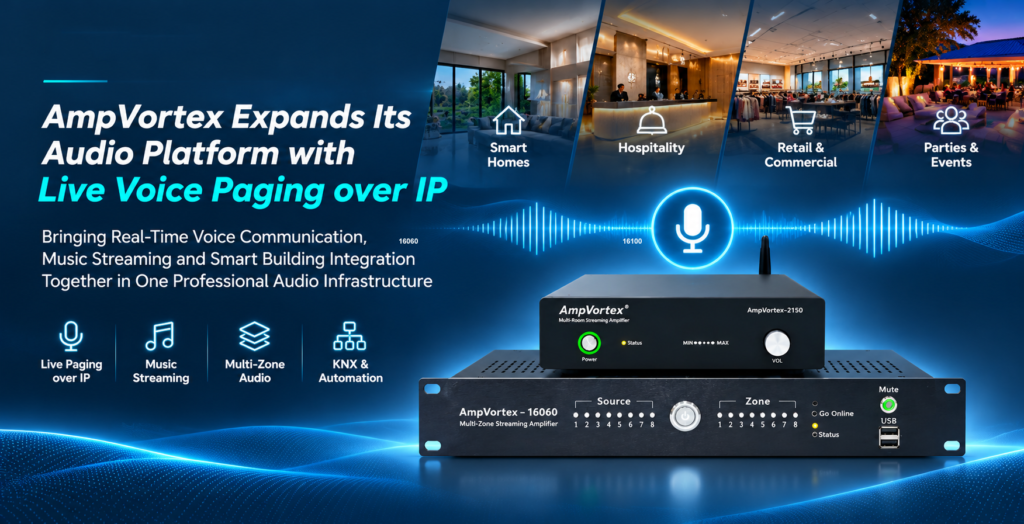
AmpVortex Expands Its Audio Platform with Live Voice Paging over IP
Bringing Real-Time Voice Communication, Music Streaming and Smart Building Integration Together in One Professional Audio Infrastructure
Modern audio systems are evolving beyond music playback.
In smart homes, hotels, commercial buildings and entertainment spaces, the same audio infrastructure that delivers music can also provide a convenient channel for live voice communication.
AmpVortex is developing Live Voice Paging over IP as a unified platform capability, designed to extend its single-zone and multi-zone streaming audio solutions beyond traditional music distribution.
The objective is simple: One audio infrastructure for music, live announcements and connected building applications.
1. From Music Streaming to Live Voice Communication
Traditional distributed audio systems are designed primarily for music playback. However, modern residential and commercial environments increasingly require flexible communication between rooms, floors and functional areas.
Live Voice Paging over IP introduces a new possibility.
Using a compatible mobile application, IP microphone or third-party software, live human speech can be transmitted over the local network to an AmpVortex audio endpoint.
The system can then reproduce the voice announcement through connected speakers, with the potential to address an individual room or multiple selected zones.
Unlike Text-to-Speech (TTS), this approach does not require converting written text into synthesized speech.
The actual human voice is captured, transmitted and reproduced in real time.
This makes the architecture suitable for natural, spontaneous communication, from calling family members across a large home to making operational announcements in commercial environments.
2. A Unified Architecture Across the AmpVortex Product Family
AmpVortex is designing Live Voice Paging as a platform-level function rather than a feature limited to a particular mobile application.
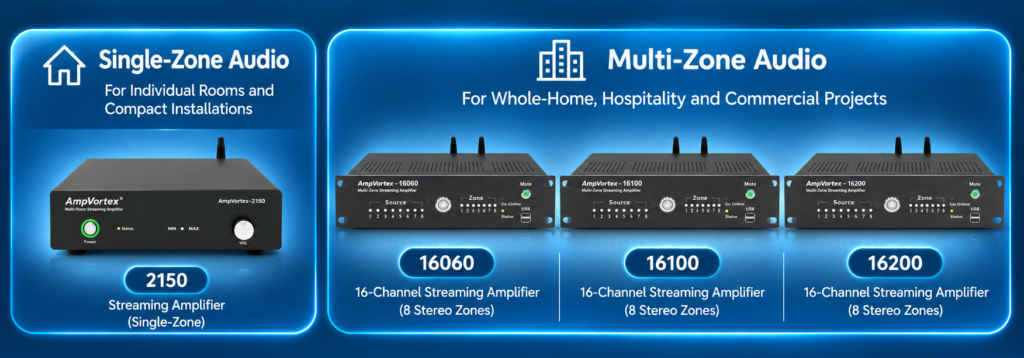
The proposed architecture is intended to support the company’s streaming audio portfolio, including:
- AmpVortex 16060 Series:16-channel streaming amplifiers supporting eight stereo audio zones.
- AmpVortex 16100 Series:Higher-power multi-zone streaming amplifiers for residential and commercial installations.
- AmpVortex 16200 Series:High-power distributed audio solutions for demanding installations.
- AmpVortex 2150:A compact single-zone streaming amplifier.
- Compatible AmpVortex streaming audio products:Network audio endpoints for external amplification systems.
By sharing a common underlying audio architecture, different products can potentially provide consistent voice paging capabilities while accommodating different installation requirements.
A single-zone amplifier can serve one room, while a multi-zone system can distribute voice announcements to designated areas throughout a property.
This approach also creates a foundation for future cross-device voice paging.
3. How Live Voice Paging over IP Works
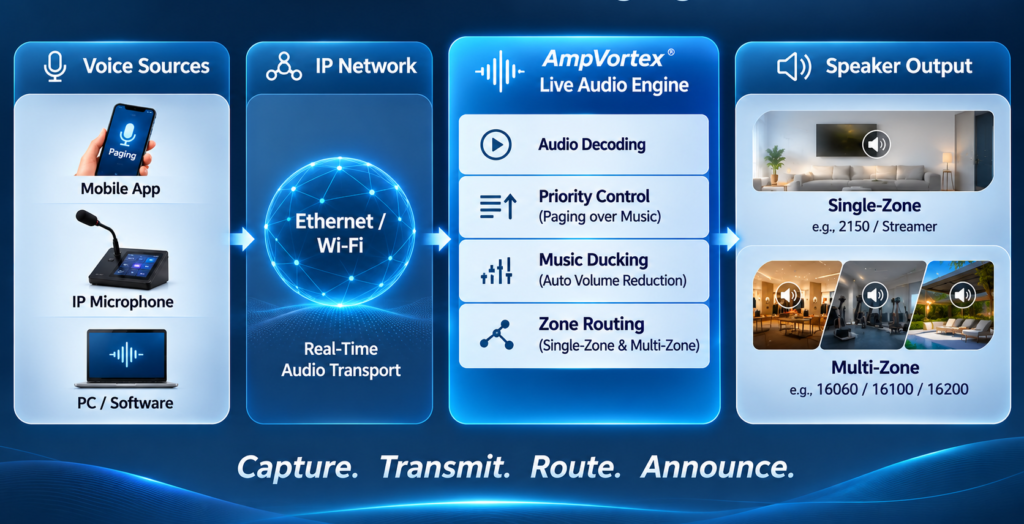
The proposed architecture consists of four functional stages.
Voice Capture
A compatible application, IP microphone or software client captures live human speech.
IP Audio Transport
The voice audio is transmitted through the local Ethernet or Wi-Fi network to a compatible AmpVortex device.
Live Audio Processing
The device’s Live Audio Engine receives the voice stream and manages audio decoding, announcement priority, background music interaction and output routing.
Speaker Output
The processed voice audio is reproduced through the connected speaker system, either within a single zone or across multiple selected zones.
The architecture separates audio transport from system control, allowing different user interfaces and automation platforms to interact with the same underlying audio capabilities.
4. Live Voice Paging Without Disrupting the Music Experience
An important design objective is allowing voice communication to coexist with everyday music playback.
AmpVortex is evaluating two complementary operating modes.
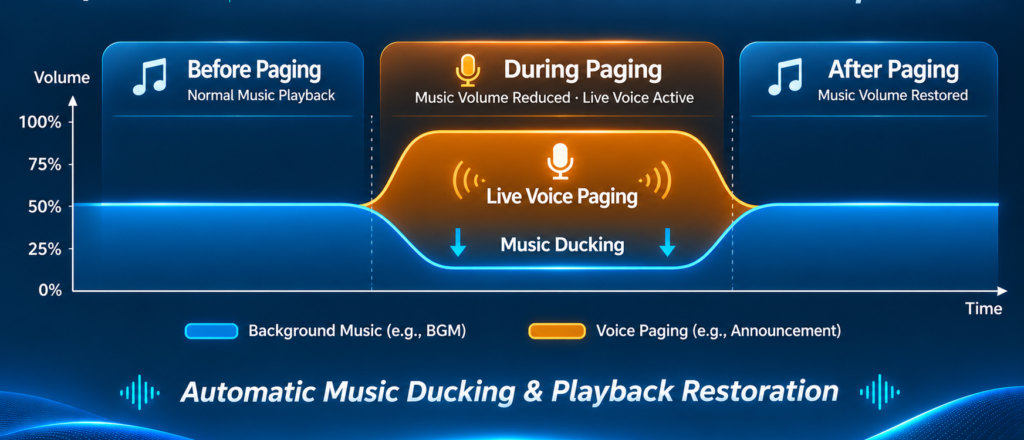
Music Ducking
When a voice announcement begins, the system temporarily reduces the background music volume.
The live voice is reproduced at an appropriate level, allowing listeners to hear the announcement clearly.
After the announcement finishes, the original music volume is restored.
Music Interruption
For announcements requiring greater clarity, the system can temporarily mute or interrupt background music before restoring normal operation.
Both approaches are intended to minimize manual intervention and maintain a convenient listening experience.
The final implementation will depend on device-level audio mixing capabilities and compatibility testing with supported streaming sources.
5. Designed for KNX and Professional Automation
AmpVortex already provides native KNXnet/IP integration across its supported professional audio products.
Live Voice Paging over IP is being designed to complement this integration architecture.
For example, a KNX wall panel could initiate a paging workflow, while a third-party application supplies the live audio stream.
Similarly, a building automation platform could select the destination zones or control the paging session through a dedicated API.
The proposed integration architecture includes:
- Native KNX control for supported automation workflows.
- REST API access for third-party applications.
- Home Assistant integration opportunities.
- Web-based paging control.
- Independent audio transport over the local IP network.
The important distinction is that automation systems control the paging operation, while the audio engine handles real-time voice transmission and playback.
This separation provides greater flexibility for professional system integrators.
6. Applications in Smart Homes and Commercial Buildings
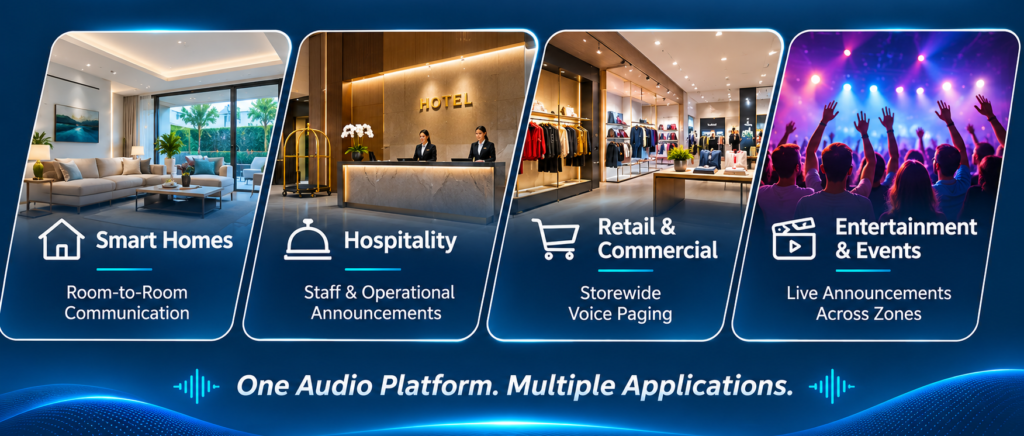
Premium Residences and Smart Homes
Large homes often include independent audio zones across living rooms, bedrooms, kitchens, terraces and outdoor spaces.
Live voice paging could allow homeowners to communicate naturally across these areas using the existing speaker infrastructure.
Hotels and Hospitality
Hotels, serviced apartments and hospitality facilities may benefit from integrated voice communication for operational announcements and staff coordination.
The same audio platform could support background music and designated non-emergency paging functions.
Retail Stores and Commercial Spaces
Retail operators could use installed audio systems for staff communication, customer-service announcements and operational messaging.
Villas, Parties and Entertainment Areas
Live voice paging could also support announcements during private gatherings and entertainment events.
A host could address guests across different rooms or outdoor zones without installing a separate announcement system.
Interactive karaoke and live performance applications would require additional low-latency audio engineering and are outside the initial paging scope.
7. Beyond a Proprietary Mobile App
A mobile application provides a convenient interface for capturing voice and selecting announcement zones.
However, AmpVortex’s broader objective is to make live voice paging an underlying audio-platform capability.
This approach creates opportunities for third-party developers, automation providers and system integrators to build customized applications around the same infrastructure.
Instead of requiring every customer to adopt a single proprietary user interface, the system can support different control environments through standardized integration interfaces.
For professional AV installations, this distinction is particularly important.
The audio infrastructure should provide the capability. Applications and automation systems should determine how that capability is used.
8. One Audio Infrastructure, More Possibilities
The evolution of distributed audio is not simply about adding more streaming services or increasing amplifier power.
It is also about making installed audio infrastructure more useful throughout a connected property.
With Live Voice Paging over IP, AmpVortex is extending its platform vision toward real-time communication, professional automation and more flexible audio applications.
By combining network audio, multi-zone amplification, intelligent routing and open integration capabilities, AmpVortex aims to support a wider range of residential and commercial requirements.
AmpVortex — One Audio Infrastructure. Music, Communication and Control.
Learn more at www.ampvortex.com.