(317)516-7460
 service@ampvortex.com
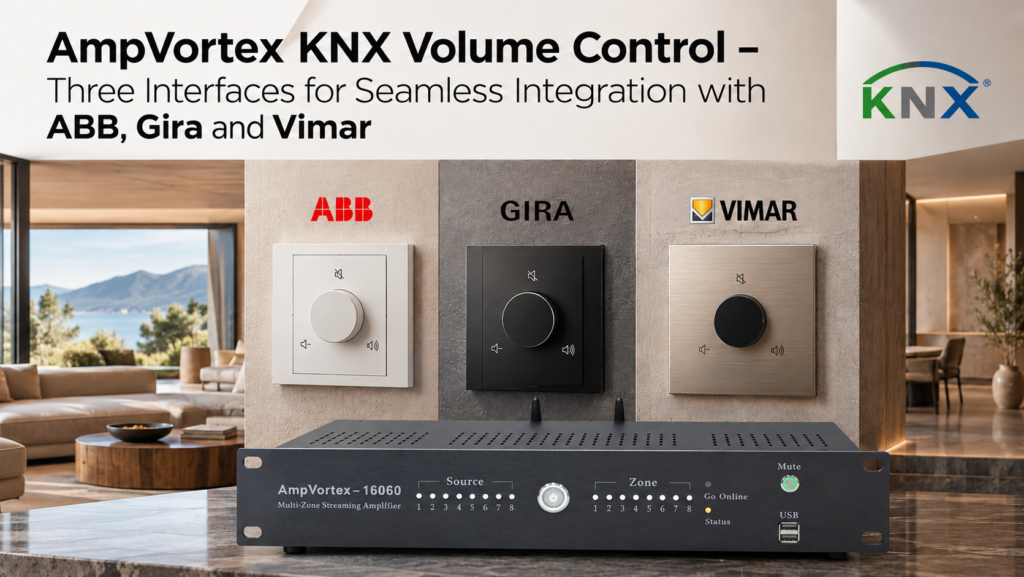
AmpVortex KNX Volume Control – Three Interfaces for Seamless Integration with ABB, Gira and Vimar
In modern smart homes and buildings, audio control should be a natural part of the KNX automation system. Users should be able to adjust their music volume directly from a wall-mounted touch panel or keypad, without having to open a dedicated audio application.
AmpVortex amplifiers provide three different KNX volume control interfaces: 1-byte, 4-bit and 1-bit. These interfaces offer flexible integration with ABB touch panels, KNX keypads supporting light dimming, and Vimar keypads.
1. 1-byte Volume Control – Integration with ABB Touch Panels
The 1-byte interface provides absolute volume control.
The controller sends a value representing the desired volume level, typically from 0% to 100%, and the AmpVortex amplifier adjusts its output volume accordingly.
This interface is particularly suitable for ABB KNX touch panels and audio control interfaces, including:
- ABB IP Touch 10
- ABB RoomTouch KNX
- ABB SmartTouch KNX
When used with a compatible ABB audio player or Audio Control interface, the user can adjust the AmpVortex volume directly through the touch panel.
For example, when the user selects 30% volume on the ABB touch panel, the corresponding 1-byte KNX value is transmitted to the amplifier, which adjusts its volume to the requested level.
The main advantage of 1-byte control is precise and intuitive operation. Users can select a specific volume level instead of repeatedly pressing buttons to increase or decrease the volume.
This makes the 1-byte interface an ideal solution for touch-panel-based audio control in residential and commercial KNX installations.
2. 4-bit Volume Control – Integration with KNX Keypads Supporting Light Dimming
AmpVortex also supports the standard KNX 4-bit relative dimming interface.
The operating principle is the same as conventional KNX lighting dimming. A keypad sends relative increase or decrease commands when a button is pressed and held. When the button is released, the adjustment stops.
This means that KNX keypads supporting the standard 4-bit relative dimming function can also be used to control AmpVortex amplifier volume.
Examples of compatible keypad product families include:
Gira KNX Pushbutton Sensors
- Gira Pushbutton Sensor 4 Standard, System 55: 5011 00, 5012 00, 5013 00
- Gira Pushbutton Sensor 4 Komfort, System 55: 5041 00, 5042 00, 5043 00
- Gira Pushbutton Sensor 4 Komfort for KNX: 5001 .., 5002 .., 5004 ..
- Gira Pushbutton Sensor 4.70 Standard: 5311 00, 5312 00, 5314 00
- Gira Pushbutton Sensor 4.70 Komfort: 5341 00, 5342 00, 5344 00
JUNG KNX Universal Push-button Modules
- JUNG 4191 TSM – 1-gang
- JUNG 4192 TSM – 2-gang
- JUNG 4193 TSM – 3-gang
- JUNG 4194 TSM – 4-gang
With the appropriate ETS application and parameter configuration, these keypad families can provide relative dimming commands for AmpVortex volume control.
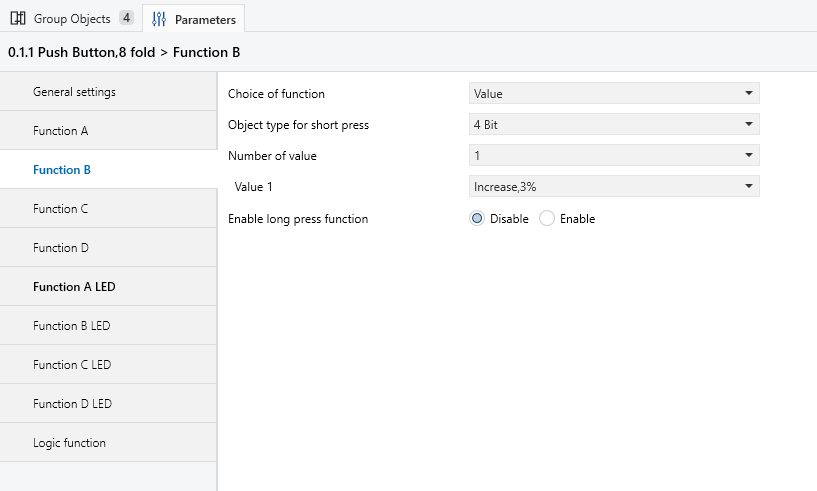
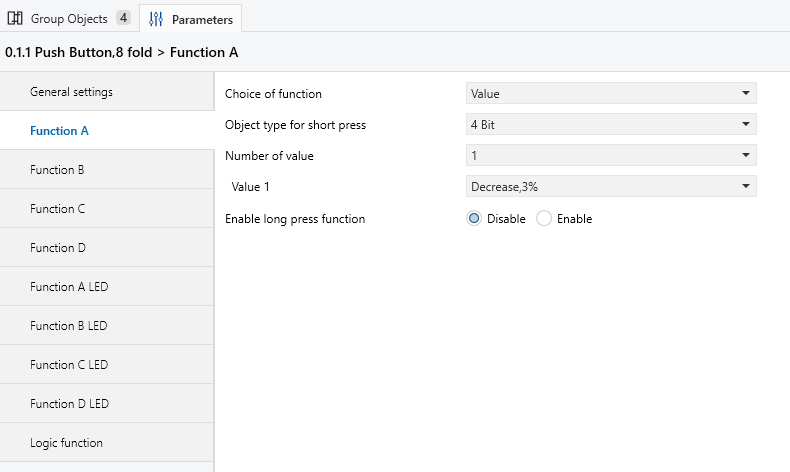
The operation is simple:
- Press and hold the increase button to raise the volume.
- Press and hold the decrease button to lower the volume.
- Release the button to stop the adjustment.
One of the key advantages of this solution is that an existing KNX lighting keypad can also become an audio volume controller.
No dedicated audio touch panel is required. The same wall keypad used for lighting dimming can be configured to control music volume.
This is particularly useful in bedrooms, living rooms, hotels and other spaces where simple and convenient wall-button operation is preferred.
3. 1-bit Volume Control – Integration with VIMAR KNX Keypads
For projects using VIMAR KNX keypads, AmpVortex provides a 1-bit volume control interface.
By assigning two separate keypad buttons to the same 1-bit volume control group address, users can control volume increase and decrease with two physical buttons.
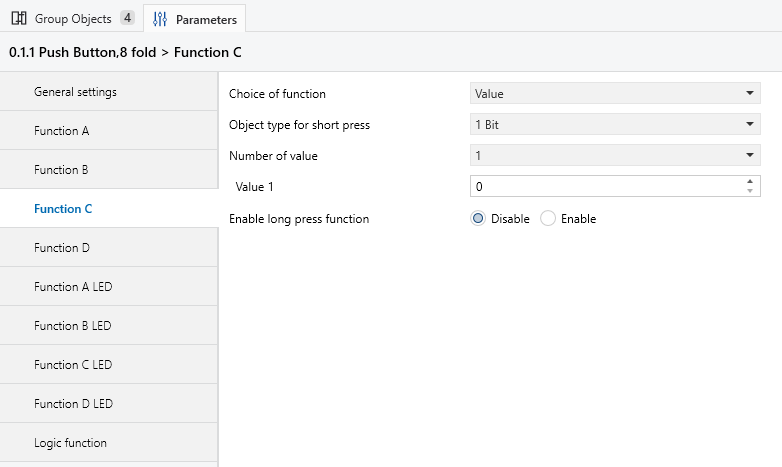
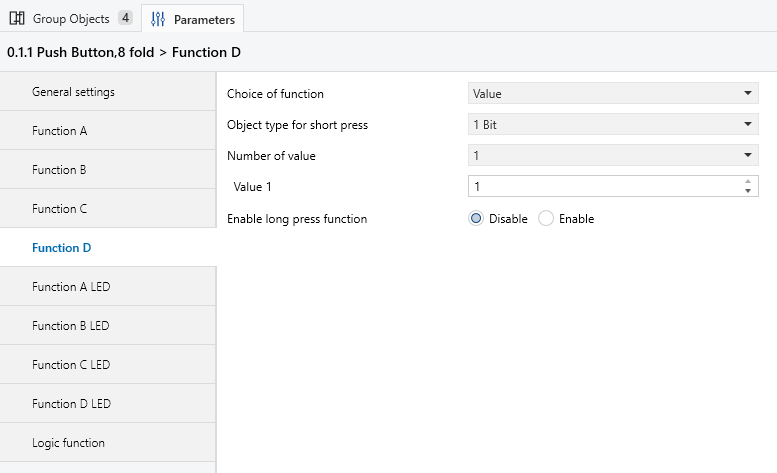
The operating logic is as follows:
- The first button sends one 1-bit value to trigger volume increase.
- The second button sends the opposite 1-bit value to trigger volume decrease.
This allows two simple physical buttons to provide complete volume adjustment functionality.
The solution is particularly suitable for VIMAR KNX keypads and installations where users prefer traditional push-button operation rather than a touchscreen.
It combines the simplicity of conventional wall switches with the flexibility of a fully integrated KNX audio system.
4. Three Interfaces for Different KNX Control Devices
The three volume control interfaces allow system integrators to select the most suitable control method according to the keypad or touch panel installed in each room.
KNX Interface | Control Method | Compatible Control Devices |
1-byte | Absolute volume control (0–100%) | ABB Touch Panels / Audio Players |
4-bit | Relative volume increase and decrease | KNX Keypads supporting 4-bit Light Dimming |
1-bit | Two-button volume increase and decrease | VIMAR KNX Keypads |
5. Making Audio a Natural Part of the Smart Building
With its three KNX volume control interfaces, AmpVortex makes it easy to integrate professional multi-room audio into an existing smart home or building automation system.
Whether a project uses an ABB touch panel, a Gira or JUNG KNX keypad, or a VIMAR wall keypad, AmpVortex offers a suitable interface for convenient volume control through standard KNX group addresses.
For KNX system integrators, this means greater flexibility in system design, fewer dedicated control devices and a more consistent user experience throughout the building.
AmpVortex – Professional Multi-Room Audio, Fully Integrated with KNX.
For more information, please visit: www.ampvortex.com