(317)516-7460
 service@ampvortex.com
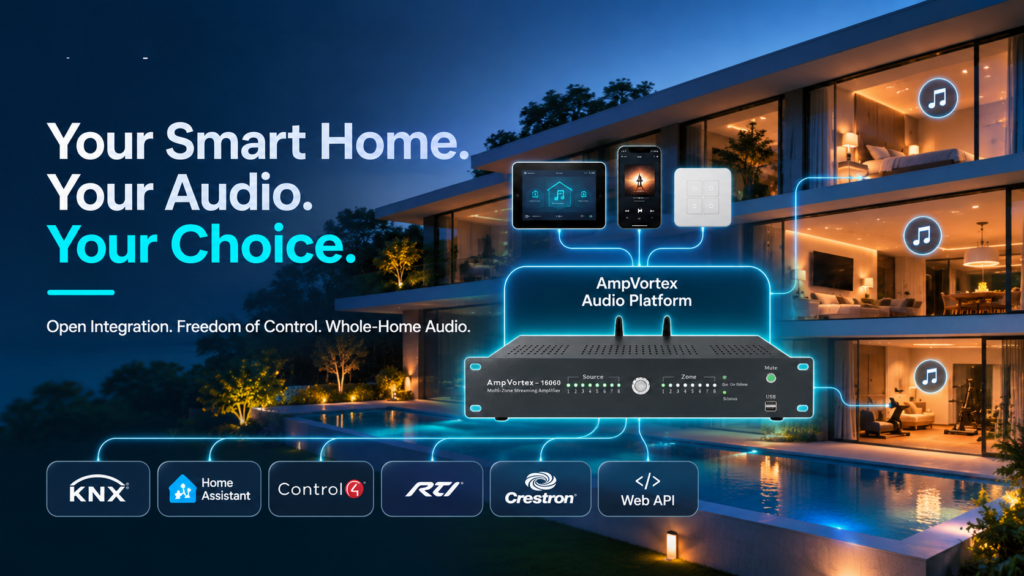
Your Smart Home Shouldn’t Be Locked Into One Audio Ecosystem
Why interoperability and freedom of choice are becoming essential for whole-home audio
The smart home is becoming more connected — but does that necessarily mean it is becoming more open?
In October 2026, the Open Home Foundation published a position paper titled Choice in the Smart Home, arguing that consumer choice depends fundamentally on interoperability.
The paper calls for smart home devices and systems to be “interoperable by design” and highlights the importance of open connectivity standards, documented APIs and local-first control.
For the professional smart home industry, this raises an important question:
Should homeowners have to build their entire home around the ecosystem chosen by one device?
For whole-home audio, we believe the answer should be no.
The Smart Home Is Bigger Than Any Single Ecosystem
A modern premium residence may contain many different technologies.
Lighting and shading may operate through KNX.
Automation may be managed through Control4, Home Assistant, Crestron or another platform.
The homeowner may use Apple devices for music, while another member of the household prefers Spotify.
Physical keypads and touch panels may coexist with mobile apps and automation.
The audio system is only one part of this larger environment.
Yet whole-home audio has traditionally had a tendency toward closed ecosystems:
One brand.
One app.
One control environment.
One way of doing things.
That can be convenient when everything remains inside that ecosystem.
But a professionally designed smart home may need to operate for many years — often longer than individual apps, cloud services or consumer technology platforms remain unchanged.
The audio infrastructure therefore needs to do more than work today.
It needs to remain adaptable tomorrow.
Interoperability Changes the Role of Audio
The Open Home Foundation describes interoperability as the backbone of choice.
That principle is particularly relevant to professionally installed audio.
Instead of asking:
“Which smart home ecosystem does this audio system require?”
perhaps the better question is:
“How can this audio system become part of the smart home ecosystem the homeowner has already chosen?”
That is a fundamentally different approach.
The homeowner should be able to choose the experience.
The integrator should be able to choose the control architecture.
And the audio infrastructure should work with those decisions — rather than dictate them.
Your Control System. Your Music. Your Home.
There is no single correct way to control a smart home.
Some homeowners prefer physical switches.
Others prefer wall-mounted touch panels.
Some want a dedicated smart home interface.
Others primarily use their phones.
And increasingly, automation means that many everyday actions may happen without opening an app at all.
Whole-home audio should accommodate these different approaches.
A homeowner might want to adjust volume from a KNX keypad.
A touch panel might provide source selection.
An automation scene might start music automatically.
And when deeper control is required, a dedicated audio application can provide access to the complete multi-room experience.
These methods do not need to compete.
They can coexist.
Choice should exist not only in what music you listen to, but also in how you interact with the system that plays it.
Local Integration Still Matters
Cloud services have transformed the smart home and created experiences that would have been difficult to imagine only a few years ago.
But not every basic function inside a home should depend entirely on a remote server.
The Open Home Foundation specifically advocates local-first functionality so that devices and systems can continue to interact locally rather than depending unnecessarily on external infrastructure.
For professional residential systems, this principle has practical importance.
Basic functions such as:
Volume
Mute / Unmute
Source Selection
Audio Routing
should be capable of becoming part of the home’s local control architecture where appropriate.
A wall switch should not need to become a cloud application simply to change the volume in a room.
This is one reason local integration technologies remain important even as cloud-based services continue to expand.
Open Integration Does Not Mean One Technology
An open approach should not simply replace one ecosystem with another.
KNX is appropriate for some projects.
Control4 may be appropriate for others.
Home Assistant has its own rapidly growing ecosystem.
Crestron and RTI remain important in professional integration.
And many projects combine multiple technologies.
The goal should therefore not be:
“Everyone should use the same platform.”
It should be:
“The audio platform should provide integrators with meaningful choices.”
That distinction matters.
True interoperability is not about choosing the “right” ecosystem for everyone.
It is about avoiding unnecessary barriers between systems.
AmpVortex as Audio Infrastructure
This philosophy has influenced the way we develop AmpVortex.
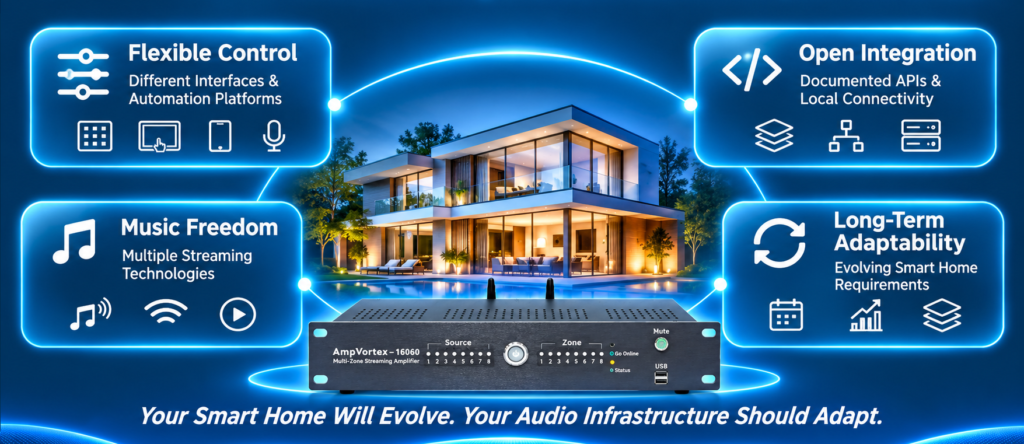
AmpVortex multi-room audio systems are designed not simply as standalone amplifiers, but as part of the wider connected-home infrastructure.
The platform combines multi-zone amplification, independent network streaming, audio routing, DSP and system control while supporting integration with third-party smart home environments.
Depending on the project and product configuration, the AmpVortex ecosystem can work with technologies including:
KNX / KNXnet/IP
Web API-based integration
alongside music technologies such as:
Google Cast on supported models
The purpose of supporting multiple technologies is not to create a longer feature list.
It is to give integrators greater freedom in how the audio system becomes part of the home.
One Audio Platform, Different Smart Home Architectures
Consider two residential projects.
One home may use:
ABB / Vimar KNX Controls
↓
KNXnet/IP
↓
AmpVortex Multi-Room Audio
↓
Multiple Audio Zones
Another may use:
Home Assistant
↓
AmpVortex Integration
↓
Multi-Room Audio
↓
Speakers Throughout the Home
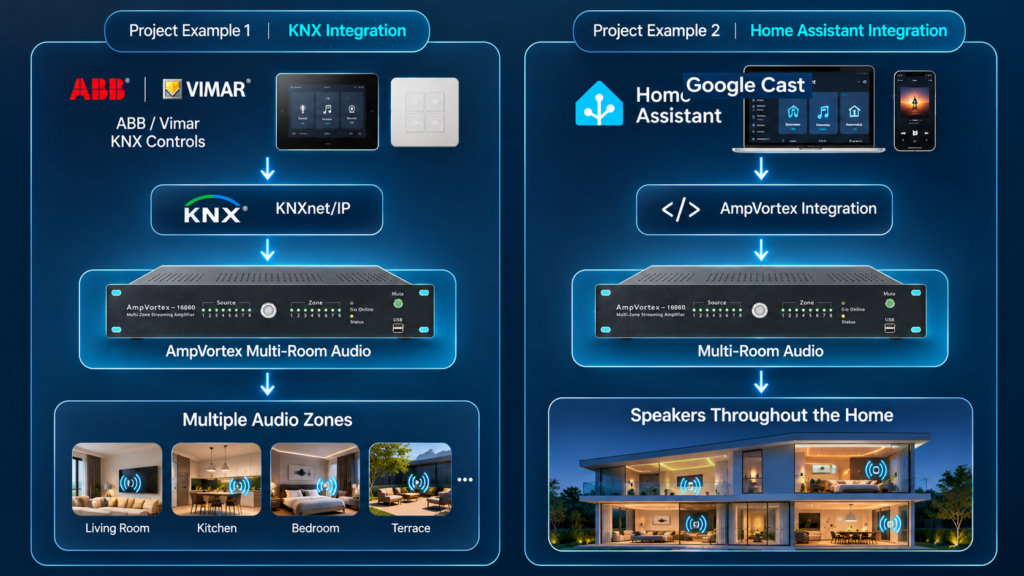
The control architecture is different.
The homeowner experience is different.
But the underlying audio infrastructure can follow the same principle:
The smart home chooses how to control the audio — the audio system does not dictate how the smart home must be built.
Interoperability Also Protects the Integrator
Freedom of choice is not only valuable to homeowners.
It matters to professional integrators as well.
Every integrator has preferred technologies, established engineering practices and different project requirements.
A KNX specialist should be able to integrate audio into KNX.
A Control4 integrator should be able to approach the same audio infrastructure from a Control4 environment.
A Home Assistant project should not require abandoning Home Assistant simply because of the audio system selected.
And custom integration should remain possible when a project requires something different.
This allows the integrator to design around the project rather than design around the limitations of a particular audio ecosystem.
A Smart Home Should Become More Flexible Over Time — Not Less
A professionally installed whole-home audio system may remain in a property for many years.
During that time, phones will change.
Music services will change.
Control interfaces will change.
Automation platforms will evolve.
New standards will emerge.
The infrastructure inside the walls is much harder to replace.
That is why interoperability should not be considered simply another product feature.
It is part of protecting the long-term value of the installation.
When selecting whole-home audio, homeowners, consultants and integrators should therefore ask:
Can the system integrate with the control platform we use today?
Does it provide practical interfaces for third-party integration?
Can important functions operate within the local smart home infrastructure?
Can we change other parts of the smart home without replacing the entire audio system?
Will the system give us more choices in the future — or fewer?
These questions may ultimately matter more than whether an amplifier has one additional feature on its specification sheet.
The Future of Whole-Home Audio Is Connected — But It Should Also Be Open
The Open Home Foundation’s new position paper puts an important idea at the center of the smart home conversation:
Choice depends on interoperability.
For whole-home audio, we believe the same principle applies.
The future should not require every homeowner to choose between isolated technology islands.
Instead, audio can become infrastructure — connected to the smart home while remaining flexible enough to work across different control environments, interfaces and music experiences.
At AmpVortex, that is the direction we are building toward.
Your control system. Your music. Your rooms.
AmpVortex provides the audio infrastructure behind them.
Learn more at www.ampvortex.com.