(317)516-7460
 service@ampvortex.com
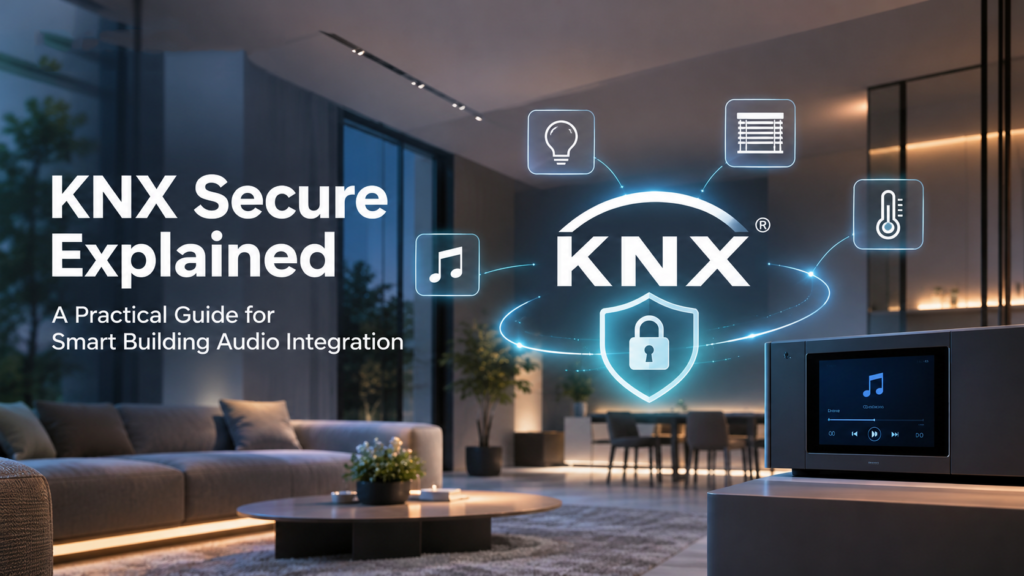
Understanding KNX Secure: What It Protects, How It Works, and When It Matters
As KNX expands beyond traditional building control and becomes increasingly connected to IP networks, mobile applications, remote services and third-party platforms, cybersecurity is becoming an important part of KNX system design.
KNX Secure was developed to address this evolution.
But what exactly is KNX Secure? What is the difference between KNX IP Secure and KNX Data Secure? And does every device in a modern KNX project need to use Secure communication?
Why KNX Secure Exists
Traditional KNX installations were often relatively isolated systems.
A KNX TP network might connect lighting, HVAC, blinds and other building functions, while an IP interface or router provided access for ETS configuration or integration with external systems.
Today, the environment is different.
KNX systems increasingly interact with:
- IP networks
- visualization systems
- mobile applications
- remote maintenance platforms
- smart-home ecosystems
- AV and multi-room audio systems
- building management and automation platforms
As connectivity increases, so does the importance of protecting communication from unauthorized access or manipulation.
KNX Secure is designed to provide protection against several important threats, including unauthorized reading of telegrams, manipulation or injection of commands, impersonation of devices, and replay attacks.
The KNX Association defines four important security properties: encryption, authentication, data integrity and freshness.
Two Different Layers of Protection
KNX Secure is not a single technology. It consists primarily of two complementary mechanisms:
KNX IP Secure
KNX IP Secure protects KNX communication transported over an IP network.
This is particularly relevant because Ethernet and LAN infrastructure may be shared by many devices and applications.
KNX IP Secure protects communication between compatible KNX IP devices such as IP routers and interfaces by adding encryption, authentication, integrity protection and mechanisms against replay attacks.
In practical terms, it protects the IP transport layer of the KNX infrastructure.
This becomes especially relevant when KNX traffic travels across networks that are less isolated or where remote connectivity is involved.
However, KNX IP Secure should not be viewed as a replacement for good network architecture.
Firewalls, network segmentation, VPNs and properly configured remote access remain important. KNX IP Secure adds another layer by protecting the KNX communication itself.
KNX Data Secure
KNX Data Secure works differently.
Instead of protecting only the IP transport layer, it protects KNX communication between participating devices and can operate across KNX media including TP, RF, PL and IP.
Importantly, Data Secure can be configured at the Group Address level.
For example, a building could use standard KNX communication for ordinary lighting functions while applying Data Secure to more sensitive functions.
This allows security to be applied selectively rather than requiring every telegram in the installation to be protected in exactly the same way.
When Data Secure is active, KNX uses mechanisms including AES-128-based encryption and authentication to protect telegram contents and verify that commands originate from authorized participants.
IP Secure vs. Data Secure
The easiest way to understand the difference is:
KNX IP Secure protects the KNX communication channel over IP.
KNX Data Secure protects the actual KNX data exchanged between devices.
They address different layers of the system and can therefore be used independently or together.
A project might use IP Secure on the KNX IP backbone while using standard communication for many field-level functions.
Another project might use Data Secure for selected sensitive Group Addresses.
A higher-security project may use both.
Does a KNX Secure Device Always Communicate Securely?
Not necessarily.
This is an important distinction.
A KNX Secure-capable device can support secure functionality without requiring every communication object to operate securely.
For KNX Data Secure, security can be determined at Group Address level. Depending on the project configuration, a Secure-capable device can therefore participate in both secured and plain communication.
KNX installations can also contain both Secure-capable and traditional KNX devices.
This mixed environment is particularly relevant for existing buildings, where KNX installations may remain operational for decades and new devices are introduced progressively.
Security therefore does not necessarily require replacing an entire KNX installation at once.
ETS and Secure Commissioning
KNX Secure also changes the commissioning process.
Secure devices contain device-specific security information, including a Factory Default Setup Key (FDSK). Device certificates can be imported into ETS, commonly through a QR code or certificate string.
ETS then manages the security keys required for commissioning and operation.
When KNX Secure is used, protecting the ETS project itself also becomes important because the project contains security-related information and keys.
This is why ETS projects using KNX Secure require password protection.
Security therefore becomes part of the complete lifecycle of the installation — from device commissioning and project storage to operation and future maintenance.
Does Every KNX Project Need Secure Communication Everywhere?
Not necessarily.
Cybersecurity should be based on the architecture, exposure and risk profile of the building.
For example, a KNX installation operating inside a carefully segmented private network presents a different risk profile from a system with extensive IP connectivity, remote access or integration with multiple external platforms.
Similarly, controlling ordinary room lighting does not necessarily carry the same security consequences as controlling access systems or other sensitive building functions.
The objective should therefore not simply be:
“Make everything Secure.”
A better question is:
“Which communication paths and building functions require protection, and what combination of KNX Secure and network security measures provides the appropriate level of protection?”
Secure and Standard KNX Will Coexist
The installed base of KNX is enormous, and KNX systems are designed for long service lives.
As a result, Secure-capable devices and traditional KNX devices will continue to coexist for many years.
The KNX ecosystem explicitly supports this gradual transition.
Existing installations can improve network architecture and remote-access security first, while Secure-capable devices can be introduced as systems are expanded or upgraded.
For system integrators, this makes interoperability particularly important.
A modern building may simultaneously contain traditional KNX devices, Secure-capable KNX devices, IP-based platforms and third-party systems connected through APIs or gateways.
Successful integration therefore depends not only on supporting a particular security feature, but also on understanding how each technology participates in the overall building architecture.
Security Is a System-Level Decision
KNX Secure is an important evolution of the KNX standard.
But cybersecurity cannot be reduced to a single checkbox on a product specification.
A secure KNX installation depends on multiple layers:
Physical security + Network architecture + Secure remote access + KNX IP Secure + KNX Data Secure + Secure commissioning + Proper project and key management
Different projects will use different combinations of these measures.
For integrators, manufacturers and building owners, the goal should be to design security around the actual architecture and risk profile of the building while maintaining the interoperability and flexibility that have always been central to KNX.
As KNX becomes increasingly connected with smart-home platforms, AV systems, energy management and building automation, understanding this balance between security, interoperability and practical system design will become increasingly important.
AmpVortex and KNX Integration
AmpVortex multi-room audio systems support native KNXnet/IP integration, enabling seamless audio control within KNX-based smart homes and commercial buildings.
While currently supporting standard KNXnet/IP communication, AmpVortex is planning KNX Secure compatibility as part of its ongoing development roadmap, balancing interoperability with evolving security requirements.
Learn more at www.ampvortex.com.