(317)516-7460
 service@ampvortex.com
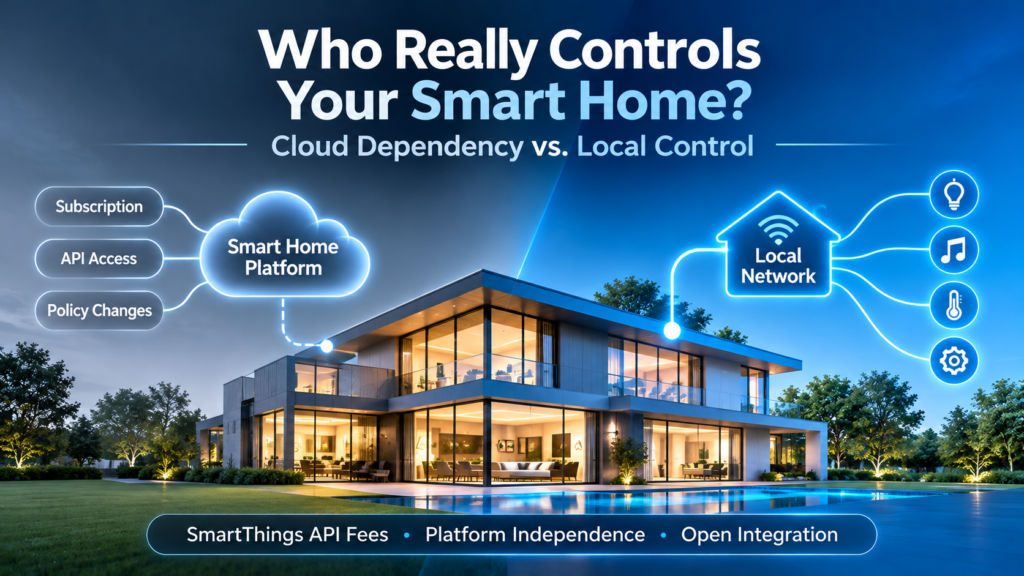
When Smart Home Integrations Become Paid Services, Who Really Controls Your Smart Home?
Samsung’s SmartThings API pricing changes highlight why open integration, local control, and long-term platform independence matter more than ever.
The smart home industry has long promoted interoperability — the ability to connect devices from different manufacturers and control them through a unified platform.
But what happens when an integration that previously worked without a subscription suddenly requires a monthly payment?
Samsung’s recent changes to its SmartThings API provide a timely example of how cloud platform policies can affect the long-term flexibility of connected homes.
For homeowners, system integrators, and technology manufacturers, the issue goes beyond a $4.99 monthly fee.
It raises a more fundamental question: Who should control the future of your smart home — the homeowner or the platform provider?
Samsung SmartThings Introduces Paid API Access
In June 2026, Samsung announced plans to introduce paid access to certain SmartThings cloud APIs.
Under the updated policy, individual developers using qualifying API integrations will need a subscription priced at $4.99 per month, while commercial API users will be subject to separate business pricing.
The changes took effect beginning November 4, 2026, with December 15, 2026, established as a key deadline for existing integrations.
One affected integration is Home Assistant’s connection to SmartThings.
Users who rely on Home Assistant to access devices through the SmartThings Cloud API will need to migrate to the updated integration and obtain an appropriate paid API plan to maintain connectivity.
Importantly, Samsung is not charging all SmartThings users.
The SmartThings mobile app, its built-in automations, and supported local integrations remain free under the announced policy.
The change specifically affects certain third-party cloud API access.
Source: Samsung SmartThings API Announcement
The Bigger Question: Who Controls the Smart Home Ecosystem?
Consider two different integration scenarios.
Scenario 1: SmartThings as the Central Control Platform
A homeowner uses SmartThings to manage Samsung appliances, lighting, sensors, and compatible devices from other manufacturers.
In this scenario, SmartThings serves as the primary automation platform.
Scenario 2: Home Assistant as the Central Control Platform
A homeowner uses Home Assistant to manage devices from multiple manufacturers, including devices connected through SmartThings.
Here, SmartThings primarily provides access to certain devices, while Home Assistant handles the user interface, automation logic, and overall system management.
Both approaches offer legitimate benefits.
However, they also reveal an important distinction between a platform acting as the central ecosystem and a platform serving as an integration layer for another ecosystem.
From a business perspective, platform providers naturally have incentives to strengthen their own ecosystems.
From the homeowner’s perspective, however, the priority is often different: the freedom to choose whichever control platform best meets their needs.
These interests do not always align.
Cloud Integration Creates Long-Term Dependencies
Cloud-based integrations have made smart homes easier to deploy and expand.
They allow devices and services to communicate without requiring every manufacturer to implement direct local connectivity.
But cloud integration also introduces dependencies.
When a smart home relies on a third-party cloud API, its continued operation may depend on factors outside the homeowner’s control:
- API pricing and subscription policies
- Cloud service availability
- Authentication and access requirements
- Changes to supported features
- Platform compatibility and integration maintenance
A system that works perfectly today may require additional configuration, ongoing fees, or replacement integrations tomorrow.
This does not mean cloud services are inherently undesirable.
Cloud connectivity provides important capabilities, including remote access, centralized services, and simplified deployment.
The real challenge arises when cloud connectivity becomes the only available path for controlling a device.
Why Local Control Matters
Local control provides an alternative architecture.
Instead of routing every command through an external cloud service, devices communicate directly over the local network.
For example, a local integration may allow a home automation controller to communicate directly with an audio amplifier using a documented network protocol.
This approach offers several potential advantages.
Reduced Cloud Dependency
Core control functions can continue operating without relying on an external cloud API, provided the local network and equipment remain operational.
Greater Platform Flexibility
Homeowners can choose their preferred automation platform without necessarily depending on a manufacturer’s proprietary cloud environment.
Predictable Long-Term Operation
Local control reduces exposure to unexpected changes in cloud API pricing, authentication policies, or service availability.
Professional Integration
System integrators can build customized automation systems using documented interfaces and established industry protocols.
For professionally installed smart homes, hotels, and commercial buildings, these considerations are particularly important.
An integrated system may be expected to operate reliably for many years, often significantly longer than the lifecycle of individual cloud services.
Open Integration Is More Than Supporting Multiple Platforms
A product may advertise compatibility with several smart home ecosystems.
But compatibility alone does not necessarily guarantee long-term flexibility.
The underlying integration architecture matters just as much.
A device that connects to five automation platforms exclusively through one proprietary cloud service may still depend entirely on that service.
By contrast, a device offering local network control and documented interfaces provides system integrators with more architectural choices.
This is why open integration should be evaluated through several questions:
- Can the device be controlled locally?
- Does it provide a documented API or established integration protocol?
- Can it operate with different automation platforms?
- Will essential control functions remain available without a mandatory cloud subscription?
- Can the integration evolve as the smart home changes?
True interoperability is not simply the number of platforms listed on a compatibility page. It is the freedom to connect, control, and adapt systems over time.
AmpVortex: Built Around Open Integration and Local Control
At AmpVortex, we believe professional audio infrastructure should remain flexible as smart homes and commercial automation systems evolve.
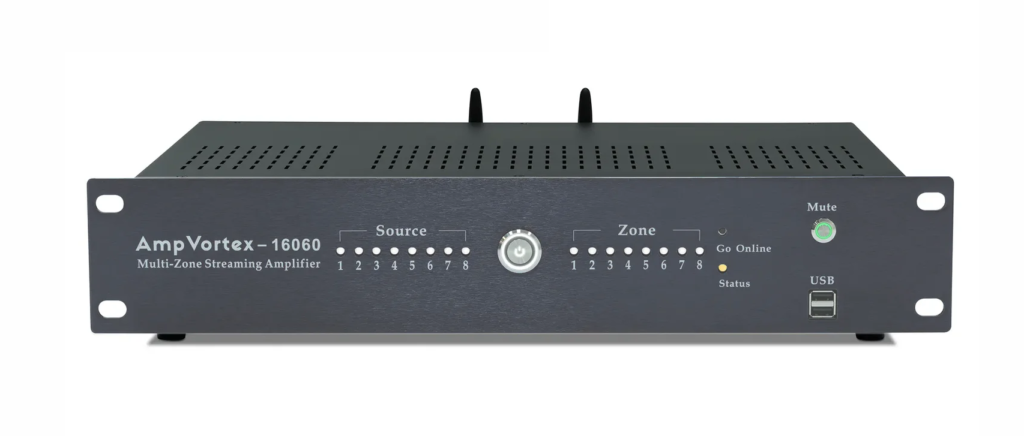
Our multi-room streaming amplifiers are designed to integrate with different control environments rather than requiring users to adopt a single proprietary automation ecosystem.
AmpVortex supports multiple integration technologies, including:
Native KNXnet/IP Integration
Direct integration with KNX-based building automation systems, supporting unified audio control within professional residential and commercial installations.
Home Assistant Integration
A dedicated Home Assistant integration enables local network communication with AmpVortex amplifiers, supporting multi-zone audio control without requiring the SmartThings Cloud API.
Web API
A network-based control interface allows developers and system integrators to incorporate AmpVortex audio functionality into customized automation applications.
Professional Automation Platforms
Integration capabilities for Control4, RTI, Crestron, and other supported control environments provide additional flexibility for professionally installed systems.
These capabilities enable AmpVortex audio systems to operate as part of a broader smart home or building automation infrastructure.
Homeowners can select the control environment that best suits their needs, while integrators retain flexibility in system design.
Importantly, AmpVortex’s local Home Assistant integration does not depend on a paid SmartThings API subscription.
The Future of Smart Homes Should Be Open
Samsung’s SmartThings API changes illustrate a broader challenge facing the connected home industry.
Cloud platforms evolve. Business models change. Integration policies are updated.
These changes are not necessarily unreasonable. Maintaining secure, reliable cloud infrastructure requires ongoing investment.
But they remind us that smart home interoperability should not depend entirely on the commercial decisions of a single platform provider.
For homeowners, the priority should be long-term freedom of choice.
For system integrators, it should be the ability to design reliable, adaptable systems.
And for manufacturers, it should be providing integration options that remain useful as technology evolves.
The best smart home is not the one that locks everything into a single ecosystem. It is the one that gives users the freedom to choose.
At AmpVortex, that philosophy guides our approach to multi-room audio integration.
Open Integration. Local Control. Long-Term Flexibility.
Learn more about our residential and commercial audio solutions at www.ampvortex.com.