(317)516-7460
 service@ampvortex.com

Modbus and BACnet: History, Standards, Market Adoption, and the Future of Building Automation
Understanding the origins, evolution, industry organizations, and future direction of two foundational communication protocols in modern building automation.
Introduction: The Communication Standards Behind Modern Buildings
Modern buildings are becoming increasingly intelligent.
Heating, ventilation, air conditioning (HVAC), lighting, energy management, security, access control, and other building services are no longer expected to operate as completely independent systems. Instead, they are increasingly connected through building automation platforms that coordinate equipment, monitor operating conditions, and improve operational efficiency.
Behind these connected environments are communication protocols that allow equipment from different manufacturers to exchange information.
Among the most established are Modbus and BACnet.
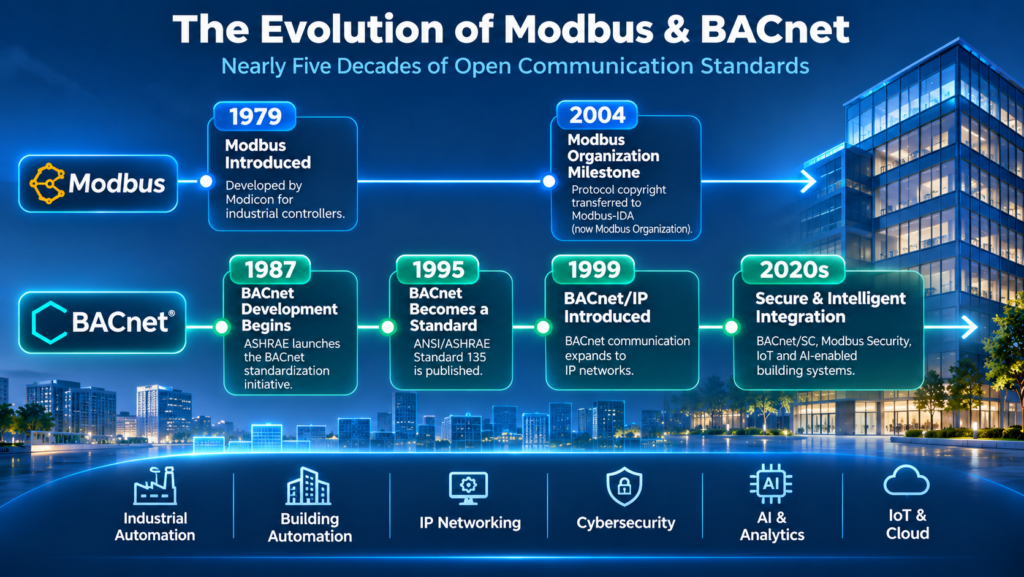
Modbus originated in industrial automation in 1979, while BACnet emerged from the building automation industry in the late 1980s and became a formal standard in 1995.
Although both technologies have existed for decades, they remain highly relevant to modern building infrastructure.
Their continued importance raises several questions:
- What do Modbus and BACnet actually mean?
- Who developed them, and why?
- Which organizations maintain their standards?
- How did they become widely adopted?
- How are they evolving to address cybersecurity, IP networking, and intelligent buildings?
- What role will they play in the future of building automation?
Understanding these questions helps explain not only the history of building automation, but also where the industry is heading.
1. What Is Modbus? Meaning, Origins, and Purpose
Modbus is an open communication protocol originally developed by Modicon, a pioneer in programmable logic controllers (PLCs).
The name reflects its origins in Modicon’s industrial communication technology, with “bus” referring to communication between connected devices.
Introduced in 1979, Modbus was designed to allow industrial controllers and equipment to exchange operational data using a common communication method.
At the time, industrial automation systems frequently depended on manufacturer-specific communication technologies.
Connecting equipment from different suppliers could require custom interfaces, specialized programming, or additional hardware.
Modbus helped simplify this process.
Its fundamental concept was straightforward: devices could exchange information by reading and writing standardized categories of data, including coils, discrete inputs, input registers, and holding registers.
For example, an automation controller might read a temperature measurement, monitor a motor’s operating status, or write a value to change a device setting.
The protocol did not need to understand the physical purpose of every connected device. It only needed a consistent way to access its data.
Why Modbus Became Popular
Several characteristics contributed to Modbus adoption:
Simplicity: Its communication model is relatively easy for engineers and equipment manufacturers to understand.
Low implementation overhead: Modbus can be implemented on comparatively resource-constrained controllers.
Open specifications: Manufacturers can develop compatible equipment without depending on a single proprietary automation ecosystem.
Broad applicability: Modbus can be used for sensors, controllers, meters, industrial machinery, and building equipment.
Long-term compatibility: Its established installed base encourages continued support across generations of products.
These characteristics helped Modbus evolve from a PLC communication protocol into a widely used interface for industrial and building equipment.
2. The Evolution of Modbus: From Serial Communication to Ethernet
The development of Modbus reflects the broader evolution of industrial communication networks.
Modbus RTU and Serial Networks
Modbus RTU is widely associated with serial communication networks, particularly RS485.
RS485 allows multiple compatible devices to communicate over a shared physical bus, making it suitable for distributed industrial equipment and building controllers.
Typical applications include energy meters, temperature controllers, HVAC equipment, and industrial sensors.
Modbus RTU remains relevant because many installations prioritize reliability, cost efficiency, and compatibility with existing equipment over high communication bandwidth.
Modbus TCP and IP Networking
As Ethernet and TCP/IP became increasingly common in industrial and commercial infrastructure, Modbus was adapted for communication over IP networks.
Modbus TCP enables Modbus messages to be exchanged through standard TCP/IP networking.
Instead of requiring a dedicated serial bus, compatible devices can communicate through Ethernet switches and IP networks.
This creates several practical advantages:
- Integration with existing Ethernet infrastructure
- Easier connectivity with industrial computers and building controllers
- Simplified communication between equipment and supervisory platforms
- Greater flexibility in network architecture
- Continued use of familiar Modbus data models
Modbus TCP typically uses TCP port 502.
Importantly, Modbus TCP does not fundamentally change the register-oriented application model. It changes how Modbus messages are transported.
Modbus Today
Modbus continues to appear in industrial automation, energy monitoring, power distribution, HVAC equipment, and building management applications.
Its strength lies in providing a relatively simple and widely understood method of equipment communication.
Even as more sophisticated protocols emerge, Modbus remains attractive for applications where basic monitoring and control are sufficient.
3. Who Maintains Modbus? The Role of the Modbus Organization
Modbus was originally developed by Modicon, which later became part of Schneider Electric.
A significant milestone occurred in April 2004, when Schneider Electric transferred the Modbus protocol copyright to Modbus-IDA, the organization associated with today’s Modbus Organization.
This transition reinforced Modbus’s position as an openly available industrial communication technology.
The Modbus Organization is an independent, member-based nonprofit association bringing together equipment manufacturers, users, and automation technology suppliers.
Its responsibilities include:
- Promoting adoption of Modbus communication technologies
- Maintaining access to protocol specifications
- Supporting implementation guidance and technical resources
- Encouraging interoperability between compatible devices
- Supporting the continued evolution of Modbus technologies
The organization’s role is important because open communication standards require more than publicly available technical documentation.
They also benefit from industry coordination, implementation consistency, and long-term technical stewardship.
For manufacturers, this provides a more predictable foundation for developing equipment intended to operate in multi-vendor environments.
4. What Is BACnet? Meaning, Origins, and Purpose
BACnet stands for Building Automation and Control Networks.
Unlike Modbus, which originated in industrial automation, BACnet was developed specifically to address communication challenges within buildings.
During the 1980s, building automation systems were becoming increasingly sophisticated.
HVAC controllers, lighting systems, security equipment, and building management platforms were adopting digital control technologies.
However, many manufacturers used proprietary communication protocols.
A building owner could purchase advanced equipment from several suppliers but still struggle to connect those systems into one coordinated management environment.
This created a significant problem for the industry.
A building might contain technically capable equipment, yet the overall automation system could remain fragmented.
The Beginning of BACnet
In 1987, an industry initiative under the American Society of Heating, Refrigerating and Air-Conditioning Engineers (ASHRAE) began developing a standardized communication protocol for building automation.
The objective was to enable equipment from different manufacturers to communicate through a common, vendor-independent framework.
After years of development and public review, ANSI/ASHRAE Standard 135 was published in 1995, formally establishing BACnet.
The protocol introduced a structured approach to describing building automation information through standardized objects, properties, and communication services.
Rather than simply exchanging numerical register values, BACnet allows devices to expose information through objects representing functions such as analog values, binary states, schedules, and alarms.
This object-oriented model is one of BACnet’s defining characteristics.
5. ASHRAE: The Organization Behind the BACnet Standard
ASHRAE originally stood for the American Society of Heating, Refrigerating and Air-Conditioning Engineers.
Today, ASHRAE operates internationally and is commonly known simply by its acronym.
The organization was established in 1894 through a predecessor society and has developed into an influential professional association covering building systems, energy efficiency, HVAC, indoor environmental quality, and related engineering disciplines.
ASHRAE develops technical standards and guidelines used by engineers, equipment manufacturers, building designers, and facility operators.
Among its important standards is ANSI/ASHRAE Standard 135, which defines BACnet.
ANSI/ASHRAE Standard 135
BACnet’s formal standardization is important because it establishes common requirements for how compatible devices communicate.
The standard addresses areas such as:
- Object types and properties
- Communication services
- Device identification and discovery
- Data exchange and monitoring
- Alarm and event functions
- Network communication mechanisms
- Interoperability requirements
BACnet is also recognized internationally through ISO 16484-5.
This international standardization has helped BACnet develop beyond its original North American market.
The BACnet Committee
The BACnet standard is maintained and extended by ASHRAE Standing Standard Project Committee 135, commonly known as the BACnet Committee.
The committee brings together representatives from manufacturers, engineering organizations, users, and other interested parties.
Its work includes updating the standard, addressing technical issues, and developing capabilities that reflect changing building automation requirements.
This continuing development process helps BACnet evolve while maintaining a standardized framework for interoperability.
6. BACnet International and BACnet Testing Laboratories
ASHRAE is not the only organization involved in the BACnet ecosystem.
Two additional names are particularly important: BACnet International and BACnet Testing Laboratories (BTL).
BACnet International
BACnet International is an industry association dedicated to promoting the successful use of BACnet technology.
It supports education, industry collaboration, interoperability initiatives, and global awareness of BACnet.
Its role differs from that of ASHRAE.
ASHRAE maintains the technical standard, while BACnet International focuses on industry adoption and the broader BACnet ecosystem.
BACnet Testing Laboratories (BTL)
BTL provides an independent product testing and certification framework.
A manufacturer may implement BACnet functionality, but claiming BACnet support does not automatically establish that the product will operate correctly with every other BACnet system.
BTL testing helps evaluate conformance with defined requirements and improve confidence in interoperability.
Products that complete the applicable certification process can receive BTL certification and appear in the official BTL product listings.
For building owners, consultants, and system integrators, this distinction matters.
BACnet compatibility and BTL certification are not the same thing.
A device may implement BACnet without being BTL-certified.
Likewise, certification provides evidence of tested conformance but does not eliminate the need to verify project-specific integration requirements.
7. How BACnet Evolved: From Building Networks to BACnet/IP
BACnet was designed to support building automation communication across different network technologies.
Over time, its networking capabilities evolved alongside the wider information technology industry.
Early Building Automation Networks
Historically, building automation networks often used dedicated communication infrastructure.
Serial technologies such as BACnet MS/TP, commonly implemented over RS485, became widely used for field controllers and distributed building devices.
These networks were suitable for connecting equipment throughout a building without requiring every controller to have a full Ethernet interface.
The Introduction of BACnet/IP
In 1999, BACnet/IP was added to the BACnet standard.
This enabled BACnet communication over IP networks and represented an important step toward convergence between building automation and conventional IT infrastructure.
BACnet/IP commonly uses UDP/IP, with UDP port 47808 as the standard default.
Unlike Modbus TCP, BACnet/IP is not simply a register-based protocol transported over Ethernet.
It retains BACnet’s object model, device discovery mechanisms, and application services.
This makes BACnet/IP particularly suitable for structured communication between building automation devices and management platforms.
Why BACnet/IP Became Important
As commercial buildings adopted more extensive IP infrastructure, BACnet/IP provided a practical way to connect automation systems across building networks.
Its advantages include:
- Standardized device discovery
- Structured access to building automation data
- Support for monitoring and control services
- Integration with building management platforms
- Support for multi-vendor automation architectures
Today, BACnet/IP is an important communication technology in commercial building automation.
8. Modbus vs. BACnet: Two Different Approaches to Interoperability
Although Modbus and BACnet can serve overlapping applications, they were designed with different priorities.
Modbus focuses on relatively simple data exchange between controllers and equipment.
BACnet provides a more comprehensive communication framework designed around building automation functions.
Category | Modbus | BACnet |
Origin | Industrial automation | Building automation |
Introduced | 1979 | 1995 standard publication |
Original developer | Modicon | ASHRAE standards committee |
Standards organization | Modbus Organization | ASHRAE |
Main data model | Coils and registers | Objects and properties |
Common IP implementation | Modbus TCP | BACnet/IP |
Common serial implementation | Modbus RTU | BACnet MS/TP |
Native device discovery | Not generally provided | Supported |
Typical strengths | Simplicity and equipment control | Building-wide integration and supervision |
Typical applications | PLCs, meters, controllers, equipment | HVAC, BMS, building automation |
The difference is not simply that one protocol is older or more advanced.
They address different integration needs.
A building automation system may use Modbus TCP to communicate with energy meters or equipment controllers while using BACnet/IP to supervise HVAC and other building services.
Both protocols may coexist within the same building.
9. Global Market Adoption: Where Modbus and BACnet Are Used
The adoption of Modbus and BACnet reflects the diversity of automation markets.
Industrial Automation
Modbus has a particularly strong historical position in industrial environments.
Its straightforward communication model makes it suitable for PLCs, sensors, instruments, motor controllers, and other industrial equipment.
For many applications, a simple register-based interface is sufficient.
This helps explain why Modbus remains relevant despite the availability of newer industrial networking technologies.
Commercial Building Automation
BACnet has a strong position in commercial building automation.
HVAC systems, building controllers, supervisory platforms, and energy management applications frequently use BACnet-compatible communication.
Its object-oriented architecture and building-specific services make it attractive for systems requiring structured equipment information and centralized management.
Hotels and Hospitality
Hotels combine several automation requirements within one property.
Guestroom controls, public-area HVAC, lighting, energy management, access control, and other systems may involve different suppliers and communication technologies.
BACnet is frequently relevant at the building management level, while Modbus may be used for equipment interfaces and subsystem communication.
KNX and other room automation technologies may also operate alongside these protocols.
Energy and Infrastructure
Energy management is another important application area.
Modbus is commonly found in meters, power monitoring devices, and energy-related equipment.
BACnet can also provide access to energy and building performance information within building management platforms.
As building operators place greater emphasis on energy efficiency and operational visibility, standardized equipment communication becomes increasingly valuable.
Regional and Industry Differences
Protocol adoption varies according to region, building type, equipment category, and historical installed base.
BACnet is strongly associated with professional building automation, while Modbus spans both industrial and building equipment markets.
However, neither protocol should be viewed as exclusive to one region or application.
The global market increasingly involves mixed-protocol environments where interoperability gateways, controllers, and standardized interfaces connect different technologies.
10. The Future of Modbus: Simplicity, IP Connectivity, and Security
Modbus’s future is closely connected to the characteristics that made it successful.
Its simplicity remains a competitive advantage.
Equipment manufacturers often need a practical communication interface without implementing a complex automation framework.
For basic monitoring and control, Modbus can remain an appropriate choice.
However, modern network environments introduce new requirements.
Modbus TCP and Connected Infrastructure
Ethernet-based communication continues to support integration between equipment, industrial computers, gateways, and supervisory systems.
Modbus TCP allows manufacturers to retain familiar Modbus concepts while connecting devices to modern IP infrastructure.
Modbus Security
Traditional Modbus RTU and Modbus TCP were not originally designed around modern cybersecurity requirements.
They generally do not provide built-in authentication and encryption comparable to contemporary secure communication protocols.
The Modbus Security protocol introduces security capabilities based on TLS, including certificate-based authentication, for applicable implementations.
Nevertheless, security depends on actual device support and network architecture.
Network segmentation, access restrictions, secure remote connectivity, and proper device management remain essential.
Long-Term Relevance
Modbus is unlikely to disappear simply because more sophisticated protocols exist.
Its large installed base, implementation simplicity, and broad equipment compatibility support continued use.
Its future role may increasingly center on practical equipment-level integration within larger, multi-protocol automation architectures.
11. The Future of BACnet: BACnet Secure Connect and Modern IT Networks
BACnet’s development is increasingly influenced by cybersecurity and the convergence of building automation with enterprise IT infrastructure.
Traditional BACnet/IP provides valuable interoperability capabilities, but conventional deployments were not originally designed to address all modern network security requirements.
This challenge has become more important as building systems connect to larger networks and remote management platforms.
What Is BACnet Secure Connect?
BACnet Secure Connect (BACnet/SC) is a newer BACnet networking option designed to provide secure communication over IP infrastructure.
BACnet/SC uses technologies including TLS and WebSockets to support authenticated, encrypted communication.
It also introduces a networking approach that can simplify certain deployments across modern IT environments.
BACnet/SC does not replace the BACnet object model or application services.
Instead, it provides a secure transport option for BACnet communication.
Why BACnet/SC Matters
Commercial buildings increasingly require cooperation between facility management teams and IT departments.
Network security policies, firewall configurations, remote access requirements, and cybersecurity standards can affect how building automation systems are deployed.
BACnet/SC helps address these requirements by providing standardized secure communication mechanisms.
Its growing relevance reflects a broader industry transition: building automation can no longer be treated as completely separate from IT security.
Will BACnet/SC Replace BACnet/IP?
Not necessarily.
Existing BACnet/IP and BACnet MS/TP installations represent a substantial installed base.
BACnet/SC provides an additional option for deployments requiring secure IP communication.
For the foreseeable future, different BACnet networking technologies are likely to coexist, depending on project requirements and equipment capabilities.
12. Beyond Protocols: AI, IoT, and the Future of Intelligent Buildings
The future of building automation is not defined by communication protocols alone.
It is increasingly shaped by how information from different building systems can be combined and used.
From Connectivity to Data Intelligence
Traditional building automation focuses heavily on monitoring and controlling equipment.
Modern building platforms are increasingly expected to analyze operating data, identify inefficiencies, and support more adaptive control strategies.
For example, building management software may combine occupancy, temperature, energy consumption, and equipment status to optimize building operations.
Modbus and BACnet can contribute data to these applications.
However, neither protocol alone provides artificial intelligence or advanced analytics.
Those capabilities are typically implemented at higher software layers.
AI-Assisted Building Operations
Artificial intelligence may help building operators identify abnormal operating patterns, forecast equipment maintenance needs, and optimize energy usage.
For these applications, reliable access to equipment data is essential.
Open communication standards can reduce the effort required to collect information from different manufacturers.
At the same time, AI-driven control must be designed with appropriate validation, cybersecurity, operational safeguards, and human oversight.
IoT and Cloud Integration
Internet of Things technologies are expanding the range of connected building devices.
MQTT, REST APIs, cloud services, and edge computing platforms are increasingly used alongside established building automation protocols.
These technologies are not necessarily replacements for Modbus or BACnet.
Instead, they may operate at different layers of the architecture.
For example, a gateway may collect data from Modbus devices and publish selected information through MQTT.
A building management platform may communicate with BACnet equipment while providing higher-level functions through Web APIs.
This layered approach allows established equipment protocols to remain useful within modern software environments.
The Importance of Local Control
Cloud connectivity can provide valuable capabilities, including remote monitoring, centralized analytics, and software services.
However, essential building operations should not automatically depend on uninterrupted access to an external cloud platform.
Local control remains important for reliability, operational continuity, and predictable response.
A resilient building automation architecture can combine local device communication with optional higher-level cloud services.
13. Why the Future Is Multi-Protocol, Not Single-Protocol
One of the most important trends in building automation is the continued coexistence of multiple communication technologies.
Different protocols have developed around different technical and commercial requirements.
KNX is widely associated with room and building automation.
Modbus is commonly used for equipment-level communication.
BACnet provides a standardized framework for building management systems.
MQTT and Web APIs are useful for software integration, data exchange, and connected services.
These technologies are not necessarily competitors in every application.
A modern hotel might use KNX for room controls, Modbus for equipment monitoring, BACnet for central building supervision, and Web APIs for specialized applications.
The challenge is not to force every system onto a single protocol.
It is to design an architecture in which different technologies can cooperate without creating unnecessary complexity.
For equipment manufacturers, this means that open integration is becoming an increasingly important product design consideration.
Documented interfaces, standardized communication, and flexible control architectures can help products remain useful as building infrastructure evolves.
14. Bringing Commercial Audio into Building Automation
Professional audio is another area where open integration can provide practical benefits.
Hotels, shopping centers, office buildings, restaurants, and other commercial facilities often operate multiple audio zones.
These systems may provide background music, announcements, source routing, and independent volume control.
Historically, commercial audio has often been managed through dedicated controllers or proprietary software.
However, audio operation frequently relates to broader building activities.
A restaurant may need background music to follow operating hours.
A hotel lobby may require different volume settings throughout the day.
A commercial facility may need centralized muting or basic equipment status monitoring.
Building automation protocols can help coordinate these functions.
Modbus TCP for Commercial Audio
A Modbus TCP interface can provide straightforward access to audio control functions through defined registers.
Potential functions include zone enable/disable, volume adjustment, mute control, and source selection.
This can be useful when a building controller or automation gateway already supports Modbus TCP.
BACnet/IP for Commercial Audio
BACnet/IP can provide a more structured interface for integrating compatible audio equipment into a BMS.
Audio functions can be represented through suitable BACnet objects and properties, enabling supported monitoring and control operations.
The exact implementation depends on the audio device, BMS requirements, and supported BACnet services.
AmpVortex PP Series and Open Building Integration
AmpVortex develops professional multi-zone audio solutions for commercial and hospitality environments.
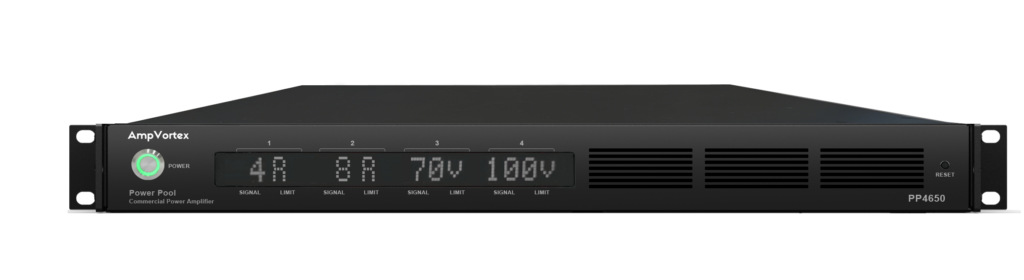
The AmpVortex PP Series includes the PP4650, PP41300, PP42600, and PP45200 professional amplifier models.
The PP4650 combines streaming, DSP processing, matrix routing, amplification, and automation-related capabilities within an integrated commercial audio platform.
As part of its ongoing development roadmap, AmpVortex is evaluating Modbus TCP and BACnet/IP support for the PP Series to expand integration possibilities with building management and automation systems.
Potential integration functions include zone control, volume management, mute control, source selection, and relevant device status monitoring.
The objective is to complement existing audio management functions with standardized interfaces suited to commercial building environments.
Final supported models, protocol capabilities, and availability will be determined following implementation and interoperability testing.
15. Looking Ahead: Open Standards as Long-Term Infrastructure
Modbus and BACnet emerged from different industries and different technical challenges.
Modbus was developed to simplify communication between industrial controllers and equipment.
BACnet was created to address fragmentation across building automation systems.
Both technologies helped reduce dependence on proprietary communication methods.
Their histories demonstrate an important principle: interoperability becomes increasingly valuable as systems grow more complex and equipment from different manufacturers must operate together.
Looking ahead, cybersecurity, energy efficiency, AI-assisted operations, IP networking, and connected infrastructure will continue to influence building automation.
New technologies will emerge, but established communication standards can remain relevant by evolving and operating alongside newer integration methods.
For building owners and system integrators, the long-term objective is not simply to adopt the newest protocol.
It is to create infrastructure that remains secure, interoperable, maintainable, and adaptable.
For manufacturers of building equipment—including professional audio systems—supporting open and documented interfaces can be an important step toward that goal.
The future of building automation is not about connecting more devices. It is about enabling different systems to work together intelligently, securely, and reliably.
AmpVortex develops professional multi-room and commercial audio solutions with a focus on flexible system architecture, open integration, and long-term adaptability.
Learn more: www.ampvortex.com