(317)516-7460
  service@ampvortex.com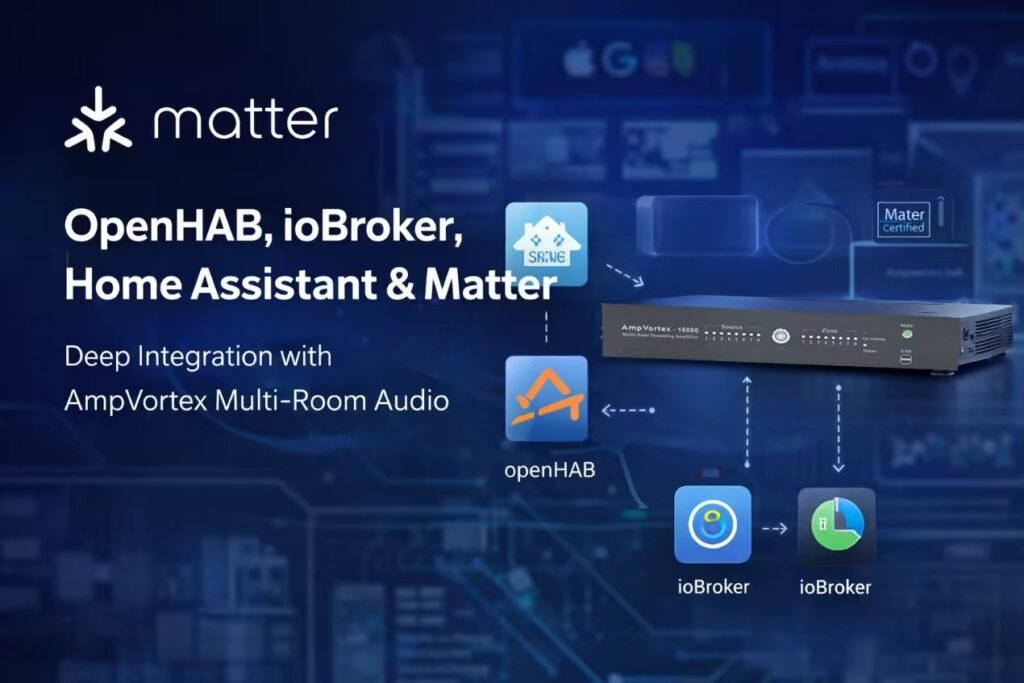
OpenHAB, ioBroker, Home Assistant & Matter: Deep Integration with AmpVortex Multi-Room Audio
As Matter continues reshaping the smart home landscape, open platforms such as Home Assistant, openHAB, and ioBroker are entering a new phase. Instead of relying on cloud bridges or proprietary integrations, these systems can now directly control Matter devices natively.
For high-performance multi-room audio systems like AmpVortex, this transition changes everything.
This article explores the technical relationship between Matter and the three major open automation platforms — and how AmpVortex fits into this architecture.
1. Understanding Matter: Device vs Controller vs Bridge
Before comparing platforms, we must clarify Matter’s architecture.
Matter introduces three essential roles:
1/ Matter Device
A hardware product implementing the Matter protocol stack.
Example:
- AmpVortex multi-room streaming amplifier
2/ Matter Controller
A platform capable of commissioning and controlling Matter devices.
Examples:
- Home Assistant
- openHAB
- ioBroker
- Apple Home
- Google Home
- Alexa
3/ Matter Bridge
Used to expose non-Matter devices into a Matter ecosystem.
Important distinction:
AmpVortex is a native Matter device, not a bridged system.
That means no translation layer, no middleware, and no cloud dependency.
2. Home Assistant: The Most Mature Open Matter Controller
Home Assistant currently offers:
- Native Matter controller support
- Thread border router capability
- Direct local device communication
- Multi-platform bridging (Apple / Google / Alexa)
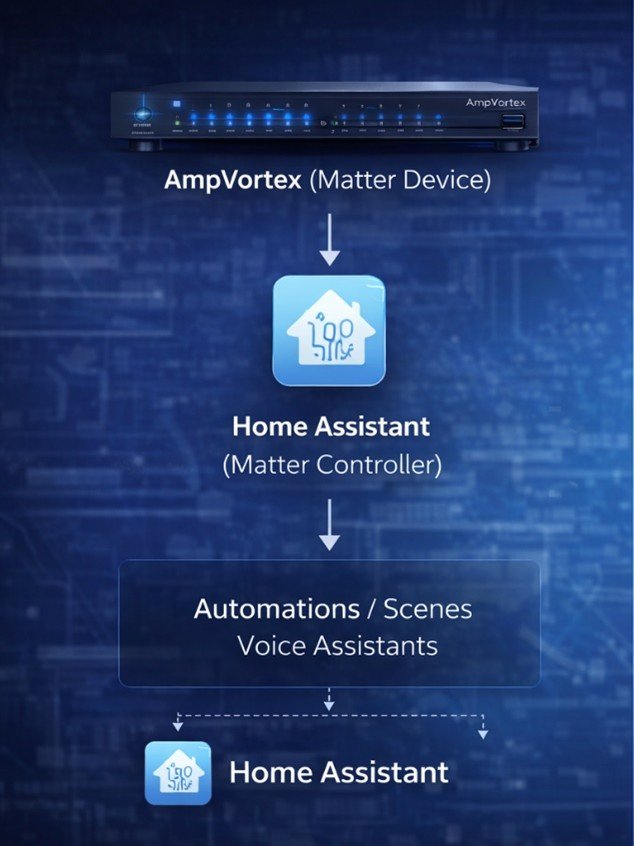
From an architecture perspective:
AmpVortex (Matter Device)
↓
Home Assistant (Matter Controller)
↓
Automations / Scenes / Voice Assistants
Why it matters:
- No MQTT hacks required
- No custom REST polling
- Direct attribute subscription
- Lower latency
For multi-room audio, this means:
- Reliable zone switching
- Stable volume control
- Real-time state feedback
3. openHAB: Structured & European-Focused
openHAB has traditionally been strong in Europe, especially in:
- KNX installations
- Professional integrator environments
- Structured rule engines
Matter support in openHAB:
- Available and evolving
- Less plug-and-play compared to HA
- Highly customizable
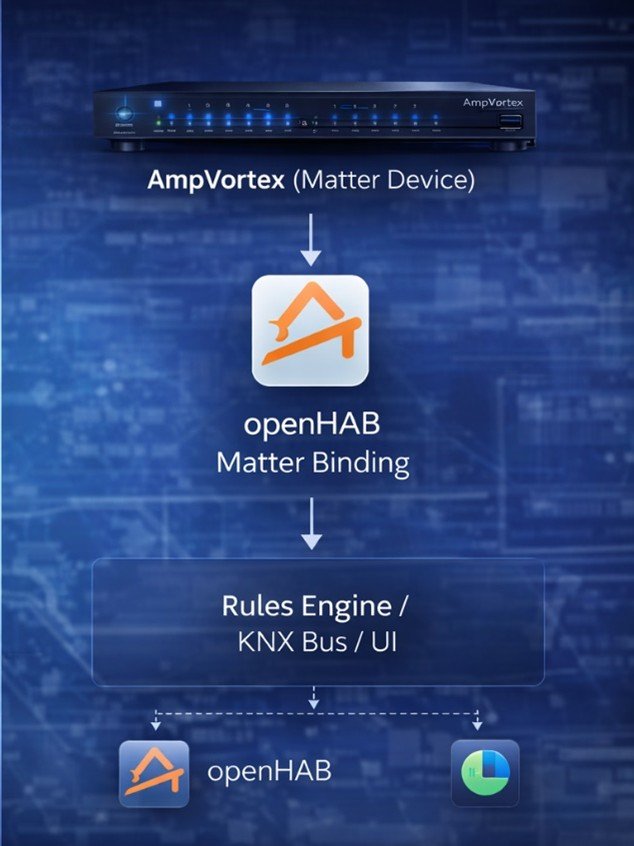
Architecture with AmpVortex:
For European projects combining:
- KNX wall panels
- Multi-room audio
- Hybrid ecosystems
AmpVortex becomes a powerful audio backbone that integrates cleanly into KNX-based environments.
4. ioBroker: Flexible & Developer-Friendly
ioBroker is popular in Germany and among advanced DIY users.
Matter integration:
- Adapter-based
- Rapidly developing
- Highly customizable
While not as polished as Home Assistant yet, ioBroker offers:
- Deep scripting flexibility
- Cross-protocol automation
- Local-first architecture
For power users:
AmpVortex can be integrated directly as a Matter device without requiring:
- Virtual audio bridges
- Custom API polling
- Reverse-engineered drivers
5. Why Native Matter Matters for Multi-Room Audio
Historically, multi-room amplifiers required:
- Proprietary apps
- Cloud-dependent APIs
- Custom drivers per platform
- Separate integration for each ecosystem
With Matter-native architecture:
AmpVortex behaves like a first-class smart device.
This enables:
- Direct zone visibility in controllers
- Unified automation triggers
- Multi-ecosystem compatibility
- Reduced integration complexity
Example household scenario:
- Apple Home user (iOS 17)
- Samsung Galaxy user (Google ecosystem)
- Alexa as voice hub
- openHAB or ioBroker as automation core
Instead of building 4 separate integrations, Matter allows a unified control path.
- AmpVortex as a Matter-Native Multi-Room Platform
AmpVortex differs from legacy multi-room systems because:
- It supports true 8-zone amplification per chassis
- It supports simultaneous streaming
- It integrates with:
- Apple Home
- Google Home
- Alexa
- Home Assistant
- openHAB
- ioBroker
- KNX
- Control4
Most importantly:
It does not require:
- AirPlay-only hacks
- Google Cast bridges
- Cloud-dependent automation
It exposes zones as controllable entities through Matter.
- Large-Scale Projects: 30–60 Zones Architecture
In high-end residential builds:
- 30–60 zones are increasingly common
- Wiring decisions must be made early
- Integration stability is critical
Matter-native devices simplify:
- Commissioning
- Controller pairing
- Long-term ecosystem flexibility
Instead of locking into a single ecosystem, the homeowner retains:
- Platform independence
- Upgrade flexibility
- Future compatibility
- OpenHAB vs ioBroker vs Home Assistant: Practical Comparison
| Feature | Home Assistant | openHAB | ioBroker |
| Matter maturity | ⭐⭐⭐⭐⭐ | ⭐⭐⭐ | ⭐⭐–⭐⭐⭐ |
| European popularity | ⭐⭐⭐ | ⭐⭐⭐⭐ | ⭐⭐⭐⭐ |
| KNX strength | ⭐⭐⭐ | ⭐⭐⭐⭐⭐ | ⭐⭐⭐ |
| Ease of use | High | Medium | Medium |
| Custom scripting | High | Very High | Very High |
| Best for | Mixed ecosystems | KNX-heavy installs | DIY power users |
- The Future: Local-First Smart Homes
The real shift is not just Matter.
It is local-first architecture.
AmpVortex + open automation platforms provide:
- Local control
- Reduced cloud dependency
- Faster response time
- Higher reliability
For professional installations, this matters more than marketing claims.
Conclusion
Matter has redefined how open automation platforms interact with devices.
Home Assistant, openHAB, and ioBroker are no longer relying on fragile integrations. They can now act as native Matter controllers.
When combined with a Matter-native multi-room amplifier like AmpVortex, the result is:
- Scalable whole-home audio
- Cross-ecosystem compatibility
- Professional-grade integration
- Future-proof architecture
The smart home is no longer ecosystem-bound.
It is protocol-driven.
And Matter is the foundation.
For more information, please visit https://www.ampvortex.com/