(317)516-7460
  service@ampvortex.com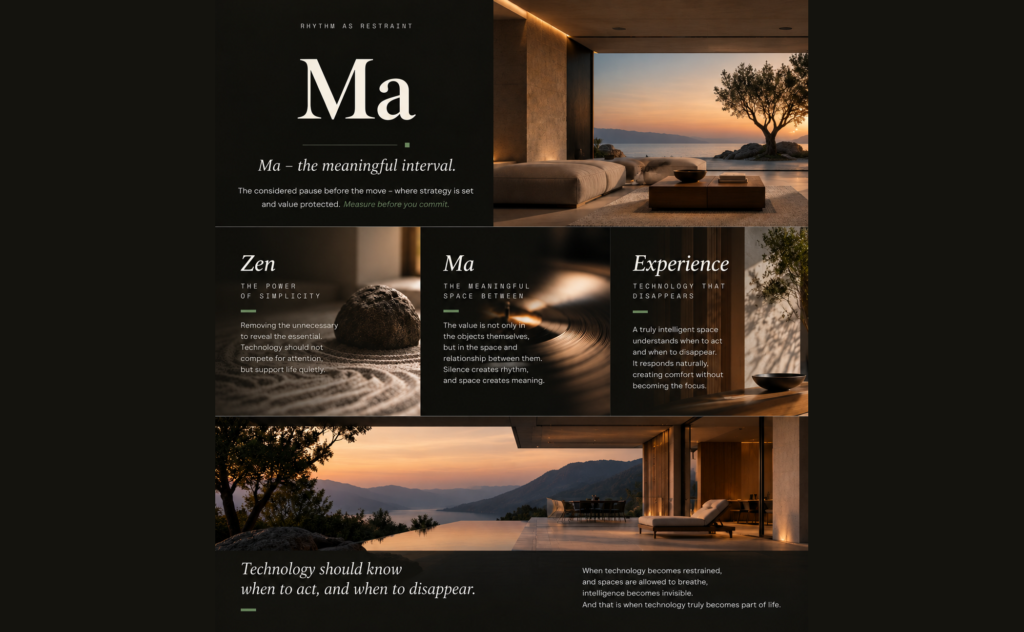
Zen and Ma: When Technology Learns to Disappear From technology as a presence to technology as an experience
In the evolution of modern technology, we have often measured progress by addition.
More features.
More functions.
More control.
More complexity.
Technology has always tried to prove its value by making itself visible.
But in the world of high-end architecture, luxury hospitality, and intelligent living, a different philosophy is emerging:
The most advanced technology is often the one you barely notice.
It does not ask for attention.
It quietly enhances the experience of a space.
This idea can be found in two profound concepts from East Asian aesthetics: Zen and Ma.
Zen: Removing the Unnecessary to Reveal the Essential
Zen is often associated with simplicity and calmness.
However, Zen is not simply about having less.
It is about understanding what truly matters.
In design, Zen asks:
What can be removed without reducing the experience?
A Zen-inspired space does not compete for attention.
It avoids visual noise.
It avoids unnecessary complexity.
The best lighting system does not constantly remind you that it is operating.
The best audio system does not demand to become the center of the room.
The best automation system does not force people to interact with technology.
Instead, technology becomes a natural part of the environment.
It supports life without interrupting it.
Ma: The Meaningful Space Between Things
The Japanese concept of Ma is often translated as “space,” “interval,” or “pause.”
But Ma represents something deeper:
The relationship between things.
The value is not only in the objects themselves, but in the space and connection between them.
In music, silence is not the absence of sound.
The pause between notes creates rhythm, emotion, and anticipation.
Without silence, music becomes a continuous stream of noise.
That meaningful interval is Ma.
In architecture, the empty space between walls, the relationship between light and shadow, and the distance between people and their surroundings all contribute to the experience.
The space between things is not empty.
It is where meaning is created.
Beyond Function: Designing Experiences
Smart living has also gone through a transformation.
The first generation of smart technology focused on:
More functions.
More devices.
More controls.
More options.
The next generation focused on:
More connectivity.
Lighting, climate, security, entertainment, and automation began working together.
But the future of intelligent spaces requires something more:
Technology must understand when to act — and when to disappear.
A truly intelligent environment does not constantly ask for attention.
It responds naturally.
It adapts quietly.
It creates comfort without becoming the focus.
Music, Space, and the Art of Listening
Music is perhaps one of the clearest examples of Ma.
Sound alone does not create a musical experience.
Music exists because sound and silence exist together.
The same principle applies to architectural audio.
A sophisticated audio system is not simply about playing louder or adding more speakers.
It is about understanding the character of a space:
A living room that encourages conversation.
A restaurant that creates atmosphere.
A hotel lobby that shapes the first impression.
A private suite that provides relaxation.
The technology should not dominate the space.
The space should define the technology.
Technology Should Know When to Act, and When to Disappear
The future of intelligent spaces is not about giving people more things to control.
It is about creating environments that better understand people.
Great technology:
Appears when needed.
Responds when requested.
Disappears when unnecessary.
This is the lesson of Zen and Ma.
Zen teaches us the power of simplicity.
Ma teaches us the value of the space between.
When technology becomes restrained, and when spaces are allowed to breathe, intelligence becomes invisible.
And that is when technology truly becomes part of life.
For more information, please visit www.ampvortex.com