(317)516-7460
  service@ampvortex.com
Two High-Level Architectures for PA Integration with DSP Amplifiers
1. Overview
Public Address (PA) systems are widely deployed across hotels, offices, commercial buildings, campuses and other public facilities for paging, background music and emergency voice applications.
At the system level, integrating a PA system with a DSP-equipped amplifier requires two fundamental functions:
- Event Signaling— notifying the amplifier that a paging or emergency broadcast event has started or ended, and identifying the zones affected.
- Audio Transport— delivering the paging or emergency audio signal to the amplifier for routing to the required speaker zones.
From a high-level system architecture perspective, these functions can generally be implemented in two ways:
Architecture 1 — Hardwired Trigger + Dedicated Priority Audio Path
Control signaling and broadcast audio are transported through separate physical paths.
Architecture 2 — Network Control + IP Audio
Control signaling and broadcast audio are both transported over the IP network.
These two architectures represent the most common high-level approaches used in professional PA and building-audio integration.
AmpVortex Note: AmpVortex PP4650 and AmpVortex 16xxx platforms are designed to accommodate both integration architectures. Trigger logic, priority behavior, network control protocols and PA system interoperability can be configured or implemented according to project requirements.
2. Architecture 1: Hardwired Trigger + Dedicated Priority Audio Path
2.1 System Principle
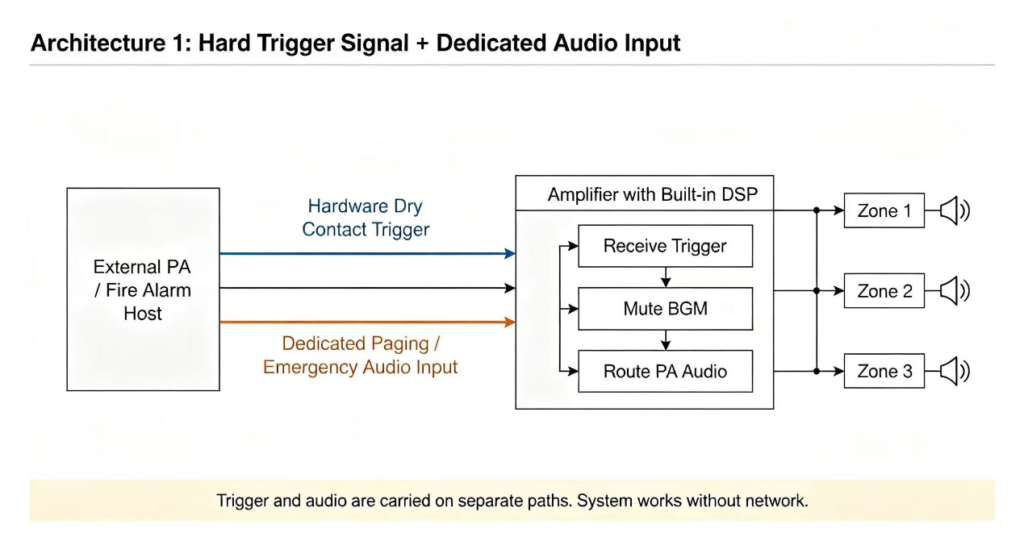
In this architecture, PA event signaling and broadcast audio use two physically independent signal paths.
Hardwired Trigger Signal
An external PA controller, fire alarm interface or building system provides a physical trigger signal to the amplifier.
A dry-contact relay is one of the most common implementations, although voltage/level trigger signals or other supported hardware interfaces may also be used depending on the system design.
The trigger informs the amplifier that a paging or emergency broadcast event has started.
Dedicated Priority Audio Path
A separate audio path carries the paging or emergency voice signal to the amplifier.
This dedicated audio path is not inherently restricted to analog line-level audio. Depending on the amplifier and overall system architecture, analog, digital or other supported audio interfaces may be used.
The fundamental architectural principle is that the broadcast audio path is independent of the trigger/control path.
A typical operating sequence is:
PA event starts → Hardwired trigger activated → Amplifier enters priority mode → Background music is muted or attenuated → Priority audio is routed to selected zones → Announcement ends → Trigger released → Previous background music state is restored.
Priority logic, for example:
Emergency Broadcast > Normal Paging > Background Music
may be managed by the external PA controller, the amplifier DSP, or a combination of both, depending on the overall system design.
Zone selection can support single-zone, multi-zone or all-zone broadcast through external trigger logic and amplifier configuration.
2.2 Key Benefits and Considerations
Key benefits include network-independent triggering, clear separation between control and audio, broad cross-vendor compatibility and predictable system behavior.
Hardwired triggering is also commonly used for fire alarm and emergency voice integration where a physical interface is required by the system design or applicable regulations.
Actual fire and life-safety compliance depends on the complete certified system design, supervision requirements, equipment approvals and applicable local regulations.
The main consideration is additional field wiring. Separate cabling may be required for trigger/control signals, priority audio and zone-specific control, increasing installation complexity compared with a fully networked architecture.
Typical applications include conventional PA systems, fire alarm interfaces, hotels, commercial buildings, offices, retail facilities and projects where paging operation should not depend on the building LAN.
A typical system topology is:
PA Controller → Hardwired Trigger → Amplifier Control Input
and simultaneously:
PA Audio Output → Dedicated Priority Audio Path → Amplifier DSP → Selected Speaker Zones
3. Architecture 2: Network Control + IP Audio
3.1 System Principle
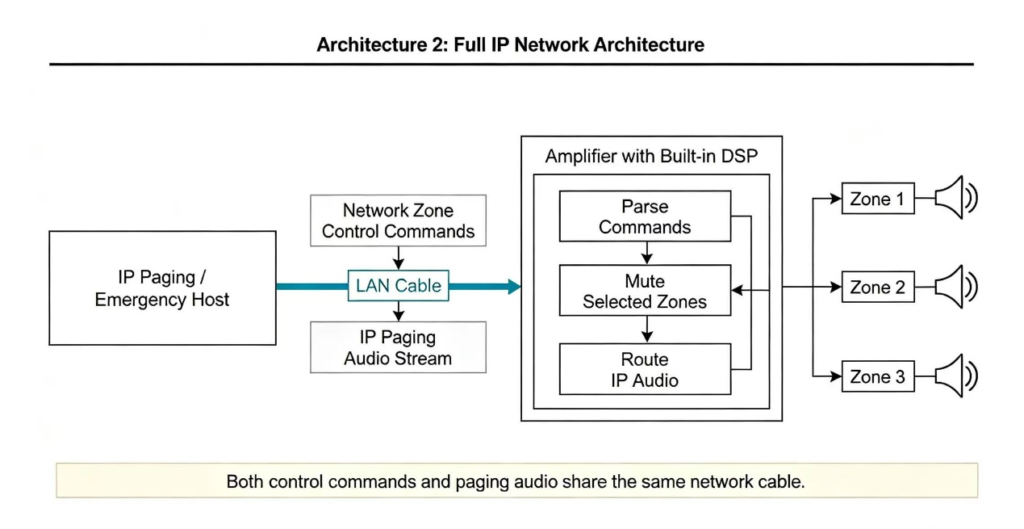
In a full IP architecture, both PA control information and broadcast audio are transported over a common IP network infrastructure.
Instead of providing separate point-to-point trigger and audio cabling, an external IP paging or PA platform communicates directly with the amplifier over the LAN.
Two primary types of information are transmitted:
Network Control Commands
The PA system sends commands indicating broadcast start and stop, target zones, background music mute or attenuation, priority state and audio routing requirements.
Depending on the implementation, additional commands and status information may also be supported.
IP Audio Stream
Paging or emergency audio is transmitted as a network audio stream.
Depending on the system design, this may use technologies such as RTP, Dante, AES67 or other supported IP audio protocols.
The amplifier receives the audio stream, processes it through its DSP and routes it to the required speaker zones.
A typical operating sequence is:
PA event starts → PA host sends network control command → Amplifier identifies target zones → Background music is muted or attenuated → IP audio stream is received → DSP routes the stream to selected outputs → Announcement ends → Broadcast session terminates → Previous background music state is restored.
One of the major advantages of this architecture is software-defined zoning. The PA controller can dynamically address a single zone, multiple zones, predefined zone groups or all zones without requiring individual physical trigger lines for each destination.
3.2 Key Benefits and Considerations
Key benefits include simplified infrastructure, flexible software-defined zoning, scalability, centralized management and reduced point-to-point control and audio cabling.
A common IP network infrastructure can carry both control and audio traffic. Additional amplifiers, zones and paging endpoints can therefore be added without reproducing the same quantity of dedicated trigger wiring.
The architecture is also well suited to centralized or remote operation and modern smart-building environments where PA, AV, automation, BMS and other systems increasingly share IP infrastructure.
Depending on the implementation, network integration may also support advanced functions such as device status, zone status, broadcast status, fault reporting, remote configuration and event logging.
The principal consideration is network availability.
Unlike a physically independent trigger architecture, a full IP implementation relies on network communication between the PA host and amplifier. Projects requiring high availability may therefore require appropriate network design measures such as redundancy, network supervision, redundant switches or links, VLAN design, QoS and backup power infrastructure.
For fire and life-safety applications, a network-only architecture should not automatically be assumed to satisfy applicable regulations. Acceptance depends on the certified system architecture, equipment approvals, redundancy and supervision design, and applicable local requirements.
Typical applications include IP paging systems, smart buildings, hotels and resorts, corporate campuses, shopping centres, transportation facilities, multi-building projects and other networked AV installations.
A typical system topology is:
IP PA / Paging Host → Ethernet Network → Network Control + IP Audio → Amplifier DSP → Selected Speaker Zones
4. Architecture Comparison
Item | Architecture 1: Hardwired Trigger + Dedicated Priority Audio | Architecture 2: Network Control + IP Audio |
Event Trigger | Dry contact, level trigger or other hardware interface | Network control command |
Audio Transport | Dedicated audio path | IP audio stream |
Control & Audio | Physically separate | Shared IP infrastructure |
Zone Capability | Single, multiple or all zones according to trigger logic and configuration | Flexible software-defined single, multiple, grouped or all-zone paging |
Network Dependency | Trigger/control can operate independently of LAN | Depends on network availability |
Field Wiring | Requires dedicated trigger and audio paths | Reduced point-to-point wiring |
Scalability | Additional zones may require additional control infrastructure | Highly scalable through network configuration |
Remote Operation | More dependent on external control infrastructure | Naturally suited to centralized and remote operation |
Cross-Vendor Integration | Straightforward through standard hardware interfaces | Requires compatible network protocols/APIs |
Typical Application | Conventional PA, fire alarm interfaces and straightforward building integration | IPAV, smart buildings and large networked PA systems |
Life-Safety Integration | Commonly suited to hardwired fire-alarm interfaces | Possible where supported by certified system architecture and applicable regulations |
Main Advantage | Simplicity, predictability and network-independent triggering | Flexible zoning, scalability and reduced dedicated cabling |
Main Consideration | Additional field wiring | Network availability, interoperability and redundancy |
5. Hybrid Architecture
Although the two architectures above represent the two fundamental integration models, they do not need to be mutually exclusive.
In many projects, a hybrid architecture can combine the advantages of both approaches.
For example, normal paging and background music distribution may use network control and IP audio, while a hardwired emergency trigger remains available as an independent priority mechanism.
A typical hybrid design could therefore use:
Normal Operation: Network Control + IP Audio
Emergency Override: Hardwired Trigger + Dedicated Priority Audio
This allows a project to benefit from the flexibility of network-based PA while retaining a physically independent control mechanism where required by the system design.
The appropriate implementation should always be selected according to the overall PA/VA system architecture and applicable project requirements.
6. AmpVortex PA Integration
AmpVortex DSP amplifier platforms are designed to support flexible integration with external PA, paging and building systems.
6.1 AmpVortex PP4650
The AmpVortex PP4650 commercial amplifier platform combines professional amplification, integrated DSP, flexible audio routing, network connectivity, Dante/AES67 network audio, native music streaming and commercial distributed-audio support within a single platform.
This architecture allows the PP4650 to participate in both conventional hardwired PA integration and modern network-based PA deployments.
In a typical commercial environment, background music can operate under normal conditions while external PA events trigger priority behavior, including background music attenuation or mute, priority audio routing and zone-specific broadcast.
6.2 AmpVortex 16xxx Series
The AmpVortex 16060 multi-zone platform combines multi-zone amplification, DSP, matrix audio routing, native music streaming, zone management, network connectivity and automation integration.
The platform can therefore participate in PA integration where paging events require background music interruption, priority routing and zone-specific audio distribution.
For both PP4650 and 16xxx platforms, specific trigger logic, PA protocols, routing behavior and integration requirements can be configured or implemented according to the project architecture.
7. Project Selection and Integration Requirements
7.1 Architecture Selection
The appropriate PA integration architecture should be selected according to the existing PA infrastructure, zone requirements, network design, system interoperability requirements and applicable fire and life-safety regulations.
If the project already uses a conventional PA controller with relay outputs and dedicated audio outputs, Architecture 1 will often provide the most straightforward integration path.
If the project is based on an IP paging platform, Architecture 2 may provide greater zoning flexibility, scalability and centralized management.
Projects requiring both network flexibility and an independent emergency interface may adopt a hybrid architecture.
The reliability, redundancy and management of the building LAN should be considered when evaluating a full IP architecture.
For fire and life-safety applications, the complete system must follow the applicable regulations and certified architecture for the project location. No individual interface method — including dry contact or IP — should by itself be considered evidence of overall fire-code compliance.
7.2 Information Required for Integration
Once the preferred architecture has been identified, the relevant PA system information should be provided to AmpVortex for integration evaluation.
For a hardwired architecture, this typically includes:
- Trigger type
- Trigger voltage/contact specification
- Number of trigger inputs
- Required zone mapping
- Priority hierarchy
- Priority audio interface
- Required mute or attenuation behavior
- Background music restoration behavior
For an IP architecture, this typically includes:
- PA host manufacturer and model
- Network control protocol or API documentation
- Audio transport protocol
- Stream format
- Zone addressing method
- Session start/stop behavior
- Priority requirements
- Network topology
- Redundancy requirements
- Required status or event feedback
Based on this information, AmpVortex can determine the appropriate configuration, firmware implementation and system integration approach for the project.
8. Summary
At the macro system level, PA integration with DSP amplifiers can be understood through two fundamental architectures.
Architecture 1 — Hardwired Trigger + Dedicated Priority Audio Path
A physical trigger — commonly a dry contact — initiates the PA priority state, while broadcast audio is delivered through an independent dedicated audio path.
This architecture provides straightforward interoperability, predictable operation and network-independent triggering, and is commonly used in conventional PA and fire-alarm integration.
Architecture 2 — Network Control + IP Audio
PA event control and broadcast audio are transported through the IP network.
This architecture enables software-defined zoning, scalable deployment, centralized management and reduced dedicated control/audio cabling, making it particularly suitable for modern IPAV and smart-building environments.
A hybrid implementation can also combine network-based normal paging with an independent hardwired emergency override.
AmpVortex PP4650 and 16xxx platforms are designed to accommodate these integration approaches, allowing system integrators and consultants to select the architecture that best matches the project’s PA infrastructure, network design, zoning requirements and applicable fire and life-safety regulations.
For more information, please visit www.ampvortex.com