(317)516-7460
 service@ampvortex.com
As AI Becomes a Hotel Control Layer, Audio Infrastructure Needs to Be Ready
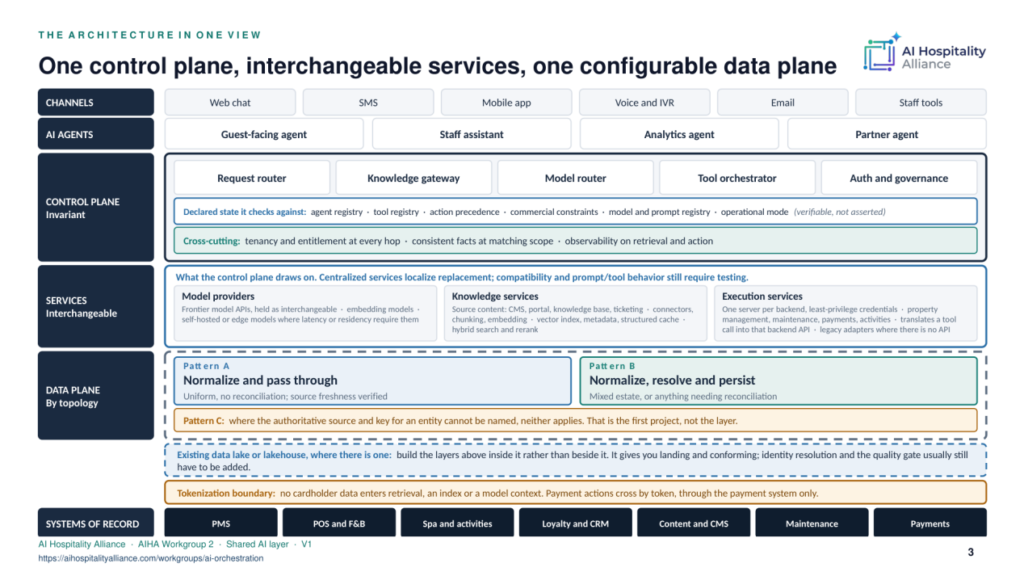
The AI Hospitality Alliance (AIHA) has released its AI Orchestration Framework for Hospitality, proposing a shared integration and control layer between AI agents and the systems that operate a hotel.
The direction is significant.
Hospitality AI is beginning to move beyond answering questions and generating recommendations. The longer-term opportunity is for authorized AI agents to coordinate actions across the hotel environment — while the systems responsible for those actions remain secure, deterministic and auditable.
For the professional AV industry, this raises an important question:
Is hotel audio infrastructure ready to become part of this connected environment?
From Hotel Software to the Physical Hotel
A hotel is much more than its PMS, CRM, booking engine or guest application.
The actual guest experience takes place in a physical environment:
Guest rooms.
Restaurants.
Bars.
Lobbies.
Lounges.
Meeting spaces.
Pools.
Spas.
Outdoor areas.
Lighting, HVAC and room controls are increasingly connected to hotel technology platforms.
Audio should be considered part of that infrastructure as well.
Imagine a guest interacting with an authorized hotel AI assistant:
“Play some relaxing music in my room.”
“Turn the music down.”
Or imagine hotel operations using intelligent workflows:
“Switch the lobby to the evening playlist.”
“Reduce the restaurant background music after 10 PM.”
“Activate the event audio preset in the ballroom.”
The AI does not need to become the audio system.
It needs a secure and predictable way to communicate intent to the audio infrastructure.
The Principle Matters: AI Proposes, Systems Execute
One of the most important principles in the AIHA framework is straightforward:
Models propose. Deterministic code acts.
That distinction is particularly relevant to professional AV.
An AI model should not directly control an amplifier simply because it generated a command.
Instead, the request should pass through defined authorization, policy and integration layers before the audio platform executes an approved action.
Conceptually:
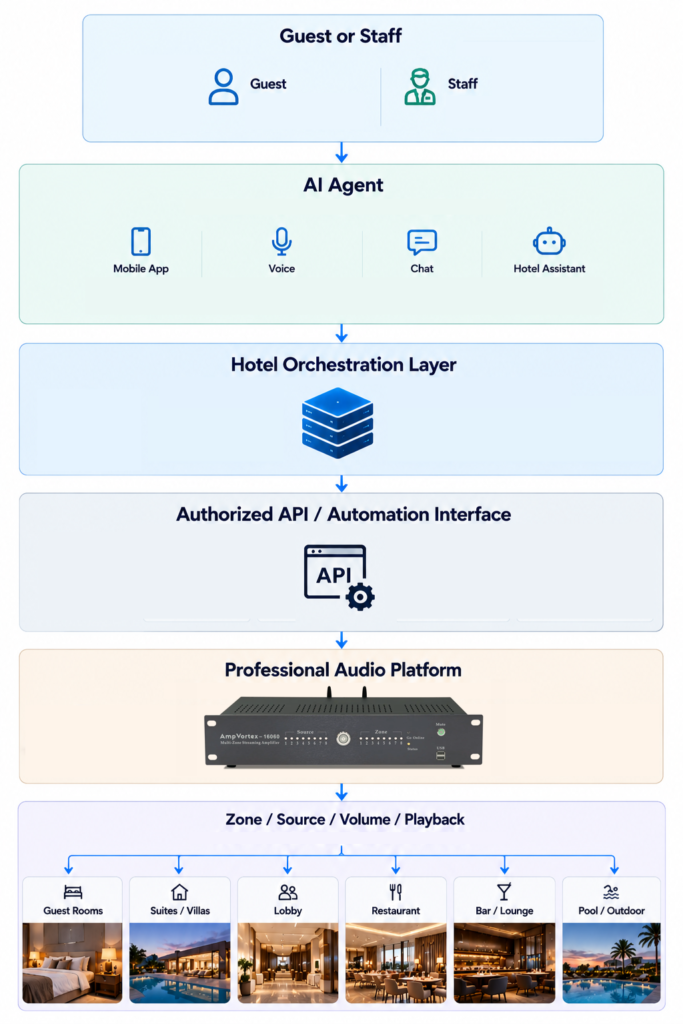
The intelligence may be new.
The requirement for reliable professional audio infrastructure is not.
Why Integrated Audio Platforms Matter
Traditional commercial audio systems are often assembled from multiple independent components:
Streaming sources, DSP processors, matrix systems, amplifiers and automation interfaces may all be separate devices.
That architecture can work well, but as hotel technology becomes increasingly software-driven, every additional system can also become another integration point.
AmpVortex takes a more integrated approach.
For hotel public areas and commercial spaces, AmpVortex platforms can combine:
- 70V/100V and Lo-Z amplification
- Network streaming
- DSP and EQ
- Audio matrix and routing
- Multi-zone control
- Automation integration
- Web-based management and API connectivity
Instead of treating audio as an isolated amplifier at the end of the signal chain, this creates a network-connected audio platform that can participate in a broader building and hospitality technology architecture.
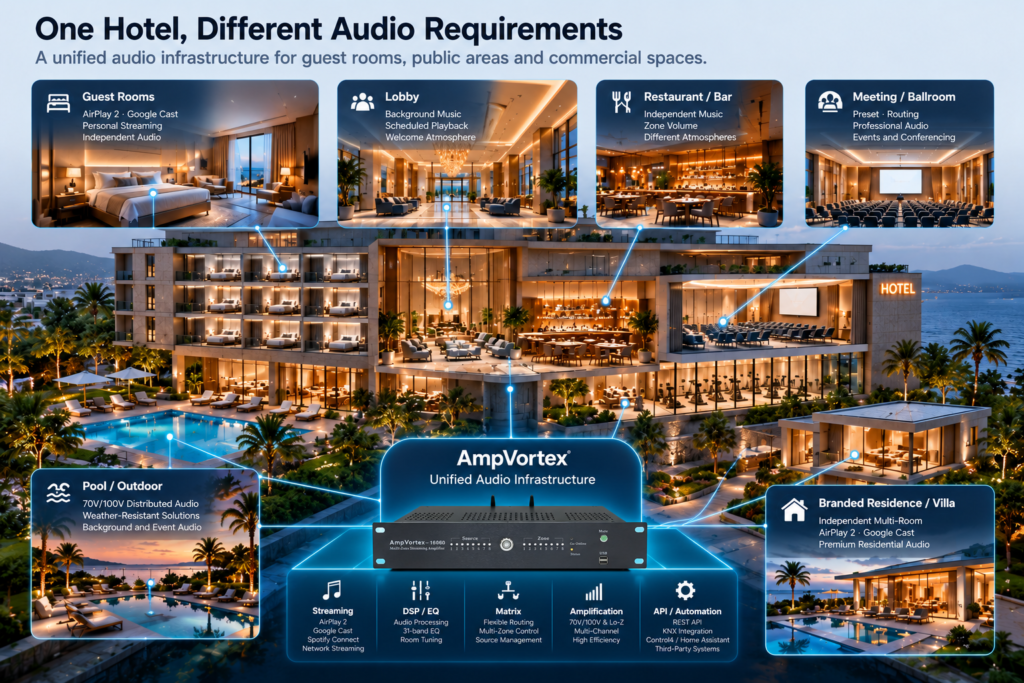
One Hotel, Different Audio Requirements
Hotels do not have one audio requirement.
They have several.
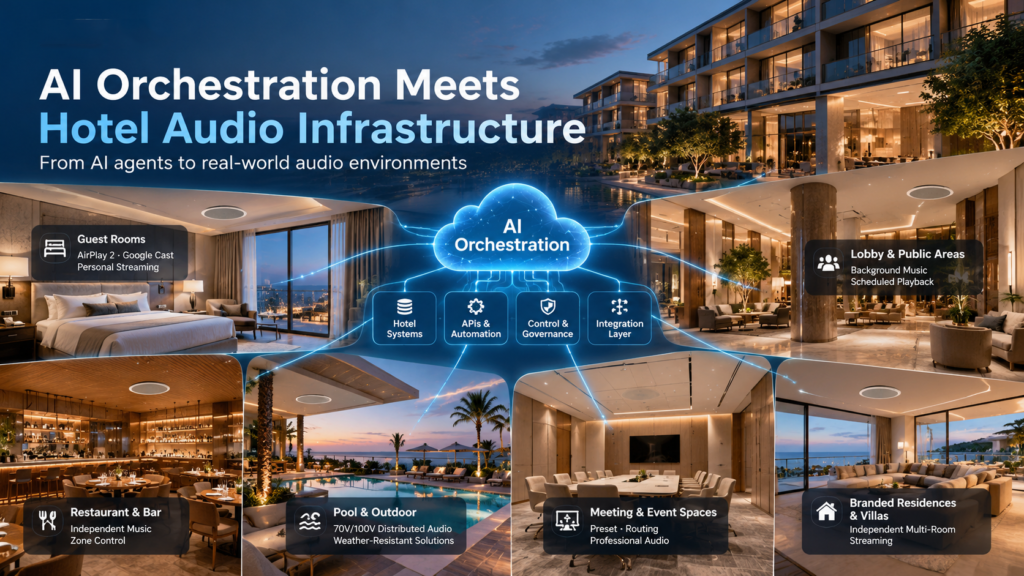
Hotel Guest Rooms
Guest-room audio increasingly needs to work with the devices and services guests already use.
AirPlay 2 and Google Cast provide familiar ways for guests to access personal content without requiring them to learn another proprietary music interface.
Hotel Public Areas
Lobbies, restaurants, bars, corridors, pools and other public areas require a different architecture.
Here, 70V/100V distributed audio, centralized streaming, DSP, matrix routing and zone control become more important.
Different areas may require different music, different schedules and different volume levels throughout the day.
Private Villas and Branded Residences
Premium residences introduce another requirement: multiple family members or guests may want independent music in different rooms simultaneously.
AmpVortex multi-room platforms can support 8 independent AirPlay 2 streams and 8 independent Google Cast streams, together with centralized amplification and smart-home integration.
The technologies differ, but the underlying direction is the same:
Audio is becoming part of the networked property infrastructure.
From API Integration to Hotel-Wide Workflows
The AIHA framework also highlights event-driven coordination between hotel systems.
This opens interesting possibilities beyond voice commands.
A future hotel workflow could connect operational events with the audio environment.
For example:
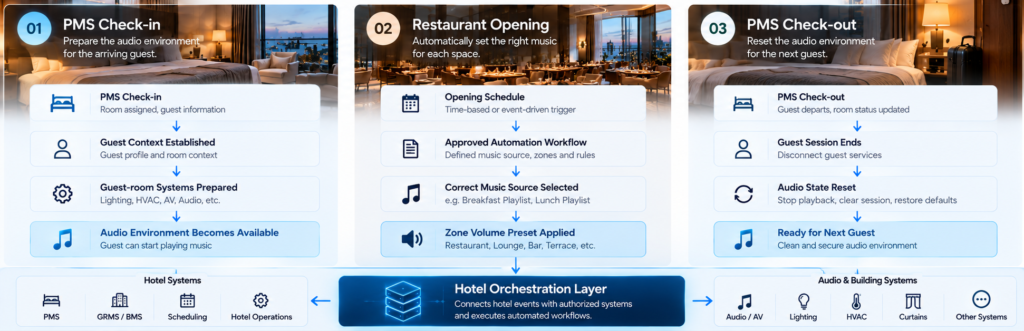
PMS Check-in
→ Guest context established
→ Guest-room systems prepared
→ Audio environment becomes available
Or:
Restaurant opening schedule
→ Approved automation workflow
→ Correct music source selected
→ Zone volume preset applied
Or:
PMS Check-out
→ Guest session ends
→ Guest-room audio state reset
The purpose is not to add AI simply because AI is fashionable.
It is to make hotel systems easier to coordinate while keeping execution reliable and controlled.
Building Audio Infrastructure for the Next Hotel Technology Stack
The AI Hospitality Alliance framework is an important signal about where hotel technology may be heading.
AI agents may become another interface through which guests and hotel staff interact with the property.
But an intelligent interface is only useful when the infrastructure behind it can respond.
For professional audio manufacturers, this means the next generation of hotel audio should not only deliver sound.
It should also be:
Networked.
Addressable.
Controllable.
Integrable.
API-ready.
At AmpVortex, this is the direction we are building toward — connecting streaming, amplification, DSP, matrix routing and automation into a unified audio platform for modern hospitality environments.
Because as hotels become more intelligent, the audio infrastructure behind them needs to be ready too.
For more information, please visit: www.ampvortex.com