(317)516-7460
  service@ampvortex.com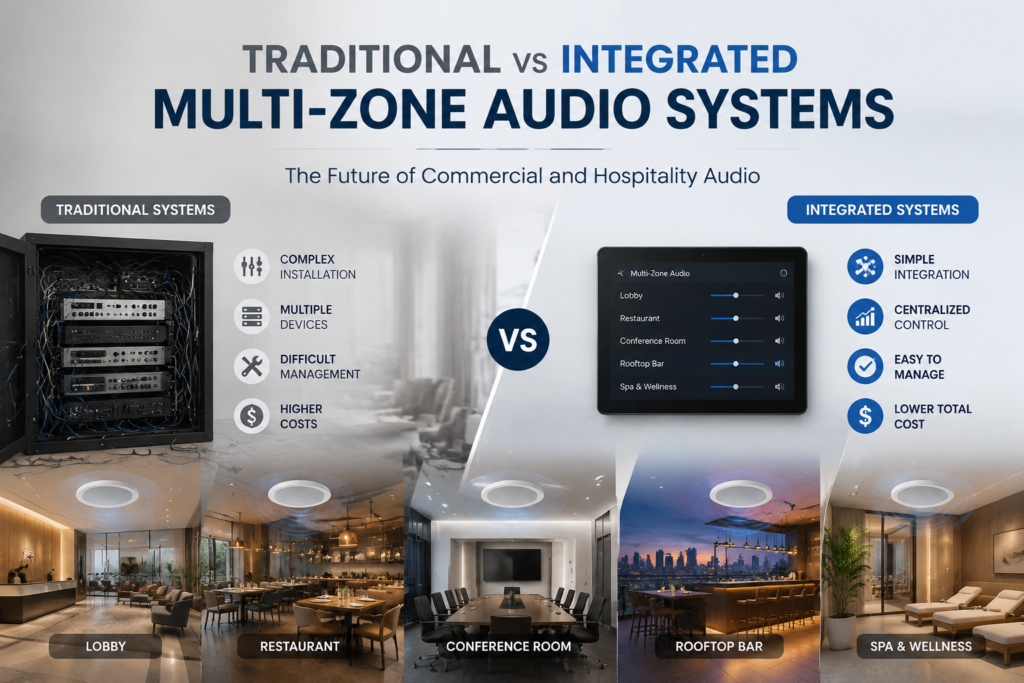
Traditional vs Integrated Multi-Zone Audio Systems: The Future of Commercial and Hospitality Audio
Introduction
For decades, commercial and hospitality audio systems have relied on a traditional architecture built with multiple independent devices: streaming players, audio matrix controllers, DSP processors, and multi-channel amplifiers.
This approach has been widely adopted for hotels, resorts, restaurants, retail spaces, and commercial buildings.
However, as modern projects demand better guest experiences, smarter automation, and easier system management, traditional multi-zone audio architectures are becoming increasingly complex.
The industry is moving toward a new generation of integrated multi-zone audio systems — platforms that combine streaming, DSP processing, amplification, zone management, and automation integration into one unified solution.
One platform. Less complexity. More control.
What Is a Traditional Multi-Zone Audio System?
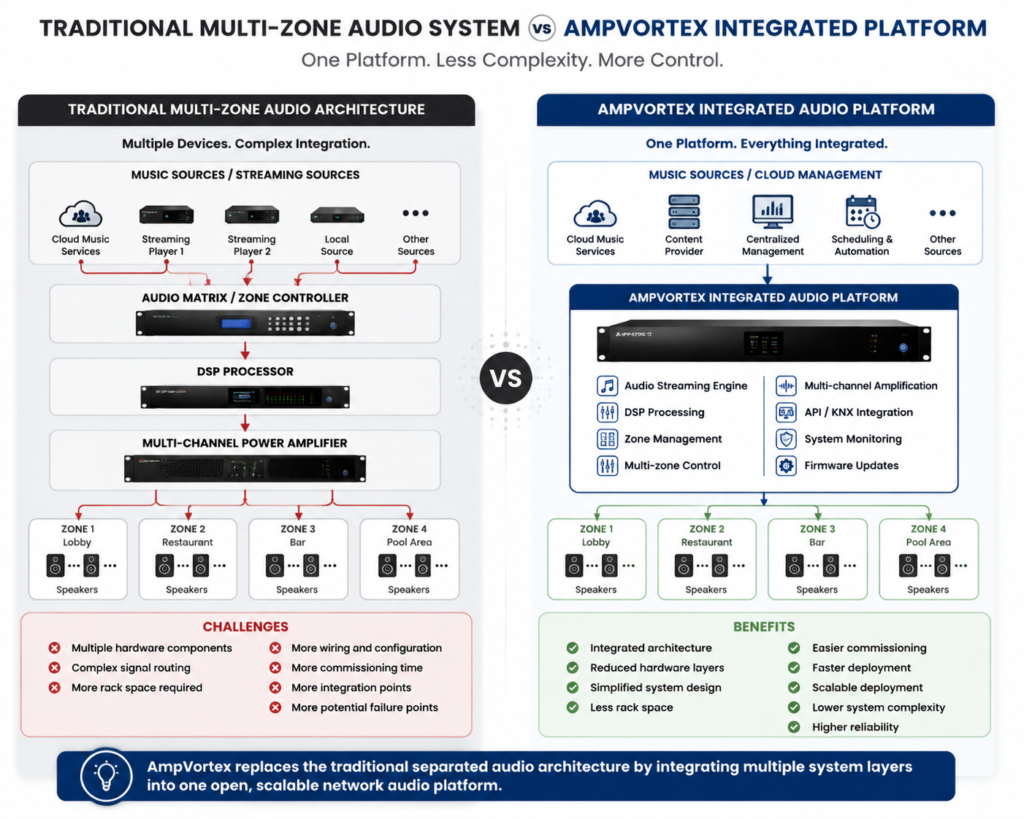
A traditional multi-zone audio system is usually built by combining several separate hardware components.
A typical architecture includes:
- Independent streaming players
- Audio matrix or zone controllers
- DSP processors
- Multi-channel power amplifiers
- Separate control systems
Each device performs a specific function.
For example:
A streaming player provides music sources.
An audio matrix manages signal routing.
A DSP processor handles audio processing.
A power amplifier drives speakers in different zones.
While this modular architecture provides flexibility, it also creates additional complexity during installation, commissioning, and maintenance.
Challenges of Traditional Commercial Audio Systems
1. Multiple Hardware Components Increase Complexity
Traditional distributed audio systems often require multiple devices working together.
This results in:
- More rack space requirements
- More wiring connections
- More configuration steps
- More potential failure points
For hospitality projects, where reliability is critical, system complexity directly affects operational efficiency.
2. Complicated Integration with Modern Building Systems
Modern hotels and commercial buildings increasingly require audio systems to integrate with:
- Smart room controls
- Building automation systems
- Touch panels
- Mobile applications
- Scheduling platforms
Traditional solutions often require additional gateways or interfaces to connect different systems.
This increases engineering effort and commissioning time.
3. Limited Scalability for Future Requirements
Today’s guests expect more personalized experiences.
They want to:
- Stream their own music
- Connect their mobile devices
- Control entertainment systems easily
Meanwhile, hotel operators need:
- Centralized management
- Reliable operation
- Easy maintenance
- Future expansion capability
Traditional architectures can become difficult to upgrade when new requirements appear.
The Evolution: Integrated Multi-Zone Audio Platforms
An integrated audio platform combines multiple system layers into a single professional audio solution.
Instead of connecting separate streaming devices, processors, controllers, and amplifiers, an integrated platform brings these functions together.
Key Features of an Integrated Audio Platform
1. Built-In Audio Streaming
Modern commercial and hospitality audio systems need flexible music sources.
Integrated platforms support advanced streaming experiences, including:
- AirPlay 2
- Google Cast
- Spotify Connect
- Network audio services
This allows users to enjoy familiar streaming experiences while maintaining professional system control.
2. Integrated DSP Processing
Digital signal processing is essential for professional audio environments.
Built-in DSP enables:
- Zone-specific audio tuning
- Equalization
- Signal optimization
- System protection
By integrating DSP functions, the system reduces the need for additional hardware and simplifies installation.
3. Multi-Channel Amplification and Zone Management
A modern multi-zone audio system must support multiple independent spaces.
Examples include:
- Hotel lobby
- Restaurant
- Bar
- Pool area
- Guest rooms
- Villas
Integrated amplification provides:
- Independent zone control
- Simplified speaker connection
- Reduced rack requirements
- Easier deployment
4. Smart Building and Automation Integration
Professional hospitality audio is no longer an isolated system.
Modern solutions need to communicate with other technologies.
AmpVortex supports integration with:
- KNX
- Control4
- RTI
- Web API
This enables intelligent scenarios such as:
- Welcome music during guest arrival
- Scheduled background music
- Automated volume control
- Room-based audio experiences
Why Integrated Audio Platforms Are Important for Hospitality
Hotels and resorts are increasingly competing through guest experience.
Audio is no longer only about background music.
It contributes to:
- Brand atmosphere
- Emotional connection
- Guest satisfaction
- Premium experiences
Guest Room Audio Experience
Modern travelers are familiar with personal streaming.
A hospitality audio system should allow guests to easily access their own content while maintaining hotel control and reliability.
Applications include:
- Guest room streaming
- Luxury villa entertainment
- Suite audio systems
- Smart room integration
Public Area Background Music Systems
Public spaces require different audio environments.
A lobby may require elegant background music.
A restaurant may require dynamic playlists.
A pool area may require independent volume control.
An integrated multi-zone audio system enables hotels to manage different areas from one platform.
Integrated Audio System vs Traditional Audio System
| Traditional Multi-Zone Audio System | Integrated Audio Platform |
Architecture | Multiple independent devices | Unified platform |
Streaming | External streaming players | Built-in streaming engine |
DSP Processing | Separate processor required | Integrated DSP |
Zone Management | Multiple control layers | Centralized control |
Automation | Additional integration work | Native API integration |
Installation | More wiring and configuration | Simplified deployment |
Maintenance | More components to manage | Lower system complexity |
Scalability | Limited by hardware architecture | Flexible expansion |
Applications of Integrated Multi-Zone Audio Systems
Integrated audio platforms are suitable for:
Hotels and Resorts
- Guest rooms
- Villas
- Lobbies
- Restaurants
- Wellness areas
- Entertainment spaces
Luxury Residential Projects
- Multi-room audio
- Smart home integration
- Villa entertainment systems
Commercial Buildings
- Retail stores
- Restaurants
- Corporate spaces
- Background music systems
The Future of Commercial and Hospitality Audio
The future of professional audio is not about adding more separate devices.
It is about creating smarter, simpler, and more connected systems.
Integrated multi-zone audio platforms provide:
✓ Simplified system architecture
✓ Reduced hardware complexity
✓ Faster commissioning
✓ Easier maintenance
✓ Better automation integration
✓ Improved guest experience
✓ Long-term scalability
As hotels and commercial buildings continue to adopt smart technologies, integrated audio platforms will become a key foundation for creating intelligent audio experiences.
Conclusion
Traditional multi-zone audio systems have served commercial projects for many years. However, modern hospitality and smart building applications require a more flexible approach.
By integrating streaming, DSP processing, amplification, zone management, and automation into one platform, AmpVortex helps system designers, integrators, and hospitality developers create simpler and more powerful audio solutions.
One platform. Less complexity. More control.
For more information, please visit: www.ampvortex.com